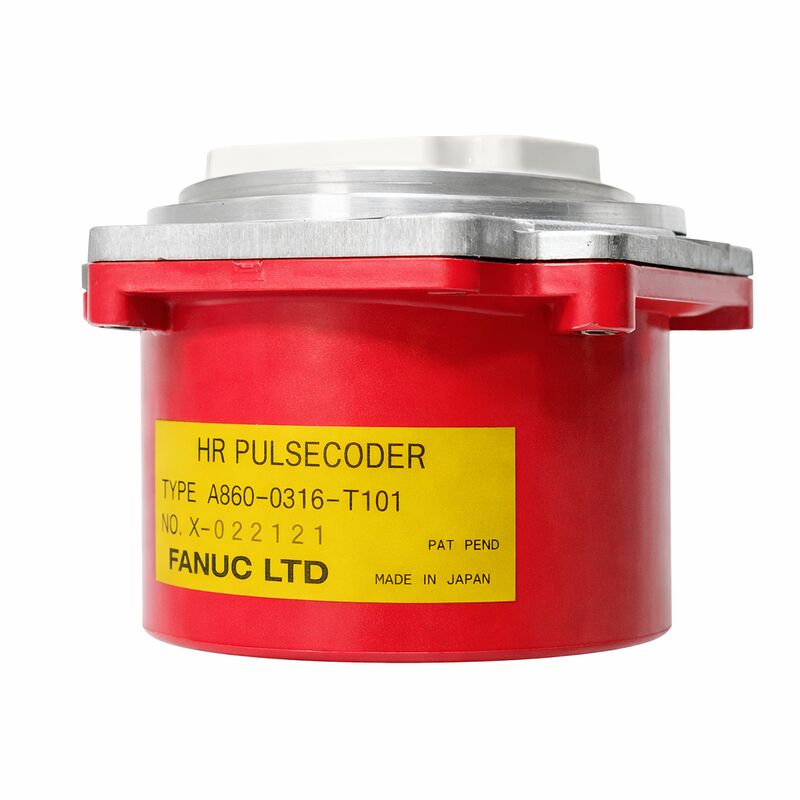
Fanuc A860-0316-T101 | High-Resolution Incremental Pulse Coder — 10,000P, Red Plastic Cap, Late S-Series AC Servo Motors, CNC Digital Servo
Overview
The Fanuc A860-0316-T101 is the high-resolution (HR) incremental pulse coder fitted on the late-generation Fanuc S-series AC servo motors.
At 10,000 pulses per revolution, it delivers more than three times the raw resolution of the 3,000P incremental encoders used on earlier S-series motors, positioning it as the most capable incremental feedback device in the S-series motor era before the Serial A and Serial C absolute encoders took over as the standard for later motor variants.
The HR designation — which also appears on the related A860-0316-T201 — specifically identified these encoders as a resolution step-up from the baseline S-series incremental coders.
When Fanuc fitted higher-speed or higher-precision-demand motors in the late S-series generation, the 3000P encoder resolution was no longer adequate for servo loop quality at the motor's rated operating speed.
The 10,000P encoder at 3000rpm generates 500,000 edge counts per second (using 4× quadrature decoding), compared to 150,000 for a 3000P encoder under the same conditions — the improvement in velocity estimation quality is directly proportional.
The red plastic cap housing is the hallmark of the entire S-series encoder generation, placing the A860-0316-T101 clearly in the same family as the Serial A and Serial C encoders of the same era.
Unlike those absolute serial encoders, however, the T101 is an incremental type — it produces A/B quadrature pulses and a Z index pulse as the motor shaft turns, without retaining any position memory between power cycles.
Every machine start-up requires a reference return cycle to re-establish the axis datum.
This is expected behaviour for machines equipped with this encoder and is a normal part of the startup sequence.
Supply of the A860-0316-T101 follows the pattern common to all late S-series encoders: it is not sold separately from motors as a standard catalogue item, and availability from any given specialist provider depends entirely on how many working S-series motors with T101 encoders have come through their repair stream.
Maintaining access to a reliable exchange supplier is the most practical spare parts strategy for facilities operating machines with this encoder.
Key Specifications
| Parameter |
Value |
| Encoder Type |
HR Incremental |
| Resolution |
10,000 ppr |
| Housing |
Red plastic cap |
| Feedback |
Incremental A/B/Z (no absolute memory) |
| Compatible Motors |
Late S-series AC servo |
| CNC Compatibility |
Zero-C/D, 16A, 18A, 21A |
| Supply Method |
Exchange / motor repair surplus |
| Repairability |
Limited |
10,000P vs Earlier S-Series Encoders — Resolution in Context
The progression through Fanuc's S-series incremental encoders followed the motor specifications. Early S-series motors used 2000P and 2500P pulse coders; standard motors moved to 3000P; the late generation of higher-speed and higher-precision motors stepped up to 10,000P with the A860-0316-T101.
This 10,000P specification placed Fanuc's S-series HR encoder at a resolution level comparable to what many other servo motor manufacturers were specifying for their premium precision servo lines of the same era.
The Z-index pulse (one per revolution) that accompanies the A and B quadrature channels serves as the reference mark for the CNC's reference return cycle.
The CNC drives the axis toward the hardware reference switch at a set feed rate, slows as the switch is triggered, and then creeps slowly until the first Z-pulse is detected after the switch trip.
The Z-pulse position relative to the reference switch is mechanically fixed by the encoder's disc and mounting, so the reference return always lands at the same absolute machine position — repeatable to within one encoder count of the Z-pulse position.
Supply Constraints and Practical Parts Management
The fact that the A860-0316-T101 is not sold separately from the motor as a Fanuc catalogue item is a significant operational consideration.
It means the primary supply channel is motor exchange: a specialist overhauls a motor, replaces the encoder, and the resulting surplus or exchange encoder becomes available.
This supply chain is less predictable than standard stocked parts, and there is no standard "new in box" procurement path from Fanuc's authorised distribution network.
Facilities managing machines with T101 encoders have two practical options: maintain a tested spare encoder acquired through exchange channels, or identify a reliable motor service provider who carries T101-compatible motors or encoders as part of their regular repair stock and can respond quickly to a machine-down event.
FAQ
Q1: How does the 10,000P incremental encoder affect the CNC's servo parameter settings compared to a 3000P encoder?
The CNC's servo parameters include settings for the encoder resolution (typically expressed as pulses per revolution or as a gear ratio parameter that relates encoder counts to machine travel).
If a 3000P motor is replaced with a 10,000P motor, or vice versa, the CMR and DMR servo parameters must be updated to reflect the new encoder's pulse count. Incorrect servo parameters with the wrong encoder produce velocity loop instability, overshooting, or axis alarm conditions on the first commanded movement.
Always update servo parameters to match the installed encoder before running production.
Q2: Can the A860-0316-T101 be replaced with an absolute encoder type?
Not directly. The amplifier and CNC must be configured for the specific feedback type — absolute serial encoders (Serial A, Serial C) require a digital servo amplifier with the corresponding serial encoder interface, and the CNC must be capable of processing absolute encoder data.
The S-series HR incremental encoder works with the analogue or early digital servo amplifier systems compatible with the late S-series motors.
Fitting an absolute encoder where an incremental type was specified requires both physical compatibility verification and parameter configuration changes, and in some cases, a different amplifier interface card.
This is a motor retrofit project rather than a simple encoder swap.
Q3: What is the diagnostic procedure when the machine shows erratic velocity or position errors on an axis with this encoder?
Start by checking the encoder feedback cable for damage, focusing on areas subject to movement (cable carriers, bends near conduit entries). Inspect both connector ends for clean, fully seated contacts.
Attach an oscilloscope to the A and B encoder outputs and rotate the motor shaft slowly by hand — a clean 90°-phase-offset square wave on both channels with no dropouts or amplitude variations indicates a healthy encoder and cable.
Erratic signals point to cable damage, connector intermittence, or a degrading optical disc inside the encoder.
If the cable and connector check clean but the oscilloscope shows signal quality issues under rotation, the encoder requires replacement.
Q4: The encoder is in a red plastic cap — how is the cap removed and the encoder accessed for replacement?
The red plastic cap clips or screws onto the rear of the motor frame, enclosing the encoder assembly and cable entry. Removal typically requires releasing the cap's retention fasteners or clips (exact design varies by motor model) and then carefully separating the encoder disc assembly from the motor shaft coupling.
The coupling method varies — some use an Oldham coupling that tolerates minor shaft misalignment; others use a direct spline or key engagement.
Consult the motor's maintenance documentation for the specific disassembly sequence, particularly the sequence for removing the encoder from the shaft coupling without damaging the disc.
Forcing the cap or encoder body without following the correct removal sequence risks cracking the optical disc, which is an irreversible fault.
Q5: Is the A860-0316-T101 compatible with the same amplifiers as the A860-0346-T101 (Serial A encoder)?
No. The T101 is an incremental encoder; the A860-0346-T101 is a Serial A absolute encoder.
These two encoder types communicate with the servo amplifier through fundamentally different interfaces — the incremental encoder uses discrete A/B/Z differential signal lines, while the Serial A encoder uses a proprietary high-speed serial protocol.
A servo amplifier designed for a Serial A encoder cannot directly accept the incremental A/B/Z signals from the T101, and vice versa.
Motor and encoder generations are matched sets; always confirm the full system — motor, encoder, amplifier, and CNC — are from compatible generations before ordering replacement parts.


 Your message must be between 20-3,000 characters!