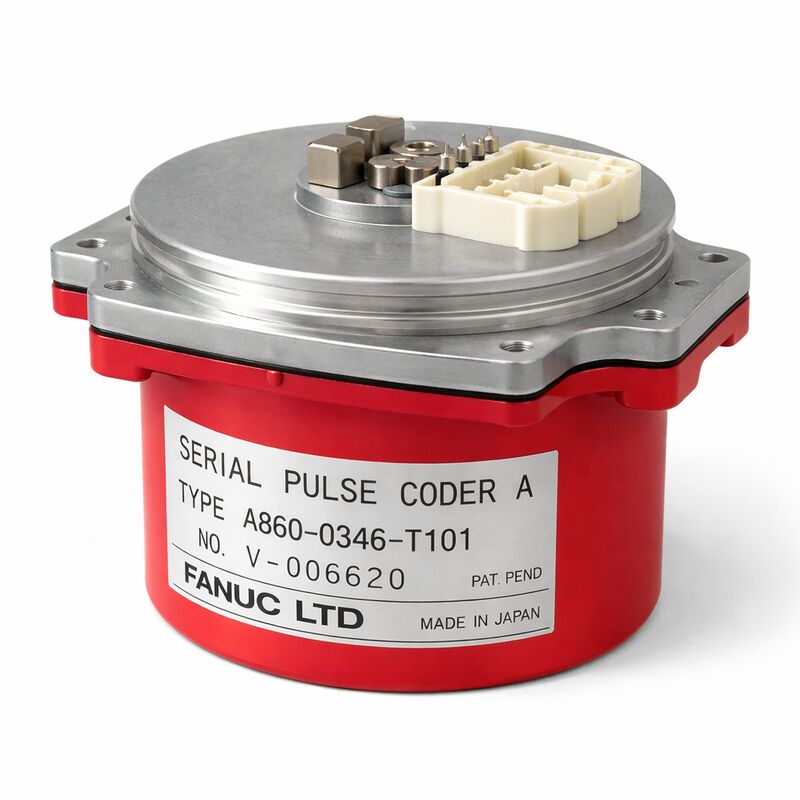
Fanuc A860-0346-T101 | Serial Pulse Coder A — 40,000P, Fanuc AC Model 0S / 5S / 10S / 20S / 30S Servo Motors, Alt. A290-0561-V572
Overview
The Fanuc A860-0346-T101 is the Serial Pulse Coder A for Fanuc's S-series AC servo motors — the 0S through 30S range — and is one of the most recognisable encoders from this era of Fanuc AC servo technology.
The red plastic housing that gives the whole S-series motor generation its "red cap" identity is the A860-0346's most visible characteristic.
Under that red cap sits the Serial Pulse Coder A mechanism, a 40,000 ppr absolute serial feedback device that represents Fanuc's transition from conventional incremental pulse coders to the more capable serial communication architecture.
Fanuc's Serial Pulse Coder A was a significant design step when introduced.
Where conventional pulse coders of the era sent discrete A, B, and Z-phase quadrature signals to the CNC, the Serial Pulse Coder A encoded position data into a high-speed serial stream — a principle described in Fanuc's documentation as operating on a totally different basis from conventional pulse coders.
This serial protocol carries absolute position data, eliminating the need for a reference return cycle at machine power-on.
The axis retains its absolute position reference through battery backup in the amplifier, and the machine can resume work at the correct coordinates immediately after power-up.
The nominal 40,000 ppr resolution, when combined with Fanuc's flexible feed gear function on the digital servo CNC, can provide detection units of 1µm, 0.1µm, or 0.01µm depending on how the machine's ball screw pitch and feed gear parameters are configured — giving the S-series motor and this encoder the fine detection granularity needed for precision CNC work.
The A290-0561-V572 alternative part number is Fanuc's own cross-reference, representing the successor packaging for the same encoder function where the T101 is no longer available through standard channels.
The A860-0346-T101 is compatible only with digital servo NC systems equipped with a Serial Pulse Coder A interface — the CNCs that ran these motors include Zero-C, Zero-D, 16 (Model A), 18 (Model A), and 21 (Model A) controls. Older analogue-servo CNCs without this digital interface cannot use this encoder type.
Key Specifications
| Parameter |
Value |
| Resolution |
40,000 ppr (Serial A absolute) |
| Effective Detection |
~1,000,000 divisions/rev (with flex feed gear) |
| Housing |
Red plastic cap |
| Compatible Motors |
Fanuc AC 0S, 5S, 10S, 20S, 30S |
| CNC Compatibility |
Zero-C/D, 16A, 18A, 21A (digital servo) |
| Feedback Type |
Serial absolute (no reference return needed) |
| Alternative Part No. |
A290-0561-V572 |
| Repairability |
Exchange/replace only |
Serial Pulse Coder A vs Conventional Pulse Coders — A Technology Step
The conventional pulse coders used on earlier Fanuc servo motors sent raw quadrature pulse trains on discrete wires.
The signal integrity of these pulse trains degraded with cable length, noise, and connector wear — and the CNC had to count every pulse from the reference position to know where the axis was.
The Serial Pulse Coder A changed this by converting position data into a noise-resistant serial format before transmission.
The CNC reads position from a data word rather than a pulse count, making the system inherently more reliable over long cable runs and less susceptible to electrical interference from the machine environment.
The "A" designation distinguishes this serial protocol from the later Serial Pulse Coder C (and the subsequent alpha and beta series encoders), which use updated protocols and higher resolutions.
The Serial A protocol is specific to the S-series motor era and the compatible CNC generation — it is not electrically or logically interchangeable with later encoder types despite the shared "serial" description.
The A860-0346 Family — T-Suffix Variants
The A860-0346 series encompasses multiple T-suffix variants (T001, T011, T041, T101, T111, T141, etc.) that differ in connector type, mechanical mounting details, and minor hardware revisions while sharing the same 40,000 ppr Serial A operating principle.
The T101 variant is specifically confirmed for the 0S through 30S motor range.
When sourcing replacements, the T-suffix must correspond to the specific motor model — cross-substituting T-suffix variants without confirming motor and connector compatibility can result in a physically non-fitting or electrically mismatched encoder.
FAQ
Q1: What does the A290-0561-V572 alternative part number indicate?
The A290-0561-V572 is Fanuc's current-catalogue equivalent for machines where the A860-0346-T101 is no longer available as a standard stocked item.
Fanuc periodically repackages or re-numbers encoder variants as their supply chains evolve; the A290-0561 prefix indicates a different physical configuration that serves the same functional replacement purpose for the same motor range.
Before ordering the A290-0561-V572, confirm that its mechanical and connector dimensions match the A860-0346-T101 installation on the specific motor, as differences in mounting flange or cable connector at the motor end could require minor adaptation.
Q2: How does the Serial A absolute encoder retain position when the machine is powered off?
The absolute position count is stored in battery-backed RAM within the servo amplifier — not within the encoder itself.
The encoder provides the angular position reference at each power-up cycle; the amplifier combines this with the stored multi-turn count to reconstruct the full axis position.
The battery that maintains this stored count is in the amplifier or in a dedicated battery backup unit.
If that battery is allowed to discharge to zero, the multi-turn count is lost and a reference return cycle must be performed to re-establish the axis datum. Routine battery maintenance on the correct schedule is the single most effective preventive action for avoiding unplanned position datum loss.
Q3: Can the A860-0346-T101 be used with analogue-servo CNCs or older Fanuc systems without the Serial A interface?
No. The Serial Pulse Coder A communicates exclusively via a high-speed serial protocol that requires a dedicated Serial Pulse Coder A receiver interface in the CNC. Older analogue-servo Fanuc CNCs (pre-digital servo) and early digital servo systems without this specific serial interface cannot decode the encoder's output.
The CNC series compatibility is limited to digital servo systems: Series Zero-C, Zero-D, and the 16/18/21 Model A generation. Attempting to connect this encoder to an incompatible system produces a communication fault rather than functional operation.
Q4: Why is stock described as limited, and what is the recommended procurement approach?
The A860-0346-T101 serves the Fanuc S-series AC servo motor generation — motors that were produced and installed during the 1980s and 1990s and are now several decades into their service life.
New production from Fanuc for this encoder generation has effectively ceased.
Available stock comes from motor overhauls, machine decommissioning, and managed service exchange inventories.
Because demand comes primarily from motor repairs rather than new installations, supply is irregular.
The recommended approach for facilities dependent on S-series motors is to secure spare encoder stock when it becomes available, rather than waiting for a machine-down event.
Q5: What are the typical failure symptoms of a deteriorating A860-0346-T101 in service?
Early bearing degradation produces mechanical noise in the encoder that may be audible when rotating the motor shaft slowly by hand.
Optical disc contamination (from coolant mist or oil vapor ingress through the red cap seal) causes erratic serial communication faults — the CNC generates serial encoder communication alarms (typically SV360-series on compatible CNCs) intermittently, often temperature-dependent as thermal expansion affects the seal.
A complete encoder failure produces a permanent communication fault alarm at power-up. In all cases, the encoder itself is not field-repairable; the motor should be removed and the encoder replaced with a tested exchange unit before returning the motor to service.


 Your message must be between 20-3,000 characters!