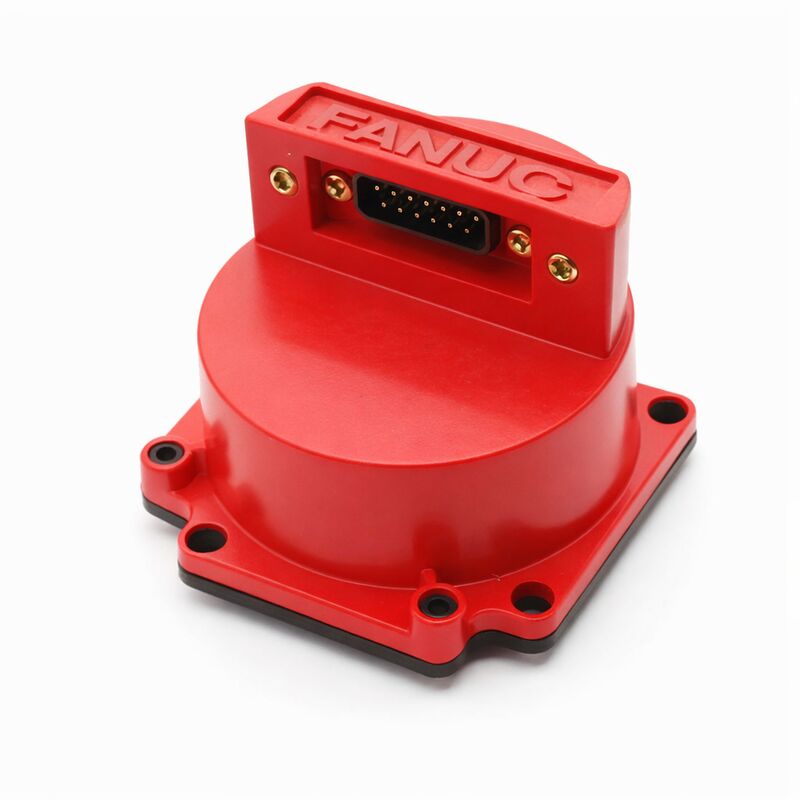
Fanuc A860-0356-T001 | Serial Pulse Coder C — 1,000,000P Absolute, Small-Frame Red Cap, Fanuc S-Series 0SP / 1SP / 2SP 3000rpm Motors, Alt. A290-0561-V574
Overview
The Fanuc A860-0356-T001 is a compact Serial Pulse Coder C absolute encoder built into a small-frame red plastic cap, designed specifically for the small, high-speed spindle-purpose motors of the Fanuc S-series.
The motors it serves — the 0-0SP/3000, 1-0SP/3000, 2-0SP/3000 and related SP (spindle purpose) variants — are high-speed compact motors with physical dimensions that required a smaller encoder body than the standard S-series Serial C variants.
The small-frame construction of the T001 is therefore not just a size convenience — it is a functional requirement for fitting these motors.
Despite its compact housing, the A860-0356-T001 delivers the same 1,000,000 ppr Serial C absolute feedback as the larger Serial C variants used on standard S-series motors. The SP-designated motors are typically used in applications where a compact high-speed drive is needed — peripheral positioning axes, secondary spindles on multi-turret lathes, tool magazine drives, and similar high-speed, relatively light-duty positions where full-size servo motor torque is not the primary requirement but speed capability and positioning accuracy are.
The Serial C protocol on the T001 is the same as that used by the larger A860-0356-T101 — both communicate via Fanuc's serial encoder bus at 1M ppr resolution, both are absolute types requiring battery backup in the amplifier, and both are compatible with the same CNC generation (Zero-C/D, 16A, 18A, 21A).
The physical size difference between T001 and T101 is entirely driven by the motor frame — small SP-series motors use the T001's compact body; standard S-series motors use the larger T101.
Fanuc has listed A290-0561-V574 as an alternative order number for this encoder.
As with other A860-to-A290 cross-references in the Fanuc encoder range, the A290 entry represents the current catalogue path for the same encoder function.
Mechanical and connector compatibility between the original A860-0356-T001 and the A290-0561-V574 should be confirmed before committing to the A290 variant as a direct physical replacement.
Key Specifications
| Parameter |
Value |
| Encoder Type |
Serial Pulse Coder C (1M ppr absolute) |
| Resolution |
1,000,000 ppr |
| Housing |
Small-frame red plastic cap |
| Compatible Motors |
0-0SP/3000, 1-0SP/3000, 2-0SP/3000 |
| Motor Type |
S-series high-speed SP variants |
| CNC Compatibility |
Zero-C/D, 16A, 18A, 21A (digital servo) |
| Alternative Part No. |
A290-0561-V574 |
| Repairability |
Exchange/replace only |
Serial C at 1M ppr — High-Speed Small Motor Logic
The SP-type motors this encoder serves operate at rated speeds of 3000rpm — not unusually fast by CNC spindle standards, but fast for a positioning servo motor in the S-series. At 3000rpm, a 1M ppr encoder generates 50 million position update events per second, giving the CNC's servo loop an exceptionally dense position data stream for velocity and position control.
This matters particularly at the low-speed end of the motor's range, where lower speed means fewer position events per unit time and the quality of the velocity estimate becomes more dependent on encoder resolution.
The 1M ppr specification ensures that even at slow speeds — during precision positioning moves, for example — the servo loop has sufficient position data for smooth, accurate control.
The Serial C protocol's 1M ppr resolution also means that when the flexible feed gear function is used in the CNC to set fine detection units (down to 0.01µm range), the SP motor's full-resolution encoder supports these fine settings without any quantisation limitation from the encoder itself.
Sourcing the Small-Frame T001
The A860-0356-T001's small-frame design makes it a specific part for a specific motor type. It is not physically interchangeable with the larger A860-0356-T101 (which fits standard-frame S-series motors), even though both carry the same Serial C 1M ppr specification.
For machines where the SP motors remain in service, the T001 is the only direct encoder replacement. Confirmed surplus stock from motor exchange programs and managed service inventories is the primary sourcing channel; given the smaller installed base of SP motors compared to standard S-series motors, T001 stock is correspondingly less available than T101 stock.
FAQ
Q1: What makes the 0-0SP, 1-0SP, and 2-0SP motors different from standard S-series motors?
The SP designation in Fanuc's motor naming typically indicates a motor optimised for spindle-purpose applications — emphasising speed range and lightweight construction over maximum continuous torque.
The 0SP, 1SP, and 2SP variants in the S-series were compact, high-speed motors suited for secondary spindles, tool spindles, and driven tool holders on multi-axis CNC lathes, where the physical space for the motor is constrained and the operating speed range is prioritised.
Their smaller physical frame compared to standard S-series motors is the reason they required the compact A860-0356-T001 rather than the standard A860-0356-T101.
Q2: Is the Serial C protocol on the T001 compatible with the same CNC controls as the Serial A (T101-family) encoder?
Yes — both Serial A and Serial C are compatible with the same Fanuc CNC generation: Zero-C, Zero-D, and the 16A/18A/21A series. The CNC's servo interface handles both protocols through the same serial encoder interface infrastructure.
The CNC's servo parameters must be configured to specify the correct encoder type (Serial A or Serial C) and resolution for each axis. Mixing Serial A and Serial C on different axes of the same machine is operationally acceptable as long as the parameters are set correctly for each axis.
Q3: The A290-0561-V574 alternative part number — is this the same encoder in different packaging?
The A290-0561-V574 is Fanuc's cross-reference for machines where the A860-0356-T001 is no longer directly available through standard channels. The functional specification — Serial C, 1M ppr, small-frame absolute — should be equivalent.
The physical packaging, connector, and mounting dimensions may differ between the A860 and A290 versions; confirm these against the existing motor installation before ordering the A290 variant to ensure it physically fits.
A connector or mounting dimension mismatch requires adaptation work that adds time to the repair.
Q4: What is the diagnostic approach when a machine with SP motors shows an encoder communication alarm on only one axis?
Single-axis alarms localize the fault to the encoder, cable, or amplifier serving that specific axis. First, inspect the entire encoder cable run from the encoder body to the amplifier connector — pay attention to areas where the cable may be pinched by a cable carrier, bent tightly around a conduit edge, or exposed to coolant. Check both connector ends for clean, fully seated pin contacts.
If the cable and connectors are intact, substitute the encoder feedback cable with a known-good cable from another axis.
If the alarm moves to the other axis, the cable is faulty.
If it stays on the original axis with the new cable, the encoder or its amplifier input circuit has failed — the encoder should be replaced before concluding the amplifier is at fault.
Q5: Are there any specific storage requirements for surplus A860-0356-T001 units held as spares?
Store surplus encoders in a clean, dry environment at room temperature (0°C to +30°C is a conservative target for long-term storage of optical electronics).
Humidity below 70% and the absence of condensation are the most important environmental conditions — moisture inside the encoder housing degrades the optical disc and accelerates corrosion on the connector pins.
Keep the encoder in its original packaging or sealed protective bag until installation.
Avoid storing near sources of strong vibration or electromagnetic fields. Before installing a long-stored spare, rotate the encoder shaft by hand to check bearing smoothness, and inspect the connector for any evidence of corrosion before connecting to the amplifier.


 Your message must be between 20-3,000 characters!