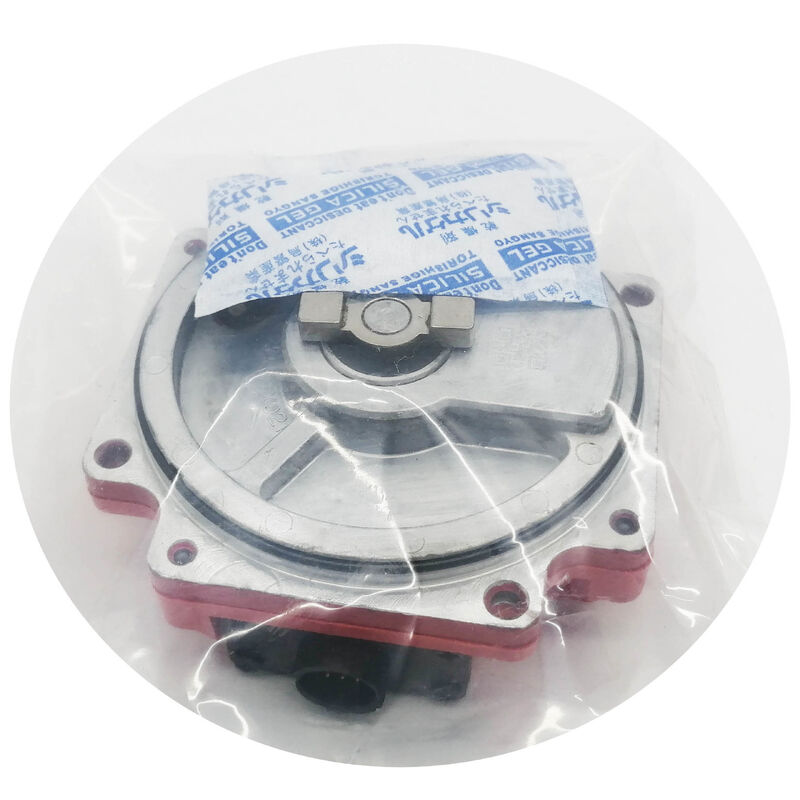
Fanuc A860-0356-T101 | Serial Pulse Coder C — 1,000,000P Absolute, Red Cap, Cannon Connector, Fanuc AC 0S / 5S / 10S / 20S 3000rpm Motors
Overview
The Fanuc A860-0356-T101 is the Serial Pulse Coder C — the higher-resolution sibling of the Serial Pulse Coder A (A860-0346 series) within the Fanuc S-series motor encoder family.
Where the Serial A provides 40,000 ppr, the Serial C delivers 1,000,000 pulses per revolution — a 25-fold improvement in resolution, achieved through a fundamentally more capable optical disc and signal processing design while retaining the same red plastic cap housing and the same absolute serial feedback architecture.
The distinction between Serial A and Serial C in the Fanuc S-series encoder family comes down to motor speed class.
The A860-0356-T101 is specifically fitted to the 3000rpm-rated variants of the S-series motors — the 0S/3000, 5S/3000, 10S/3000, and 20S/3000. At these higher rated speeds, the finer position resolution of the Serial C encoder provides a proportionally denser position update rate per unit of time, which is important for servo loop stability and velocity smoothness at the motor's rated operating speed.
The Serial A at 40,000 ppr is adequate for the lower-speed motor variants; the Serial C at 1M ppr is the appropriate specification for the 3000rpm-capable motors in this range.
The Cannon connector on the A860-0356-T101 is its most visually distinctive feature compared to other A860-0346 and A860-0356 variants. "Cannon connector" refers to a circular military-style connector type — the MS connector format — which was used on this specific encoder variant and distinguishes it from T-suffix variants using D-Sub or other connector types.
The cable at the motor end and the cable assembly at the amplifier end must match this Cannon connector; using the A860-0356-T101 in a machine that originally had a different connector variant requires cable adaptation.
Fanuc's alternative order number A290-0561-V574 covers the successor catalogue entry for this encoder where the original A860-0356-T101 is not available through standard channels.
As with other A860 to A290 cross-references in the Fanuc encoder range, mechanical and connector compatibility should be confirmed before ordering the A290 variant as a physical drop-in replacement.
Key Specifications
| Parameter |
Value |
| Encoder Type |
Serial Pulse Coder C |
| Resolution |
1,000,000 ppr (absolute) |
| Housing |
Red plastic cap |
| Connector |
Cannon (MS-type circular) |
| Compatible Motors |
0S/3000, 5S/3000, 10S/3000, 20S/3000 |
| CNC Compatibility |
Zero-C/D, 16A, 18A, 21A (digital servo) |
| Feedback Type |
Serial absolute (no reference return needed) |
| Alternative Part No. |
A290-0561-V574 |
| Repairability |
Exchange/replace only |
Serial C vs Serial A — Resolution and Speed Class
The choice between Serial A (40,000 ppr) and Serial C (1,000,000 ppr) within the S-series encoder generation was made by Fanuc based on the motor's rated speed. For a motor running at 1,000 rpm, 40,000 pulses per revolution produces 40,000 position updates per second — more than sufficient for the servo loop's update rate.
For a motor running at 3,000 rpm, the same encoder produces 120,000 position updates per second, but the position uncertainty per control cycle is correspondingly coarser.
The Serial C at 1M ppr produces 3,000,000 updates per second at the motor's rated 3000 rpm, giving the servo amplifier a significantly finer position estimate for each control cycle and thereby enabling tighter velocity regulation and lower torque ripple at the higher speed.
This speed-class pairing — Serial A for standard-speed motors, Serial C for 3000rpm variants — reflects Fanuc's deliberate encoder specification strategy: selecting the resolution class that supports the motor's maximum rated performance without overspecifying for the motor's typical operating regime.
Cannon Connector — Installation and Compatibility
The Cannon (MS-type circular) connector on the A860-0356-T101 is a ruggedised circular connector with a bayonet locking ring. In industrial machine tool environments, this connector type provides secure mating and good resistance to vibration-induced loosening compared to flat D-Sub connectors.
The cable assembly from the motor to the servo amplifier will terminate in a corresponding circular socket that mates with the Cannon plug on the encoder.
Sourcing replacement cable assemblies that preserve this Cannon connector standard is important: modifying the connector type during a repair creates a non-standard installation that may not mate correctly with replacement encoders sourced in future.
FAQ
Q1: What exactly differentiates the Serial C from the Serial A protocol, and are they electrically compatible?
The Serial A and Serial C are both serial absolute encoder protocols developed by Fanuc for the S-series motor generation, but they are distinct protocols — they are not electrically or logically interchangeable. The CNC's servo amplifier must be configured for the specific encoder type installed on each axis.
Fitting a Serial C encoder on an axis configured for Serial A will produce a protocol communication fault.
The motor's original specification document (or the motor nameplate) confirms which encoder type was factory-installed.
Q2: Can the A860-0356-T101 be used with the C-series servo amplifier units?
Yes. The Serial C encoder was designed to interface with Fanuc's C-series servo amplifier generation that was in production alongside the S-series motors.
The amplifier must have the Serial C interface card installed and configured for the axis; the same amplifier could potentially support either Serial A or Serial C on different axes depending on which interface cards are fitted.
When maintaining or replacing amplifiers on a machine with A860-0356-T101 encoders, confirming the replacement amplifier's Serial C interface capability is essential before installation.
Q3: The alternative part number is A290-0561-V574 — is this a direct drop-in replacement?
The A290-0561-V574 is Fanuc's current catalogue reference for machines where the A860-0356-T101 is no longer available through standard channels.
"Direct drop-in" depends on mechanical fitment — the A290 variant should provide the same Serial C 1M ppr absolute feedback, but the connector type and mounting flange may differ between the original A860 and the A290 catalogue entry.
Confirm connector compatibility with the machine's existing cable before committing to the A290 variant, as a connector mismatch requires cable adaptation that adds time and cost to the repair.
Q4: How does the 1M ppr resolution of the Serial C affect machining precision in practice?
The 1,000,000 ppr resolution provides a theoretical position resolution at the motor shaft of 360 degrees / 1,000,000 = 0.00036 degrees per count. On a standard 10mm pitch ball screw directly coupled to the motor, this corresponds to 0.01µm per count.
In practice, mechanical compliance in the machine structure, thermal drift, and servo tuning errors are all larger than this theoretical limit — meaning the 1M ppr encoder resolution is not the limiting factor in the machine's positioning accuracy.
Its practical value is in the quality of the velocity estimate it provides to the servo loop, enabling smoother motion and lower following error at the motor's rated 3000rpm speed.
Q5: What physical inspection should be done before installing a surplus A860-0356-T101?
Inspect the Cannon connector for bent or corroded pins — the circular pin array in this connector type is more difficult to visually inspect than a flat D-Sub and requires close examination with the bayonet ring removed.
Check the red cap housing for cracks or evidence of impact damage, which can break the optical disc inside without any external evidence of encoder failure.
Rotate the motor shaft (with the encoder attached) slowly by hand and listen for bearing roughness.
Finally, if the surplus unit is from a machine-down exchange, ask the supplier whether the encoder was tested on a serial C rig before dispatch — a unit that has only passed static electrical tests may still have intermittent disc or bearing faults that emerge under rotation.


 Your message must be between 20-3,000 characters!