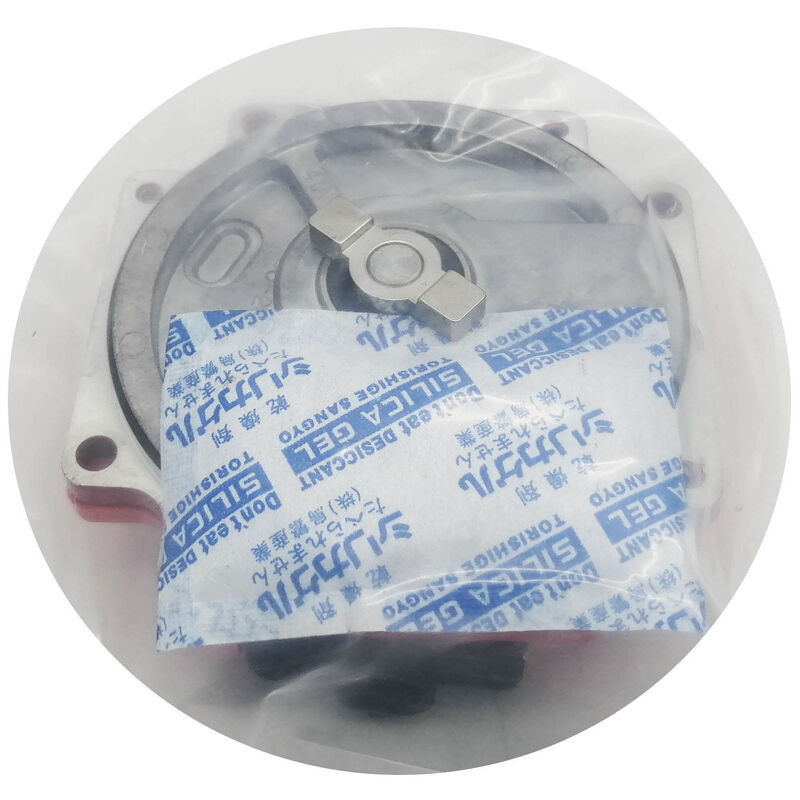
Fanuc A860-0360-T011 | αA64 (64K) Absolute Pulse Coder — Supercapacitor Backup, 15-Pin Flat Plug, Fanuc Alpha α1 / α2 / αM2.5 Servo Motors
Overview
The Fanuc A860-0360-T011 is the αA64 (Alpha A 64K) absolute pulse coder for small Fanuc alpha series AC servo motors — specifically the α1/3000, α2/2000, α2/3000, and αM2.5/3000 motor class.
At 64,000 pulses per revolution of absolute multi-turn position data combined with incremental A/B/Z signals, this encoder provided the alpha motor generation with a significant resolution step up from the 40,000 ppr Serial A encoders of the preceding S-series motor era.
The T011 variant carries one distinctive characteristic that immediately separates it from other αA64 variants: it uses a supercapacitor rather than a battery for position backup. Where the T001 (D-Sub connector variant) and T101 rely on an external battery in the amplifier to maintain absolute position through machine power cycles, the T011's internal supercapacitor provides short-term position retention — described as "a couple of minutes" — after the machine's power supply is disconnected.
This is not a substitute for full battery-backed absolute position retention: if the machine is powered down for maintenance, a normal production shutdown, or any period longer than the supercapacitor's hold time, the absolute position reference is lost and a reference return cycle must be performed on next power-up.
This supercapacitor behaviour is operationally important to understand.
A machine with A860-0360-T011 encoders will need a reference return after every extended power-off, which is different from the behaviour of battery-backed absolute encoders where position is retained indefinitely.
For production operations where the machine is powered down between shifts, the reference return adds a few minutes to startup.
For continuous-operation facilities where the machine is rarely fully powered down, this distinction has minimal practical impact.
The 15-pin male flat plug on the T011 differs from the D-Sub connector of the T001.
Fanuc has confirmed that the newer flat version (T011) is compatible with older motor and cable installations — the motor-side cable socket accepts the T011's flat connector — making the T011 a usable replacement for T001 encoders in many field installations.
Key Specifications
| Parameter |
Value |
| Encoder Model |
αA64 (Alpha A 64K) |
| Resolution |
64,000 ppr (absolute multi-turn) |
| Feedback Type |
Serial absolute + A/B/Z incremental |
| Position Backup |
Supercapacitor (short-term) |
| Connector |
15-pin male flat plug |
| Compatible Motors |
α1/3000, α2/2000, α2/3000, αM2.5/3000 |
| Motor Series |
Alpha (pre-i generation) |
| Alternative Part No. |
A290-0360-V511 |
| Repairability |
Exchange/replace primary route |
Alpha Series Motor Context — Where the A860-0360-T011 Fits
The Fanuc alpha motor series bridged the generation gap between the S-series (red cap) AC servo motors and the modern alpha i (BiSx) series. Alpha motors are the motors equipped with alphaA-type encoders — the A860-0360 family — rather than the Serial A/C encoders of the S-series or the BiA/BiI encoders of the alpha i series.
Small alpha motors in the α1 through αM2.5 class were widely used on the X and Y axes of compact CNC machining centres and on lighter axes of turning centres during the 1990s and 2000s.
The αA64 encoder at 64,000 ppr was appropriate for these small alpha motors' rated speed and torque class.
On a 10mm pitch ball screw at 1000rpm, the 64K encoder produces 64,000 position updates per second — providing the servo loop with a position update every 15.6µs at this speed.
The combination of absolute position data with the incremental A/B/Z signal output allowed the servo amplifier to use the high-frequency incremental signals for velocity control within each servo cycle while using the absolute serial data for position verification.
Supercapacitor Backup — Operational Procedures
The supercapacitor backup means power-down procedure and startup sequence require specific attention on machines using the T011. When powering down normally (planned shutdown), allowing the machine's encoder supply to remain active for the full servo-off sequence before cutting main power helps extend the supercapacitor charge into the post-shutdown period.
On restart after any shutdown longer than the supercapacitor hold time (which varies with capacitor age and temperature), the CNC will display an encoder alarm or prompt for reference return.
The supercapacitor is a wearable component — its charge retention decreases over time and with thermal cycling. An aging supercapacitor reduces the position hold time after power-off, which can cause unexpected absolute position loss on machines where the power-off duration had previously been within the encoder's hold capability.
A T011 that begins requiring reference return after shorter power-off intervals than it previously tolerated is exhibiting supercapacitor degradation.
FAQ
Q1: Why would a machine use the supercapacitor T011 rather than the battery-backed T001 or T101?
The T011 variant was likely specified for machine configurations where a separate battery backup for absolute position was either not required or was handled at the system level rather than the encoder level.
Some machine builders preferred the simpler wiring of a supercapacitor encoder for axes where the reference return time was acceptable.
The T001 with D-Sub connector and external battery provides indefinite position retention; the T011 provides only short-term retention but requires no battery maintenance.
The appropriate variant for any specific installation is determined by the machine builder's original specification.
Q2: Can the T011 replace the T001 on the same alpha motor without any cable modification?
Yes — Fanuc has confirmed that the new flat connector T011 version is compatible with older installations.
The cable socket at the motor side that was installed for the T001 (D-Sub) accepts the T011's flat male connector. However, the operational change must be understood: if the original machine had a battery-backed absolute system (T001), replacing it with a supercapacitor encoder (T011) changes the position backup behaviour.
The machine will now require reference return after extended power-offs rather than retaining position indefinitely. This operational change should be communicated to machine operators and documented in the maintenance records.
Q3: What alpha motors are confirmed compatible with the A860-0360-T011?
Confirmed compatible motors include α1/3000, α2/2000, α2/3000, and αM2.5/3000. These are the small-frame alpha servo motors used primarily on lighter CNC machine axes — X and Y of small VMCs, rotary axes, and auxiliary positioning axes.
The larger alpha motors (α6, α12, α22 class) use higher-current encoder variants from the same A860-0360 family.
Motor and encoder compatibility is confirmed by checking the motor's order specification number against the encoder suffix listed in the Fanuc alpha servo motor manual.
Q4: How does the αA64's 64,000 ppr compare to the later alpha i encoder resolutions?
The alpha i motors introduced encoders with 1,000,000 ppr (BiA1000) and 128,000 ppr (BiA128) absolute resolution, representing a substantial improvement over the αA64's 64,000 ppr.
However, the alpha (non-i) motors are not compatible with the alpha i encoders — the two generations use different mechanical interfaces, shaft coupling designs, and serial protocols.
For machines with original alpha (non-i) motors, the αA64 remains the correct encoder specification regardless of the higher resolution available in later generations.
Q5: What does a failing supercapacitor in the T011 look like in practice, and how is it addressed?
The most characteristic symptom is the machine requiring reference return after progressively shorter power-off intervals than it previously tolerated. Initially, a T011 in good condition might retain position for several minutes after power-off; a supercapacitor at end-of-life might retain position for only seconds.
When the hold time drops below the power-cycling time of a normal production shutdown, the machine will need reference return at every startup — a significant operational nuisance.
The supercapacitor is internal to the sealed encoder assembly and is not separately replaceable; the encoder unit itself must be replaced.
This is a standard wearout failure mode and should be anticipated on encoders that have been in service for ten or more years.


 Your message must be between 20-3,000 characters!