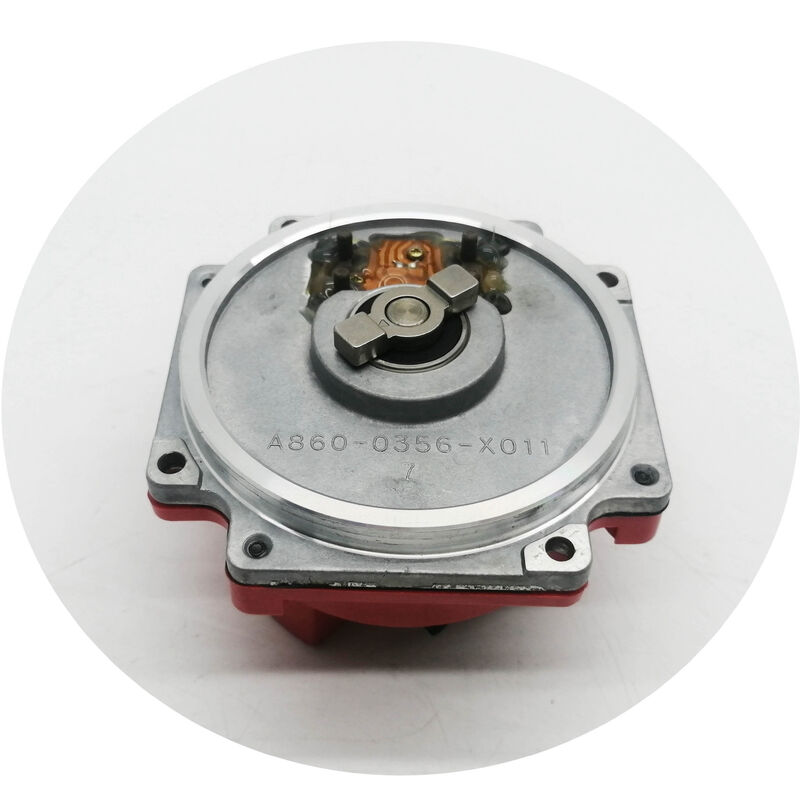
FANUC A860-0360-T101 | Alpha αA64 Absolute Pulse Coder — 64K ppr / Hardwired Cable / Earliest Alpha ABS Version
The Hardwired Cable — What It Means in Practice
The A860-0360-T101 is the earliest generation of the αA64 absolute pulse coder family. Its defining characteristic, immediately visible in the field, is the hardwired cable: unlike the later T001, T011, T201, and T211 variants where the encoder has a detachable connector and a separate cable assembly, the T101's cable exits the encoder body from a sealed grommet with no connector. Cable and encoder are one inseparable assembly. This matters for maintenance. On a T001 installation, a damaged cable can be replaced without touching the encoder.
On a T101, a cut or failed cable means replacing the entire encoder-plus-cable unit. When sourcing a replacement T101, the cable length and the connector at the amplifier end must match the original installation. The hardwired design eliminates one potential failure point — connector intermittence at the encoder body — which was a useful reliability measure in the vibration and thermal cycling environment of production CNC machines. The tradeoff is the service constraint described above.
T101 vs Later αA64 Variants
All αA64 variants produce the same 64K ppr serial absolute feedback and are compatible with the same CNC controls and amplifiers. They are not physically interchangeable without cable adaptation.
| Variant |
Cable Type |
Position Backup |
| T101 |
Hardwired (this unit) |
Battery in amplifier |
| T001, T201 |
Detachable connector |
Battery in amplifier |
| T011, T211 |
Detachable connector |
Internal supercapacitor (short-term only) |
Fitting a T201 in a T101 installation is possible — it requires a new motor-side cable with the T201 connector. This converts the installation to a detachable-cable system, which simplifies future encoder replacements. No CNC encoder parameter changes are needed — only the physical cable assembly changes. The T011/T211 supercapacitor variants require reference return after any power-off period exceeding the capacitor hold time. The T101's battery-backed approach retains absolute position indefinitely, making startup faster and simpler.
Key Specifications
| Parameter |
Value |
| Resolution |
64,000 ppr |
| Feedback |
Serial absolute, multi-turn |
| Cable |
Hardwired (integral) |
| Backup |
Battery in amplifier |
| Compatible CNC |
Series 15, 16, 18, 21 Model A |
| Compatible Motors |
Alpha a3 class and above |
FAQ
Q1: The T101 has a hardwired cable. Can it still be tested separately from the motor?
Yes. A service provider with an Alpha test rig connects the T101's hardwired cable directly to the rig's encoder input, mounts the encoder on a test motor, and drives the system to verify serial communication, position counting, and fault-free operation under rotation. The hardwired cable is an installation constraint, not a testing barrier, as long as the amplifier-end connector is undamaged and the cable reaches the test equipment.
Q2: Can the T101 be replaced with a T201 or T211?
Yes, if the cable is also replaced. Fitting a T201 requires installing a new motor-side encoder cable with the T201's connector at the encoder end. No CNC encoder parameters change — only the physical assembly. The T211 supercapacitor variant is not recommended as a T101 substitute: the T101's battery-backed absolute retention is operationally superior to the T211's limited supercapacitor hold time.
Q3: What CNC alarm appears when the T101 loses communication?
Typically SV-360 or an equivalent encoder communication alarm on Series 15/16/18/21 Model A controls. Before condemning the encoder, inspect the cable along its full run for physical damage, and confirm the amplifier-end connector is fully seated. If alarms persist through cable inspection, the encoder's internal electronics or disc have failed. The T101 is not field-repairable.
Q4: The motor this T101 is on has been in service for over 20 years. Should a spare be on hand?
Yes. The T101 is deep in the legacy parts category — original production ceased many years ago, and replacements come exclusively from motor overhaul exchanges and managed surplus. A facility running Alpha motors with T101 encoders is managing ageing assets. Having a tested spare reduces the risk of a machine stopping because no immediate replacement was available.
Q5: What should be checked on a surplus T101 before installation?
Inspect the cable along its full length for cuts, abrasion, and connector pin damage at the amplifier end. Rotate the encoder shaft by hand and listen for bearing roughness. Examine the encoder body seal around the cable exit for cracks or coolant ingress evidence. Confirm the supplier tested the encoder on a closed-loop Alpha test rig under rotation — a static electrical test does not detect intermittent disc faults that only appear during shaft movement.


 Your message must be between 20-3,000 characters!