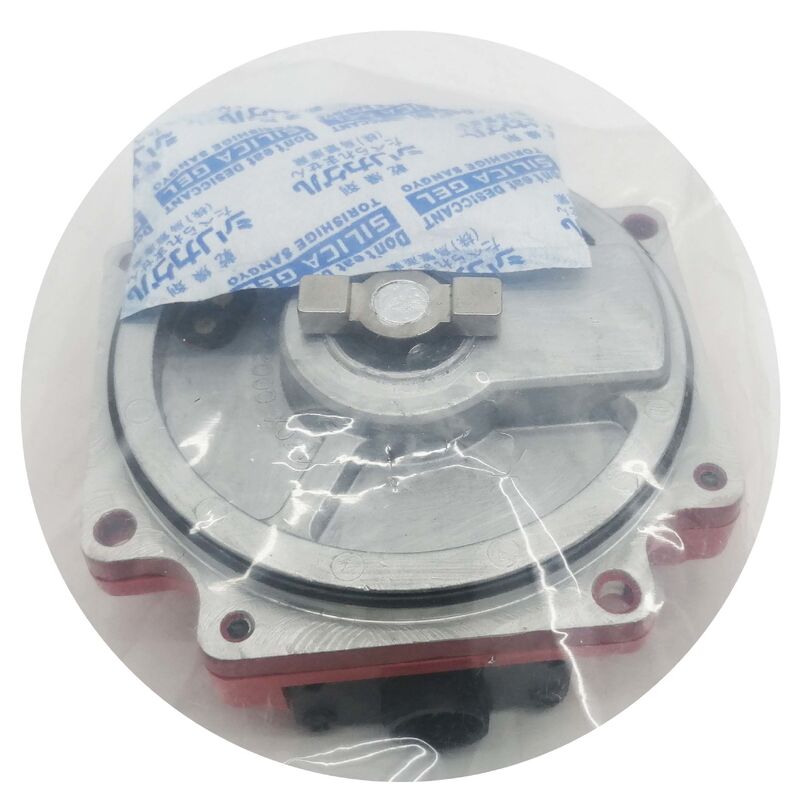
Fanuc A860-0365-T101 | Alpha αi64 Incremental Pulse Coder — 64,000P, With Cable, Fanuc Alpha AC Servo Motors a3 and Larger
Overview
The Fanuc A860-0365-T101 is the αi64 incremental pulse coder supplied with cable, fitted to mid and large-frame alpha series AC servo motors from the a3 class onward.
At 64,000 pulses per revolution, it is the incremental counterpart to the αA64 absolute encoders of the A860-0360 family — same motor compatibility range, same CNC generation, but fundamentally different feedback behaviour: incremental rather than absolute, meaning the axis requires a reference return cycle each time the machine powers up.
The "W/CABLE" designation is a practical differentiator within the A860-0365 family.
The T001 variant (without cable) has a separable connector at the encoder body, allowing the feedback cable to be swapped independently; the T101 comes with the cable pre-assembled to the encoder.
In service, the W/CABLE format streamlines the motor overhaul process — a replacement T101 arrives as a complete assembly, ready to install without a separate cable procurement step.
The cable assembly exits from the encoder body with the appropriate connector for the amplifier end already terminated, making installation faster on a machine-down scenario.
The αi64 encoder distinguishes itself from the older αA64 (A860-0360 family) by the "i" designation, which marks it as part of Fanuc's incremental alpha encoder generation — a generation update that brought improved signal quality and compatibility with a wider range of controls compared to the original αA64 absolute series.
For machine applications where absolute position retention at power-off is not operationally required — either because a short reference return at startup is acceptable, or because the machine's cycle never leaves a state where reference return is burdensome — the incremental αi64 is a cost-effective and technically capable encoder choice.
The T101/E variant carries a special designation (/E suffix) and cannot be substituted with the standard T101 — the /E is a purpose-built variant for specific motor and machine configurations and requires exact replacement with another /E unit.
Key Specifications
| Parameter |
Value |
| Encoder Model |
αi64 (Alpha i 64K) |
| Resolution |
64,000 ppr |
| Feedback Type |
Incremental (A/B/Z quadrature) |
| Cable |
Included (W/CABLE) |
| Compatible Motors |
a3 and larger (alpha series) |
| Motor Series |
Alpha (pre-i generation) |
| CNC Compatibility |
15/16/18/21 (Model A) |
| Special Variant |
T101/E — cannot replace standard T101 |
| Status |
Active / Surplus / Exchange |
Incremental vs Absolute — Operating Implications for the αi64
The incremental nature of the A860-0365-T101 means the encoder produces A/B quadrature pulses and a Z index pulse as the motor shaft rotates, but it does not retain any position information between power cycles.
Each time the CNC powers up, the encoder counter starts at zero from an unknown physical position. The reference return procedure — driving the axis to a fixed hardware reference switch and finding the encoder's Z-pulse — establishes the axis datum before production begins.
For machines where this reference return is a routine part of the startup sequence and does not create operational friction, the incremental αi64 works as reliably as any absolute encoder for day-to-day production.
The advantage over absolute types is that there is no battery to monitor, no risk of position data loss from a failed battery, and no absolute position management required.
The encoder simply counts pulses when the motor rotates — straightforward and robust.
On machines where the production process requires the axis to resume at an exact position after an unplanned power cycle (emergency stop, power interruption), the lack of absolute position memory requires a full reference return before resuming, which may cause a scrap part or require repositioning from a known reference. For such applications, an absolute encoder type is preferable.
Cable-Included Configuration — Service Advantages
The W/CABLE format reduces the parts count in a motor repair scenario. When an encoder fails, the replacement T101 brings the cable with it — no separate encoder cable needs to be located, ordered, or matched to the encoder connector type.
The cable is dimensioned and terminated for the alpha motor installation it serves, which also removes the risk of inadvertently fitting the wrong cable length or connector type.
For facilities where maintaining a broad inventory of Fanuc encoder cables is not practical, the W/CABLE encoder simplifies spare parts stocking to a single SKU that covers both encoder and cable replacement needs simultaneously.
FAQ
Q1: Can the A860-0365-T101 replace the αA64 absolute encoder (A860-0360-T001) on the same motor?
The αi64 T101 and the αA64 T001 fit the same mid-to-large alpha motor frame and are compatible with the same CNC generation.
An incremental encoder can physically replace an absolute encoder on the same motor — the motor runs normally, the encoder signals are compatible.
The operational change is significant: the machine will no longer retain absolute position through power cycles. Every startup will require a reference return. Whether this is acceptable depends on the machine's application and the operator's workflow.
If the change is made, the CNC servo parameters must be updated to reflect the incremental encoder type.
Q2: The T101/E is listed as a special variant — what does this mean and how is it identified?
The /E suffix on the A860-0365-T101/E marks it as a special configuration variant — typically involving a specific cable length, connector modification, or electrical characteristic that differs from the standard T101.
Fanuc and machine builder documentation for the specific machine will specify whether the /E variant is required. Identifying a /E in the field is done from the encoder's part number label; if the physical encoder is marked A860-0365-T101/E, it must be replaced only with another /E unit.
Substituting a standard T101 for a /E (or vice versa) risks connector mismatch, cable length issues, or electrical interface incompatibility.
Q3: What happens to the incremental count if the encoder feedback cable loses signal briefly during machine operation?
Even brief signal loss (a loose connector, transient EMI spike, or cable fault) causes the CNC to lose the current position count on the affected axis.
The CNC immediately generates an encoder alarm (typically SV-360 series) and the axis stops. Unlike an absolute encoder, which can re-establish position by reading its stored count, an incremental encoder that loses signal must re-establish position through a reference return before the axis can resume motion.
This makes reliable cable and connector condition especially important for incremental encoder installations — any degradation in the cable assembly should be addressed before it causes a production interruption.
Q4: How are the 64,000 ppr from the αi64 used by the CNC servo loop?
The servo amplifier decodes the A/B quadrature signals from the αi64, generating 4× the raw pulse count through edge detection — so 64,000 ppr becomes 256,000 quadrature edges per revolution at the hardware count level.
At the rated operating speed of a typical alpha motor (2000–3000rpm), this produces millions of position updates per second, giving the servo amplifier a dense enough data stream for stable velocity estimation and position control.
The Z index pulse (one per revolution) provides the reference mark for the reference return cycle.
Q5: What is the recommended service approach when the A860-0365-T101 produces intermittent alarms rather than a permanent fault?
Intermittent alarms are more difficult to diagnose than permanent ones.
Start with the cable: flex and observe the cable run while the motor is stationary and the CNC is in a safe monitored state — intermittent alarms triggered by cable movement indicate cable damage or connector intermittence.
Check both the encoder end and the amplifier end connector for partially disengaged pins and verify the connector locking mechanisms are engaged.
If the alarm cannot be triggered by cable movement, connect an oscilloscope to the A and B phase encoder outputs and observe the signal quality during slow motor rotation — signal dropouts, reduced amplitude, or non-square waveforms indicate a degrading optical disc inside the encoder.
If signal quality issues are confirmed under rotation but the cable checks clean, exchange the encoder.


 Your message must be between 20-3,000 characters!