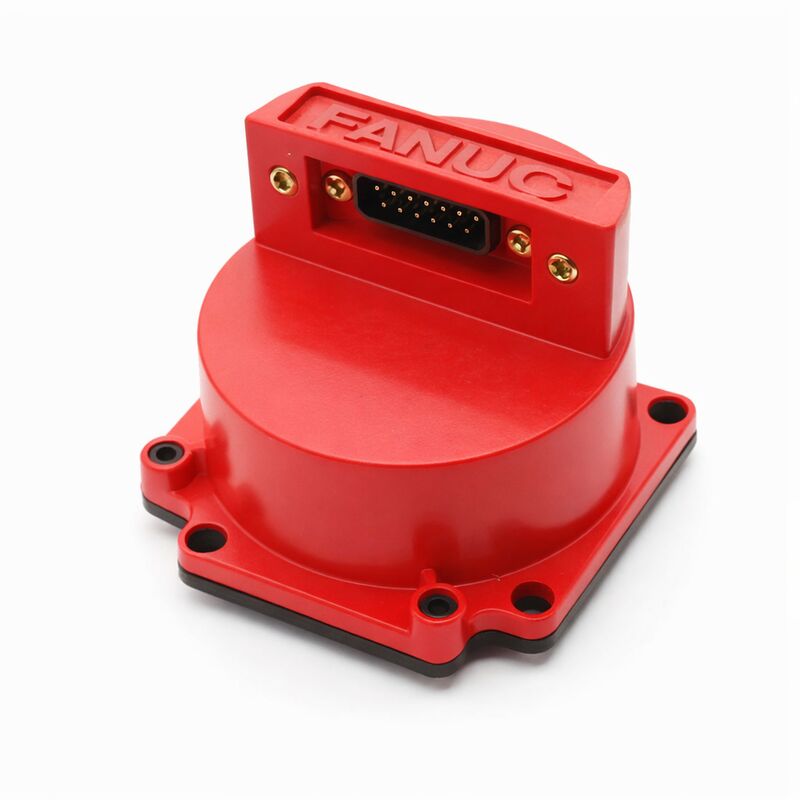
Fanuc A860-0370-T001 | Alpha αA1000 Absolute Pulse Coder — 1,000,000P, Fanuc Alpha AC Servo Motors a12 / a22 / a30 / a40
Overview
The Fanuc A860-0370-T001 is the αA1000 absolute pulse coder for Fanuc's large-frame alpha series AC servo motors — the a12, a22, a30, a40, and related αM and αL variants. At 1,000,000 pulses per revolution, the A1000 delivers a 15-fold resolution improvement over the αA64 (64K ppr) encoder found on smaller alpha motors, and this figure is directly matched to the higher torque and higher inertia characteristics of the large alpha motor class.
There is a clear logic to why a large, heavy-duty servo motor needs a finer encoder.
High-inertia loads connected to large motors mean slower acceleration and deceleration — the servo loop spends more time at intermediate speeds where velocity regulation quality is most visible.
The 1M ppr encoder gives the amplifier far more position update events per motor revolution than a 64K unit, so velocity estimation is smoother and the servo loop can maintain tighter speed control even during the gradual acceleration and deceleration ramps typical of large axes.
On a machine tool with a large saddle or heavy table driven by an a22 or a30 motor, this translates to better surface finish on profiled cuts.
The αA1000 provides absolute multi-turn position feedback, meaning the axis position is stored through power cycles without requiring a reference return sequence each time the machine powers up.
Position retention relies on battery backup within the servo amplifier — the encoder reports its shaft position data through the serial encoder interface, and the amplifier's battery-backed RAM holds the accumulated absolute count between power cycles.
If the battery is properly maintained, the machine can resume production immediately after power-on without any axis homing routine.
The A860-0370-T001 was produced alongside the alpha motor generation and remains in active service on a substantial number of machine tools worldwide.
Sourcing replacement units comes primarily from service exchange pools and surplus stock rather than new production, since the motor generation it serves is no longer the current Fanuc offering.
This makes proactive spare parts planning particularly valuable for facilities operating fleets of machines with alpha motors in this size range.
Key Specifications
| Parameter |
Value |
| Encoder Model |
αA1000 |
| Resolution |
1,000,000 ppr |
| Feedback Type |
Serial absolute (multi-turn) |
| Compatible Motors |
a12/a22/a30/a40, αM, αL variants |
| Motor Series |
Alpha (pre-i generation) |
| CNC Compatibility |
15/16/18/21 (Model A), alpha servo interface |
| Repairability |
Exchange/replace only |
1M ppr Resolution — Large Motor, Large Load Applications
The α12/2000 motor produces 12N·m of continuous torque at its 2000rpm rated speed.
The α22/2000 steps up to 22N·m, and both are commonly used on horizontal machining centre pallet drives, large CNC lathe saddles, and precision boring mill facing axes — all applications where mechanical mass and cutting force demand sustained high torque.
The αA1000's 1M ppr resolution matches this demand at the feedback level: at 2000rpm, the encoder generates over 33 million position update edges per second, giving the servo amplifier extremely dense position data for stable velocity control at the rated operating point.
For the a30/1200 and a40/1200 motors — which operate at the lower 1200rpm rated speed — the encoder's 1M ppr provides proportionally denser position updates at typical operating speeds, which is important for these low-speed, high-torque motors that often run at a fraction of their rated speed during heavy cutting passes.
Sourcing and Service Considerations
The A860-0370-T001 exists within the A860-0370 product family, which includes multiple T-suffix and V-suffix variants.
All members of the 0370 family share the αA1000 resolution and the same large-frame alpha motor compatibility, with T-suffix variants distinguished primarily by connector type and mechanical fitment details.
When ordering a replacement, confirming the correct T-suffix for the specific motor installation is essential — different connectors at the motor-side cable end mean different variants are not directly interchangeable without cable modification.
FAQ
Q1: What distinguishes the A860-0370-T001 from the V-suffix variants like A860-0370-V501 and V502?
The T001 is a motor-mounted encoder that includes a cable integrated or supplied with the unit; the V-suffix variants (V501, V502) are connector-only or cable-separate versions used in different installation configurations.
All share the same αA1000 1M ppr absolute resolution and fit the same large-frame alpha motor series.
The practical difference is in how the encoder connects to the motor-side feedback cable — confirm which connector and cable arrangement your motor uses before selecting the correct variant for replacement.
Q2: The absolute position data is described as stored in the amplifier, not the encoder — what does this mean for encoder replacement?
When the A860-0370-T001 is replaced, the new encoder starts counting from an arbitrary angular position within one revolution. The amplifier's multi-turn absolute count was tied to the old encoder's mechanical relationship with the motor shaft.
After fitting the replacement encoder, the axis must be driven to its reference point and a manual reference return executed to re-establish the absolute position datum in the amplifier's battery-backed memory.
This is a normal post-replacement procedure and does not indicate a fault with the new encoder.
Q3: How is the αA1000's battery backup managed, and what happens if the battery fails?
The backup battery is located in the servo amplifier or a dedicated battery unit — not in the encoder itself. When the amplifier's power is off, the battery maintains a small current to the SRAM that holds the absolute position count.
A battery alarm (BAT alarm) on the CNC signals that battery voltage has fallen to the warning threshold; at this point, replace the battery before the next planned power-down to avoid position data loss.
A completely discharged battery causes the amplifier to lose the multi-turn count, triggering an absolute encoder reference lost alarm at next power-up. Recovery requires a fresh reference return after fitting a new battery.
Q4: Can the A860-0370-T001 be used with i-series CNC controls (0i, 16i, 18i) intended for alpha i motors?
The αA1000 encoder is designed for the first-generation alpha motor series and the compatible CNC generation (Series 15/16/18/21 Model A).
The i-series CNC controls (0i, 16i, 18i, 21i) are designed for alpha i motors, which use the BiA128 or BiA1000 encoder types with different serial protocols.
The αA1000 serial protocol is not compatible with the i-series CNC's encoder interface.
A machine retrofit from alpha to alpha i motors would require replacing both the motors and the encoders.
Q5: What are the common fault symptoms that indicate the A860-0370-T001 has failed?
The most common presentation is a servo alarm on the affected axis at power-up — typically an encoder communication fault (SV360-series alarm on compatible CNCs). Intermittent encoder alarms that clear on power cycling but recur suggest a degrading optical disc or contamination inside the encoder, while a permanent alarm that remains after checking the cable and connector points to encoder failure.
Mechanical symptoms — roughness or resistance when the motor shaft is rotated by hand — indicate bearing wear inside the encoder, which will eventually produce signal errors even if the electronics are intact.
In all cases, the encoder is not field-repairable; exchange is the service route.


 Your message must be between 20-3,000 characters!