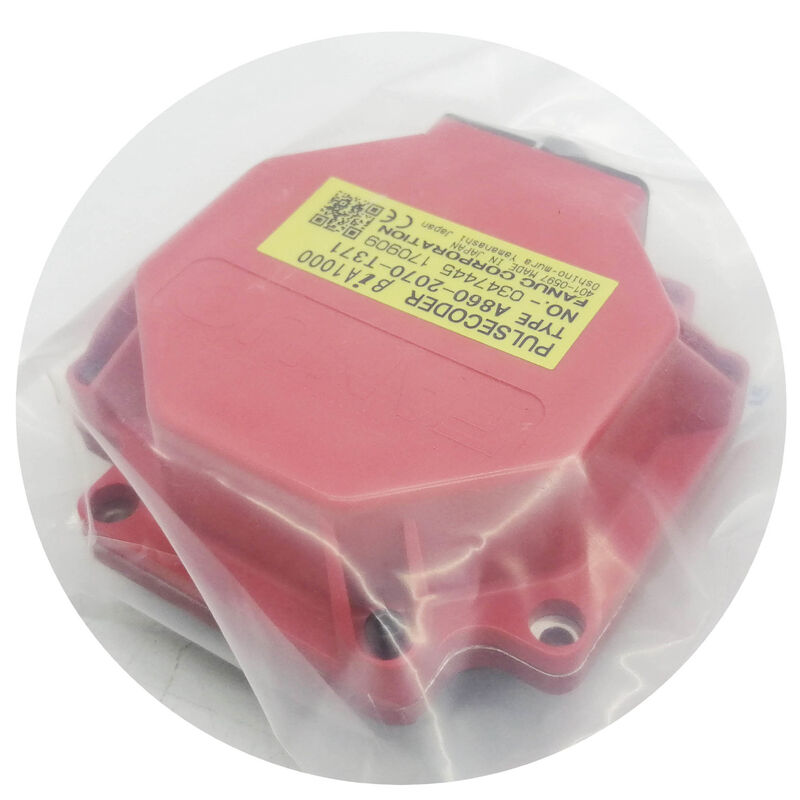
Fanuc A860-2070-T371 | BiA1000 Absolute Pulse Coder — Beta i B-Series Servo Motors, βiS4/3000-B through βi22
Overview
The Fanuc A860-2070-T371 is the BiA1000 absolute pulse coder for Fanuc's Beta i B-generation servo motors — the encoder variant specific to the current-production B-series motors starting from the βiS4/3000-B and extending through the βi4, βi8, βi12, βi22, and other Beta i B-series variants.
It represents the highest resolution encoder available in the Fanuc Beta i pulsecoder family, providing 1,000,000 pulses per revolution absolute feedback to the connected servo amplifier.
The "B" suffix in the motor designation is the key compatibility marker. When Fanuc transitioned Beta i motors from the standard series to the B (or model B) generation, the encoder changed from the earlier BiA128 or BiA1000 designs to the T371-suffix version represented by this part number.
This change is not interchangeable in both directions — the A860-2070-T371 is specifically designed for the B-series motor mechanical and electrical interface, and substituting an earlier T321 or T301 variant on a B-series motor will not produce correct operation.
At 1,000,000 ppr absolute resolution, the BiA1000 provides the CNC with a complete, unambiguous position reference from the moment the machine powers up — no reference return cycle is needed to re-establish axis zero position.
The absolute position is maintained through a battery backup circuit within the amplifier.
If battery voltage drops below the monitoring threshold, the CNC issues a battery alarm and the absolute position reference must be re-established through a manual reference return before production can resume.
The BiA1000 is built using Fanuc's integrated optical disc and signal processing design, which encapsulates the entire encoder assembly in a sealed unit fitted directly to the rear of the servo motor shaft.
This construction provides very high shock and vibration immunity compared to traditional separate encoder designs, but it also means the unit is not field-repairable in the conventional sense. Internal component failures require complete encoder replacement rather than component-level repair.
Key Specifications
| Parameter |
Value |
| Encoder Model |
BiA1000 |
| Resolution |
1,000,000 ppr (absolute) |
| Feedback Type |
Serial absolute |
| Motor Series |
Beta i B-generation |
| Motor Range |
βiS4/3000-B to βi22 and variants |
| CNC Generation |
0i-MF/TF, 31i-B, 32i-B, 35i-B |
| Repairability |
Exchange/replace only |
| Status |
Stock-critical |
BiA1000 vs BiA128 — Resolution and Motor Generation Distinction
The Beta i encoder family spans two main resolution classes. The BiA128 (128K ppr absolute, A860-2020 series) fits the earlier and smaller Beta i motors — the ai2 class and similar.
The BiA1000 (1M ppr absolute, A860-2070 series) serves the larger and newer Beta i motors including the B-generation series addressed by this part number.
The difference is not simply resolution: the mechanical mounting, shaft coupling geometry, and electrical interface differ between the two families, making cross-substitution physically impossible without modification.
The 1M ppr resolution of the BiA1000 provides exceptionally fine position feedback, contributing directly to the smooth velocity regulation and low-speed torque ripple suppression that characterise modern Beta i motor performance.
At 1M counts per revolution, the CNC interpolator has far more position update data per motor rotation than older 128K or 3000P encoder designs — the velocity estimate derived from position differentials is smoother, which translates to better servo loop stability at both low speeds and during fine contouring motions.
Stock Criticality and Exchange Strategy
Specialists in this encoder consistently describe the A860-2070-T371 as stock-critical: demand comes both from motor repairs and from direct replacement needs when encoders fail in service, while new supply from Fanuc is limited by the relatively small installed base compared to higher-volume alpha i encoder variants. Unlike alpha i encoders which appear on far more machine models globally, the Beta i B-series encoder pool is smaller.
The practical implication for maintenance planning is clear: if a machine uses B-series Beta i motors, securing at least one spare A860-2070-T371 as a standby component significantly reduces the risk of extended downtime when an encoder fails. Exchange programs — supplying the faulty encoder as a core — are the most cost-effective service route where tested, warranted exchange units are available.
FAQ
Q1: How do I confirm whether my Beta i motor requires the A860-2070-T371 specifically, rather than an earlier BiA1000 variant?
The motor part number's suffix "-B" (or "#B" variant) confirms B-generation motors requiring the T371 encoder. For example, βiS4/3000-B motors explicitly carry the B designation.
If the motor's nameplate shows a part number ending in -B or the motor body is physically labelled as model B, this is the correct encoder.
Earlier Beta i motors without the B designation use the T321 or T301 variant of the same BiA1000 family. When in doubt, cross-reference the motor's order specification number against Fanuc's motor documentation for the correct encoder suffix.
Q2: The encoder is described as non-repairable — is this a design limitation or a service policy?
Both. Fanuc builds the BiA1000 encoder as a sealed, integrated assembly — the optical disc, bearing assembly, signal processing board, and connector are all factory-bonded together without serviceable subcomponents accessible from outside. Internal failures at the optical disc, bearing, or PCB level cannot be addressed at component level without specialised equipment that Fanuc does not supply to the aftermarket.
Some third-party services claim repair capability, but the results are inconsistent, and a failed repair of an encoder attached to an operating motor risks losing absolute position data and causing further axis damage. Exchange with a verified, load-tested unit is the established industry practice.
Q3: What happens to the absolute position when the machine power is off and the battery is not connected?
The absolute position of each axis is stored in battery-backed RAM within the amplifier — not in the encoder itself. The encoder provides the count data; the amplifier retains the accumulated absolute reference.
If battery power is lost while the machine is off, the stored absolute position count in the amplifier is lost. On next power-up, the CNC detects the position data loss and requires a full reference return cycle for every affected axis before production can resume.
The battery is in the servo amplifier or in a dedicated battery unit, not in the encoder — inspecting and replacing batteries on the correct schedule is the preventive action.
Q4: Can the A860-2070-T371 be substituted with the earlier A860-2070-T321 on the same motor?
The T371 and T321 represent different hardware revisions within the BiA1000 family.
The T371 is specifically designed for B-generation motors, and the T321 is for the earlier non-B generation.
Fitting a T321 on a B-generation motor typically results in either a parameter error or unreliable position feedback due to physical interface differences in the encoder-to-shaft coupling and potentially the signal interface at the amplifier.
Always match the T-suffix to the motor generation.
Q5: What alarm code does the CNC generate when this encoder fails, and how is the fault distinguished from a cable fault?
Serial encoder communication faults typically appear as Servo Alarm 360 (Communication error in the pulse coder) or Alarm 368/369 depending on the CNC generation and axis involved.
A cable fault between the amplifier and encoder produces similar alarms.
To distinguish encoder from cable: first swap the feedback cable with a known-good cable from another axis. If the alarm follows the cable to the new axis, the cable is at fault. If it remains on the original axis with the new cable, the encoder or its connection to the amplifier is faulty.
Inspect the connector at both ends for bent pins or contamination before concluding the encoder itself has failed.


 Your message must be between 20-3,000 characters!