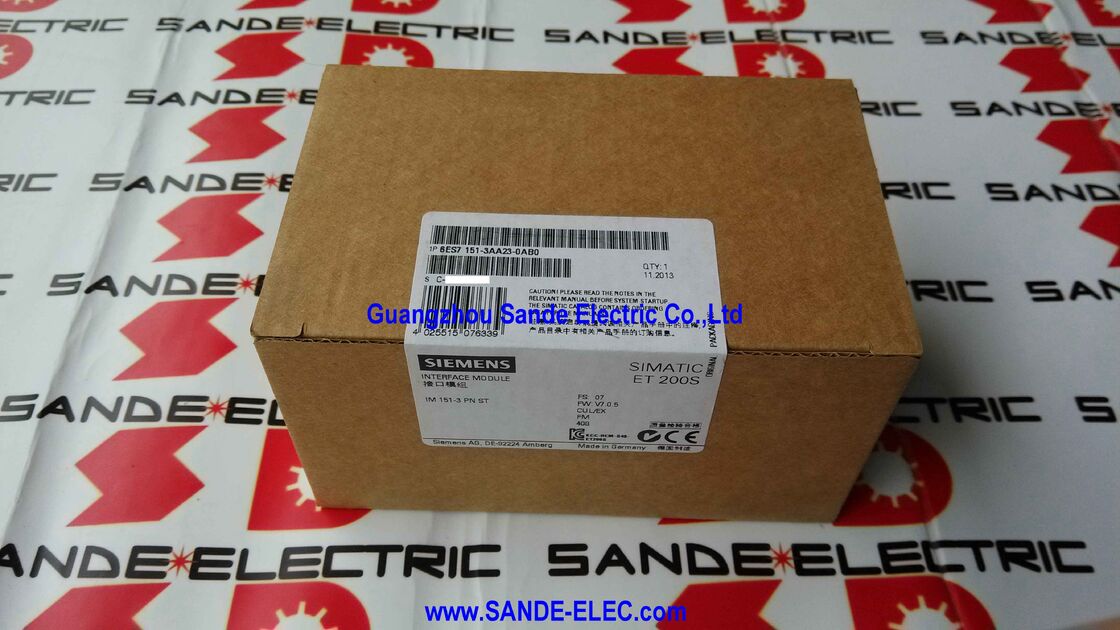
Siemens 6ES7151-3AA23-0AB0 | SIMATIC ET 200S IM 151-3 PN ST — PROFINET IO / 100 Mbit/s / 2×RJ45 / IRT 250µs / Shared Device / Media Redundancy
PROFINET Instead of PROFIBUS — What Changes at the Station
Where the PROFIBUS IM 151-1 connects an ET 200S station to a PROFIBUS DP network via a 9-pin Sub-D connector at a maximum of 12 Mbit/s, the IM 151-3 PN ST connects via 100 Mbit/s Ethernet using standard RJ45 ports. The underlying signal modules and terminal modules are the same hardware — only the interface module changes when migrating an ET 200S station from PROFIBUS to PROFINET.
This matters practically: an installed ET 200S station's field wiring, I/O modules, and DIN rail mounting remain intact through a PROFIBUS-to-PROFINET conversion. The IM swap changes the network protocol; nothing else in the station needs to be disturbed.
The integrated 2-port switch is the architectural advantage that defines how PROFINET line topology works in the field. Rather than routing a cable from a panel switch to each individual station, the network cable runs from station to station — in one RJ45 port, out the other — through every station in the line. A twenty-station production line operates on a single cable path with no external switches at any station.
Key Specifications
| Parameter |
Value |
| Part Number |
6ES7151-3AA23-0AB0 |
| Interface |
2 × RJ45 PROFINET |
| Transfer Rate |
100 Mbit/s |
| Min. IRT Cycle |
250µs |
| Max. Modules |
63 |
| Max. Width |
2m |
| Supply |
24VDC |
| Power Loss |
~3.3W |
| Dimensions |
60 × 75 × 119.5mm |
| Status |
Phase-out / spare |
IRT — Deterministic Timing for Motion and High-Speed Applications
PROFINET offers three communication layers: TCP/IP, RT (Real-Time), and IRT (Isochronous Real-Time). The IM 151-3 PN ST supports IRT — the layer where a reserved bandwidth in each PROFINET send cycle is protected from interference by other network traffic. Regardless of background communication load, the IRT data transfer completes within its allocated window with jitter measured in microseconds rather than milliseconds.
The 250µs minimum IRT update time of the ST variant covers the majority of coordinated motion and machine synchronisation applications. For applications requiring sub-250µs cycles, the HF (High Feature) variant reaches 125µs. For discrete I/O and general process measurement where IRT is not required, the same IM 151-3 PN ST runs in standard RT mode at longer cycle times.
Shared Device — Two Controllers, One Station
Shared Device allows the IM 151-3 PN ST station to be accessed by two separate PROFINET IO controllers simultaneously, with each controller assigned its own module subset. The most common application: a safety controller manages the F-rated I/O modules in the station (emergency stop, light curtain, safety relay) while a standard controller manages the standard I/O modules — both within a single physical ET 200S station, eliminating the cost and panel space of a separate dedicated safety I/O station. Shared Device is not available simultaneously with the IRT high-flexibility option.
FAQ
Q1: What separates the IM 151-3 PN ST from the IM 151-3 PN HF?
The ST supports IRT with a minimum 250µs update cycle. The HF reduces this to 125µs and adds direct PROFIsafe support for F-module integration at the interface module level. For applications that don't need sub-250µs IRT or direct PROFIsafe through the IM, the ST is the appropriate and more economical choice.
Q2: Can the IM 151-3 PN ST replace an installed IM 151-1 (PROFIBUS)?
The physical electronic modules and terminal modules are compatible with both IM variants — the station's hardware stays in place. The swap requires reconfiguring the station's network connection from PROFIBUS to PROFINET in the controller's TIA Portal or STEP 7 hardware configuration, assigning a PROFINET device name to the new IM, and verifying the PROFINET network layout. Field wiring is unchanged.
Q3: How is the PROFINET device name assigned?
The IO controller assigns the name during commissioning — via Siemens's Topology detection (automatic, using LLDP data) or manually through TIA Portal's "Assign device name" function. Once assigned, the name is stored in the controller project and retained in the IM 151-3 PN ST itself. The Prioritised Startup feature allows faster communication establishment after power cycling by avoiding a full rediscovery sequence.
Q4: Is the 63-module maximum always the practical limit?
Rarely. The actual limit is usually the station's backplane current budget — the total current capacity of the installed power modules minus the sum of all electronic modules' current draws — or the 2m maximum station width. For stations with many analogue modules (higher per-module current draw), the current budget is typically exhausted before the 63-module count is reached. A backplane current calculation against all installed modules is required during station design.
Q5: Does the IM 151-3 PN ST support hot-swap of electronic modules?
Yes. The two-piece architecture — terminal module stays, electronic module swaps — allows module replacement while the station communicates. The IM 151-3 PN ST generates insertion and removal interrupts that notify the PROFINET IO controller of the change. The user programme can respond to these interrupts to manage the transition, for example by substituting safe default output values while a module is absent.



 Your message must be between 20-3,000 characters!