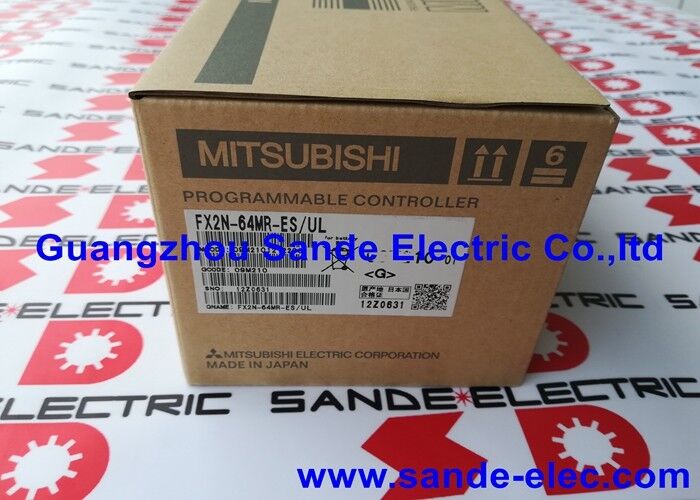
Mitsubishi FX2N-64MR-ES/UL | MELSEC FX2N PLC Base Unit — 32 DI (24VDC) + 32 Relay NO Outputs, 100–240VAC, 8K Steps RAM, 0.08µs/Step, UL Listed, 220×90×87mm
Overview
The Mitsubishi FX2N-64MR-ES/UL is the 64-point relay output base unit of the MELSEC FX2N series — Mitsubishi Electric's second-generation compact PLC platform that defined what a capable yet affordable machine controller should be when it was introduced in the early 2000s.
In a single 220×90×87mm housing, it integrates a 32-input, 32-relay-output I/O system, a full PLC CPU, and an AC power supply — ready to wire directly to sensors and actuators without any additional hardware for a remarkable range of machine control applications.
The FX2N represented a significant step forward from its predecessors (FX0N, FX2) in processing speed and memory capacity, and it remains one of the most widely deployed PLC platforms in the world measured by installed base.
Factories across Asia, Europe, and North America still operate thousands of FX2N-equipped machines, and maintaining those machines keeps the FX2N-64MR-ES/UL in constant demand on the spare parts market despite its discontinuation.
The "MR" in the part designation identifies this as the relay output variant — the most versatile output type in the FX2N family. Relay contacts switch both AC and DC loads at voltages up to 250VAC or 30VDC, without the transistor output constraint of handling only DC or requiring separate power supply considerations for mixed AC/DC loads.
A machine control panel with solenoid valve pilots (24VDC), motor contactors (230VAC coils), and indicator lamps (24VDC or 230VAC) can wire all outputs directly to the FX2N-64MR's relay contacts without intermediate relays or voltage conversion.
Key Specifications
| Parameter |
Value |
| Digital Inputs |
32 × 24VDC |
| Digital Outputs |
32 × relay NO, 2A/250VAC |
| Power Supply |
100–240VAC, 60VA |
| Program Memory |
8K steps RAM |
| Execution Speed |
0.08 µs/basic instruction |
| Max. System I/O |
256 points (with expansion) |
| High-Speed Counters |
6 |
| Dimensions (W×H×D) |
220×90×87mm |
| Weight |
1.0 kg |
| Certification |
UL, CE |
| Status |
Discontinued |
32 Relay Outputs — Versatility and Load Compatibility
The relay outputs on the FX2N-64MR-ES/UL are mechanical contacts — physically separate conductors that close when the PLC output coil is energised.
This is fundamentally different from transistor outputs, which are solid-state switches limited to DC loads within specific voltage and current ranges.
Each relay contact in the FX2N-64MR is rated for 2A at 250VAC (resistive). In practical machine control, this covers:
Solenoid valve pilots (24VDC, 100–300mA): Pneumatic and hydraulic valve pilots in this current range connect directly to the relay outputs — no interposing relay needed.
Motor starter and contactor coils (230VAC, 50–200mA): Motor starter coils for single-phase or three-phase motors up to medium size connect directly through the relay, provided the coil current is within the 2A contact rating.
Indicator lamps (24VDC or 230VAC, 10–100mA LED or incandescent): Both voltage levels and both incandescent (resistive) and LED (slightly capacitive) loads wire directly to relay outputs.
Relay coils for higher-current switching: When a load exceeds 2A — a large contactor, a significant resistive heater — the FX2N relay output drives an interposing relay coil (typically 0.1–0.2A at 24VDC), and the interposing relay's higher-rated contacts connect to the heavy load.
The relay contacts are grouped into output commons: groups of outputs sharing a common return terminal.
This grouping allows different voltage levels on different output groups — some outputs driving 230VAC loads while others drive 24VDC loads, using separate commons.
8,000 Steps of RAM — Program Capacity and Memory Expansion
The 8,000-step RAM program memory is the standard capacity for the FX2N-64MR-ES/UL.
A "step" in MELSEC FX2N programming corresponds approximately to one ladder instruction (a contact, a coil, or an applied instruction). A typical machine control program for a conveyor system with 20 sequences, 15 timers, and 10 counters occupies roughly 500–2,000 steps — well within the 8,000-step capacity.
For programs that approach or exceed 8,000 steps — sophisticated multi-axis positioning programs, programs with extensive data processing, or programs integrating multiple machine functions — an optional memory cassette (FX2N-EEPROM-8L or FX2N-ROM-E1) extends the program storage to 16,000 steps and provides non-volatile storage (the RAM retains program when power is applied, backed by a battery; the EEPROM cassette retains without battery backup).
The RAM program memory allows the program to be modified in the field using Mitsubishi's GX Developer or GX Works2 programming software — the program is uploaded from the PLC, edited, and downloaded back.
EEPROM-backed programs require writing the modified program to the cassette, which is then installed in the PLC.
High-Speed Counters — Encoder Integration
The FX2N-64MR-ES/UL includes six built-in high-speed counter inputs (HSC), operating at counting rates significantly above the normal PLC scan cycle — enabling encoder-based position feedback and high-speed event counting without the scan cycle limitation that makes standard software counters unsuitable for fast signals.
The high-speed counter inputs use specific input points (X0 through X7 in various HSC configurations) and support single-phase counting, two-phase quadrature (A/B encoder) counting, and phase differential counting.
Quadrature counting with A/B phase signals from an incremental encoder provides both position counting and direction detection, making the FX2N-64MR suitable for basic positioning applications — web tension control, conveyor length measurement, and actuator position monitoring — without requiring a separate positioning module for straightforward tasks.
For demanding multi-axis positioning applications, the FX2N platform supports additional positioning modules (FX2N-10PG, FX2N-20GM) connected as special function modules to the base unit's right expansion bus.
FAQ
Q1: Can relay outputs be used for both AC and DC loads simultaneously on the same FX2N-64MR base unit?
Yes, this is one of the relay output's key advantages over transistor outputs. Each output group on the FX2N-64MR has its own common terminal. By wiring different groups to different power supply commons (24VDC for one group, 230VAC for another), the outputs in each group switch at the corresponding voltage.
The PLC program sees no difference — it activates output coils by address (Y0, Y1, etc.) regardless of what voltage is switching at the contact.
The physical isolation of the relay contact from the PLC's internal logic allows this mixed-voltage architecture safely.
Q2: What is the contact electrical life of the relay outputs, and how does high cycling frequency affect it?
Mitsubishi specifies the relay contacts at 100,000 operations for rated resistive load (2A / 250VAC). Inductive loads (solenoid valve coils, contactor coils) reduce contact life due to the inductive kick when the circuit opens.
For applications where the FX2N output cycles rapidly — ON/OFF regulation of a heater at short cycle times, for example — transistor outputs paired with an SSR are preferred over relay outputs for extended contact life.
For standard machine sequencing with typical cycle counts of 10–100 operations per hour, relay outputs provide years of reliable service.
Q3: Does the FX2N-64MR-ES/UL include built-in Ethernet or serial communication, or does it require add-on modules?
The base FX2N-64MR includes one RS-422 peripheral port (using a mini-DIN connector) for programming connection via GX Developer or GX Works2. There is no built-in Ethernet or Modbus communication in the base unit.
Communication expansion is achieved through communication modules mounted on the right expansion bus: the FX2N-232-BD (RS-232C), FX2N-485-BD (RS-485), FX2N-232IF (RS-232C isolated), or FX2N-CNV-BD with subsequent communication modules.
Ethernet communication requires the FX2N-ENET or FX-Enet-BD modules. Each base unit accommodates up to two communication interface boards.
Q4: The FX2N is discontinued. What is the direct Mitsubishi successor for new machine designs?
Mitsubishi succeeded the FX2N with the FX3U series (third generation), and subsequently with the FX5U/FX5UC series (current generation).
The FX5U-64MR/ES is the functional equivalent for new designs — 32 DI + 32 relay outputs, 100–240VAC supply — with significantly improved performance (processor speed, instruction set), built-in Ethernet and RS-485 communication, and current Mitsubishi factory support.
For machines where maintaining the FX2N program is essential for continuity, the FX3U-64MR/ES is a closer functional match and often simpler to migrate from FX2N, as it uses the same programming environment.
Q5: Can expansion modules from the FX3U/FX3G series be connected to an FX2N-64MR-ES/UL base unit?
No. The FX2N and FX3U/FX3G series use different expansion bus connectors and protocols. FX2N expansion modules (FX2N-8EX, FX2N-8EYR, FX2N-4AD, etc.) connect to the FX2N base unit's right-side expansion connector.
FX3U/FX3G expansion modules are not directly compatible with FX2N base units.
This is an important consideration when sourcing replacement expansion modules for existing FX2N systems — only FX2N-compatible (or FX-compatible) expansion modules should be specified.



 Your message must be between 20-3,000 characters!