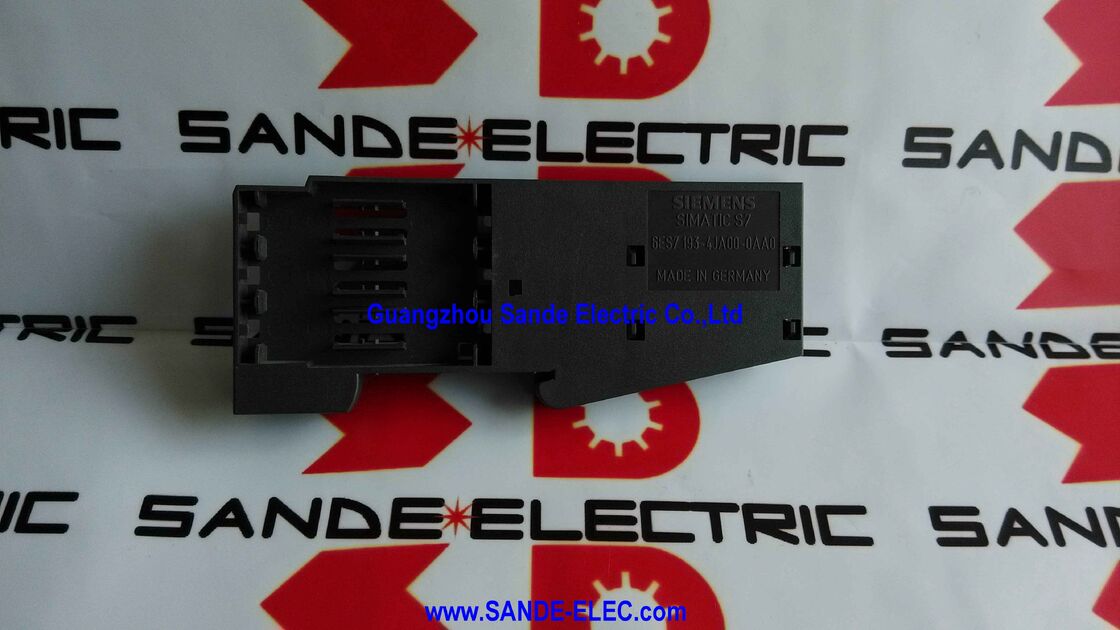
Siemens 6ES7193-4JA00-0AA0 | SIMATIC ET 200S Termination Module — Bus Termination / One Per Station / 30×106×7.5mm / 50g / Active Spare
Small Component, Non-Negotiable Function
Every ET 200S station has two ends. The left end holds the interface module — the IM 151-1 or IM 151-3 that connects the station to PROFIBUS DP or PROFINET. The right end must hold the 6ES7193-4JA00-0AA0 termination module. No exceptions.
The ET 200S internal backplane bus runs electrically from left to right through every electronics module in the station. The bus carries communication data, 24V DC logic power, and module identification signals. When the bus reaches the last electronics module and has nowhere to go, it needs a defined termination — not an open connector dangling in air, which becomes an antenna for electrical noise and a source of false diagnostics in the interface module's bus-scan cycle.
The termination module closes these connections. It also provides the mechanical end-stop that locks the last terminal module firmly to the DIN rail profile. Both functions — electrical termination and mechanical locking — require the module to be installed regardless of station size, module count, or which interface module is in use.
An ET 200S station without its termination module runs the risk of intermittent communication errors, spurious diagnostic alarms from the interface module, and in some configurations, failure to initialise at all.
Key Specifications
| Parameter |
Value |
| Part Number |
6ES7193-4JA00-0AA0 |
| Function |
ET 200S backplane bus termination |
| Dimensions |
30 × 106 × 7.5mm |
| Weight |
50g |
| Configuration |
None required |
| Power |
None required |
| Compatible System |
SIMATIC ET 200S |
| Status |
Active |
When the Termination Module Disappears
It is one of the most easily lost components in the ET 200S system. The scenarios that cause it to go missing:
Station expansion — adding modules to an existing station means removing the termination module to insert the new electronics, then reinstalling it at the new rightmost position. In the middle of a commissioning or maintenance task, it gets set on a bench and forgotten.
Station relocation — during machine reconfiguration, disassembled stations get sorted into trays. The termination module, at 50g and 7.5mm thick, easily ends up in the wrong container.
Initial commissioning from mixed supplier orders — when an ET 200S station is assembled from components sourced across multiple orders or suppliers, the termination module may not be included with any individual line item. It is nobody's responsibility unless it is explicitly on the bill of materials.
A small stock — a handful of 6ES7193-4JA00-0AA0 units — covers all three scenarios and occupies negligible storage space. The cost of a production delay waiting for a single termination module to arrive vastly outweighs the cost of holding a few spares.
One Per Station, Not Per Module
A single termination module closes the entire station regardless of whether that station holds 3 electronics modules or 30. One 6ES7193-4JA00-0AA0 per ET 200S station is the rule — not one per rail section, not one per power module, just one per complete station assembly.
FAQ
Q1: Is one termination module needed per station or per rack segment?
One per complete ET 200S station, always at the rightmost position. Unlike some modular systems that require termination per rail or per group, ET 200S uses a single termination module to close the entire station's backplane bus at one end. A facility with eight separate ET 200S stations needs eight termination modules.
Q2: The module is listed as a spare part — was it not included in original deliveries?
ET 200S stations typically include the termination module in the interface module package or station kit on original delivery. It is listed as a spare part here because its primary market role is as a replacement for units lost or damaged in existing installations. For new stations assembled from individual component orders, explicitly include the 6ES7193-4JA00-0AA0 in the parts list — it may not be bundled with any individual module order.
Q3: Does it work with both PROFIBUS DP and PROFINET ET 200S variants?
Yes. The termination module closes the internal backplane bus connections, which are physically identical across all ET 200S variants regardless of which network interface module (IM 151-1 for PROFIBUS DP or IM 151-3 PN for PROFINET) is installed. The termination module contains no protocol-specific electronics — it is a passive bus closure component.
Q4: Does a missing termination module cause an immediate station alarm?
It can. The DP or PN master may detect that the station is not reporting a complete configuration during its initialisation scan and generate a slave diagnostic fault. In some installations the station runs with intermittent errors rather than a hard alarm. Either way, an open bus end is never correct, and the termination module must be installed regardless of whether an alarm is visible. Intermittent errors in electrically noisy environments are the failure mode most likely to occur without it.
Q5: How many electronics modules can precede the termination module?
The maximum depends on the interface module variant. With IM 151-1 DP, up to 63 electronics modules can be installed before the termination module. With IM 151-3 PN variants, the maximum is configuration-dependent. In every case, exactly one termination module is required at the end, after all electronics modules and their paired terminal modules, regardless of how many modules precede it.



 Your message must be between 20-3,000 characters!