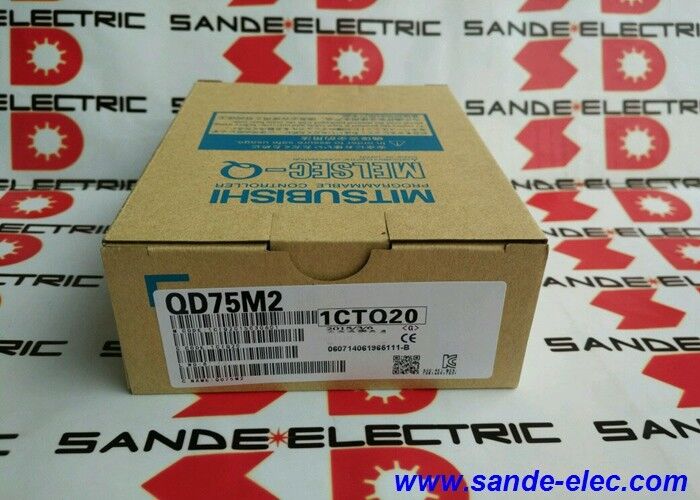
Mitsubishi QD75M2 | MELSEC-Q 2-Axis SSCNET Positioning Module — 600 Data/Axis, Linear and Circular Interpolation
Two-Axis Positioning from a Single Q Slot
The QD75M2 is the two-axis variant in Mitsubishi's QD75M positioning module family for the MELSEC-Q platform. It handles two independent servo axes through SSCNET — Mitsubishi's Servo System Control Network — connecting the Q PLC directly to MR-H-BN or MR-J2-series servo amplifiers over fibre-optic or cable.
Each of the two axes holds up to 600 sets of positioning data in the module's flash memory — target positions, speeds, and acceleration parameters that the module executes on command from the CPU. The positioning data survives power cycles without a battery, stored in non-volatile flash. Up to 100,000 write cycles are supported.
Two types of motion are available. Single-axis point-to-point positioning is the standard application: the axis moves from its current position to a target at a commanded speed. Two-axis linear interpolation moves both axes simultaneously along a straight line in two-dimensional space. Two-axis circular interpolation moves both axes along an arc. Selecting between these modes is a matter of positioning data configuration rather than additional hardware.
The QD75M2 starts up quickly — a positioning start takes 6–7 ms. The QD75M design is substantially faster than the older AD75 series in this regard. SSCNET cable total length and connection arrangements are compatible with MR-H-BN and MR-J2HBUS-M cable families.
QD75M Family Comparison
| Model |
Control Axes |
Interpolation |
| QD75M1 |
1 |
None |
| QD75M2 |
2 |
2-axis linear, 2-axis circular |
| QD75M4 |
4 |
2/3/4-axis linear, 2-axis circular |
All three variants share the same 32-point I/O assignment and 600 data/axis capacity.
Key Specifications
| Parameter |
Value |
| Part Number |
QD75M2 |
| Axes |
2 |
| Max Pulse Output |
200 kpps |
| Positioning Data |
600 / axis |
| Interface |
SSCNET |
| I/O Points |
32 |
| Supply |
24V DC |
| Current |
0.40A @ 5V DC |
| Flash ROM |
Max 100,000 writes |
| Status |
Discontinued |
FAQ
Q1: The QD75M2 shows a positioning data error. What should be checked first?
Verify the positioning data stored in the module for the affected axis — check target position, command speed, and acceleration/deceleration settings against the axis's parameter limits. A command speed or position outside the allowable range generates a data error before the positioning starts. Also confirm the servo amplifier READY signal is present, as a missing READY prevents positioning execution.
Q2: Can the QD75M2 control servo amplifiers via standard pulse output instead of SSCNET?
No. The QD75M series uses SSCNET only. For open-collector or differential pulse output to servo amplifiers without SSCNET, the QD75D or QD75P series modules are the appropriate variants. The M in QD75M specifically identifies the SSCNET connection type.
Q3: The QD75M2 is discontinued. Is it still available?
Yes — the industrial automation aftermarket holds exchange and tested surplus stock for the QD75M2. MELSEC-Q modules from decommissioned systems are actively traded. Request a functional test confirmation that covers both axes before accepting a used unit.
Q4: Does the QD75M2 require a separate power supply, or does it draw from the Q rack?
The module draws 0.40A at 5V DC from the Q backplane's internal supply. An external 24V DC supply is also required for the module's field-side circuits — this is connected to the module's 24V terminal, separate from the backplane. Verify both supplies are present if the module fails to initialise.
Q5: Is a programming tool required to load positioning data, or can it be done from the PLC ladder?
Both methods are available. GX Configurator-QP is the dedicated setup and monitoring tool for the QD75M series — it provides a table-based interface for entering and verifying positioning data without ladder programming. The same data can also be written from the CPU using TO instructions (buffer memory access) in the ladder program for dynamic positioning data generation during machine operation.



 Your message must be between 20-3,000 characters!