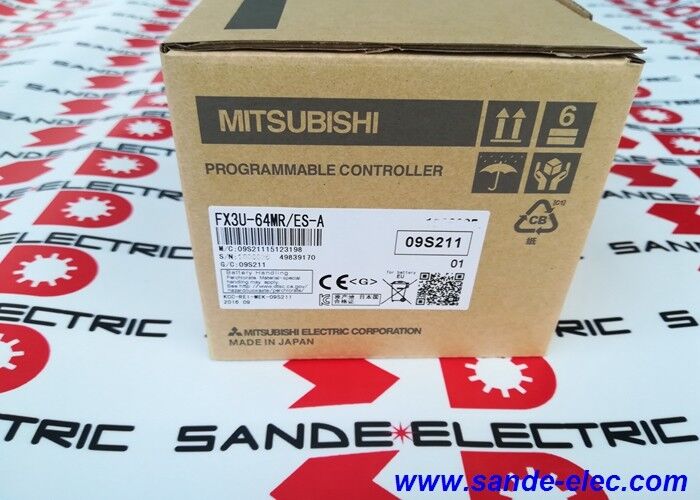
Mitsubishi FX3U-64MR/ES-A | MELSEC-F FX3U PLC — 32 DI / 32 Relay DO, 100–240V AC, 64K Steps
Part Number: FX3U-64MR/ES-A (also: FX3U-64MR/ES)
Cross Reference: FX3U64MRESA
Manufacturer: Mitsubishi Electric (Japan)
Product Type: PLC CPU Main Unit — MELSEC-F (FX) Series, FX3U
FX3U — The High-End FX Family Controller
The FX3U-64MR/ES-A is the AC-powered, relay-output variant of Mitsubishi's FX3U — the flagship of the MELSEC-F compact PLC range. With 32 24V DC sink/source inputs and 32 relay outputs, it handles a wide mix of field device types from a single unit. The relay outputs switch loads up to 240V AC or 30V DC at 2A per point, eliminating the need for intermediate relay panels in most machine control applications.
Processing speed is the FX3U's main advantage over earlier FX2N and FX1N systems. At 0.065 µs per contact instruction, the FX3U executes programs roughly 3× faster than the FX2N. For machines with tight scan-time requirements — fast conveyor control, servo positioning interlocking, or high-frequency I/O processing — this headroom matters. The 64K-step RAM program memory accommodates substantial ladder programs with plenty of room for structured programming with sub-routines and function blocks.
The built-in RS-422 port connects directly to Mitsubishi GOT HMI panels, programming tools (GX Developer, GX Works2), and serial devices, without an additional communication module. For more demanding networking requirements — Ethernet, CC-Link, or additional serial ports — the FX3U's extension board and special module slots support the full range of FX3U communication modules.
FX3U Expansion Capability
The FX3U-64MR/ES-A can expand beyond its 64 built-in I/O points. Up to 8 FX3U extension modules connect directly to the right of the main unit, adding analog I/O, high-speed counter inputs, positioning modules, and additional discrete I/O. The total local I/O capacity is 256 points. Remote I/O via CC-Link or PROFIBUS modules extends total I/O to 384 points — making the FX3U scalable from the base 64-point unit up to large distributed systems without changing the CPU.
Key Specifications
| Parameter |
Value |
| Part Number |
FX3U-64MR/ES-A |
| I/O |
32 DI + 32 relay DO |
| Supply |
100–240V AC, 45W |
| Program |
64K steps (RAM) |
| Speed |
0.065 µs / contact instr. |
| Communication |
RS-422 built-in |
| Memory Card |
64K (optional cassette) |
| Real-Time Clock |
Built-in (battery-backed) |
| Dimensions |
220 × 90 × 86 mm |
| Weight |
1.0 kg |
| Certifications |
UL, cUL, CE |
FAQ
Q1: The FX3U-64MR/ES-A is the relay output version. When should the transistor output version (FX3U-64MT/ES) be chosen instead?
Relay outputs switch any AC or DC load up to 240V AC / 30V DC and are the natural choice for contactors, solenoid valves, and pilot lights. Transistor outputs are faster (< 0.2ms vs 10ms for relays) and have no mechanical wear — the right choice when outputs must switch at high frequency (more than a few cycles per minute) or when PWM control of DC loads is needed. High-speed positioning outputs and stepper/servo pulse outputs also require the transistor variant.
Q2: The GX Developer software is installed but cannot communicate with the FX3U-64MR/ES-A. What should be checked?
The built-in RS-422 port requires an FX-USB-AW (or SC-09) USB-to-RS422 converter cable between the PC's USB port and the FX3U's mini-DIN 8-pin port. Verify the cable and driver are correctly installed in Device Manager. Also confirm GX Developer's serial port setting matches the converter's assigned COM port number. The FX3U does not have a USB port natively — a direct USB connection without the converter will not work.
Q3: The PLC shows a battery alarm. How often does the internal battery need replacement?
The FX3U uses a CR2032 battery (or equivalent Mitsubishi battery pack) to retain RAM program data and the real-time clock during power-off. Battery life depends on power-off duration — typically 5 years of normal use with daily power cycles, shorter with extended power-off periods. Replace the battery with the PLC powered on to avoid program loss. After replacement, verify the real-time clock retains the correct time.
Q4: Can the FX3U-64MR/ES-A replace an FX2N-64MR/ES-A in an existing machine?
Yes — the FX3U is backward compatible with FX2N ladder programs. Most FX2N programs run on the FX3U without modification. The FX3U has the same physical footprint as the FX2N (220 × 90 mm), so it drops into the same DIN rail space. Verify any special function modules used with the FX2N are also compatible with FX3U before replacing — some older special modules are FX2N-specific.
Q5: How many extension modules can the FX3U-64MR/ES-A support?
Up to 8 extension modules (FX3U-xMY series) can be connected directly to the right of the main unit, expanding the local I/O to 256 points total. Special function modules (analog, high-speed counter, positioning) are included in this count. The power budget from the main unit's internal 5V supply limits the number of expansion modules; verify the combined current draw of all connected modules does not exceed the FX3U's 5V bus capacity.



 Your message must be between 20-3,000 characters!