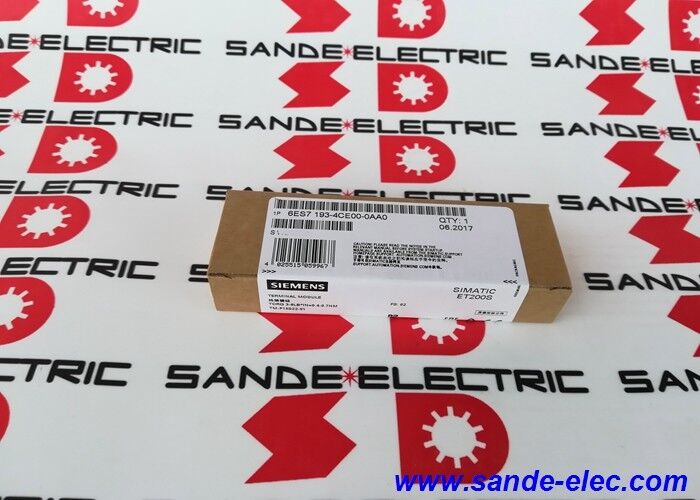
Siemens 6ES7193-4CE00-0AA0 SIMATIC DP Terminal Module
Overview
The 6ES7193-4CE00-0AA0 is a SIMATIC DP terminal module TM-P15S22-01 for ET 200S.
Siemens identifies it specifically as a terminal module for power modules, 15 mm width, with screw terminals, 2 × 2 terminal connections, without terminal access to AUX1, and with AUX1 continuous. Siemens also lists it as a spare part, which places it directly in lifecycle support and installed-base replacement for ET 200S station hardware.
This is a structural ET 200S hardware component rather than a signal electronics module. Its role is to provide the correct terminal and mounting base for compatible ET 200S power modules.
In systems already built around ET 200S terminal-module architecture, the exact TM-P15S22-01 format is important because terminal modules define the physical and wiring-side arrangement of the installed station.
Technical Data
| Parameter |
Value |
| Part Number |
6ES7193-4CE00-0AA0 |
| Manufacturer |
Siemens |
| Product Type |
SIMATIC DP terminal module TM-P15S22-01 |
| System |
ET 200S |
| Intended Use |
For power modules |
| Width |
15 mm |
| Terminal Type |
Screw terminals |
| Terminal Connections |
2 × 2 terminal connections |
| AUX1 Access |
Without terminal access to AUX1 |
| AUX1 |
Continuous |
| Height |
119.5 mm |
| Depth |
43 mm |
| Weight |
Approx. 55 g |
| Delivery Quantity |
1 piece |
| Product Lifecycle Context |
Spare part |
Application Value
This terminal module is suited to ET 200S station assembly and replacement, especially where the installed system already uses ET 200S power modules with the TM-P15S22-01 base arrangement.
Because terminal modules define how the electronics and the field-side wiring are mechanically and electrically organized, keeping the same terminal module helps preserve the original station structure and field-connection layout.
It is especially relevant in maintenance environments where ET 200S hardware is already installed and the objective is to maintain compatibility at the terminal and station-assembly level. Siemens’ classification of the part as a spare part supports that role directly.
Selection Notes
The key checks are the ET 200S platform, the TM-P15S22-01 designation, the 15 mm width, the screw-terminal format, and the fact that the module is intended for power modules with no terminal access to AUX1 and AUX1 continuous.
These points define whether the replacement matches the original ET 200S base structure.
FAQ
Q1: What kind of product is 6ES7193-4CE00-0AA0?
It is a SIMATIC DP terminal module TM-P15S22-01 for ET 200S. Siemens defines it as a terminal module for power modules, not as a CPU, communication processor, or ordinary signal I/O card. Its function is tied to station assembly and terminal arrangement.
Q2: Why is the terminal-module type important on ET 200S?
Because ET 200S hardware is built around specific terminal bases that determine how modules are mounted and how field wiring is brought into the station.
Siemens identifies this exact part as TM-P15S22-01, and that designation is one of the most important compatibility points when replacing a terminal module in an installed ET 200S system.
Q3: What does “for power modules” mean on this model?
It means the terminal module is intended for the ET 200S power-module side of the station, not for every module type in the system.
Siemens states that directly in the datasheet, so the intended electronics module class should match before ordering a replacement.
Q4: Why do the AUX1 details matter?
Siemens specifies this model as without terminal access to AUX1 and with AUX1 continuous. Those details matter because they affect the terminal layout and how auxiliary potential is carried through the station.
In ET 200S systems, terminal-module details like this are part of the correct base configuration.
Q5: What should be checked before ordering?
Check the installed part number, confirm the station is ET 200S, verify that the original base is TM-P15S22-01, and make sure the installed configuration depends on the same 15 mm width, screw terminals, and AUX1 arrangement.
Those are the main matching points for this module.



 Your message must be between 20-3,000 characters!