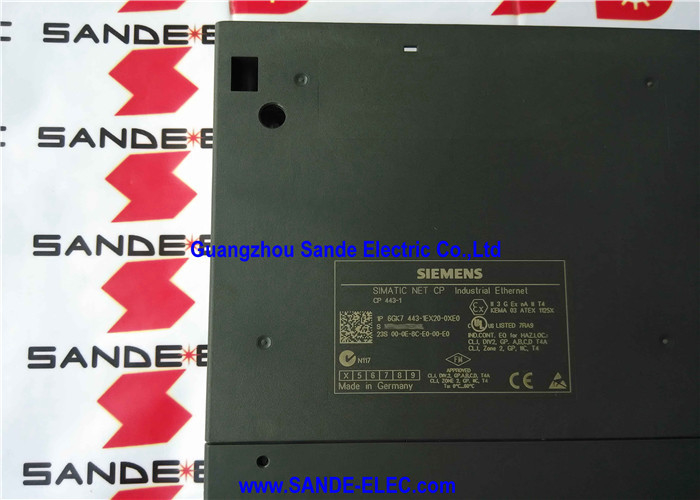
Siemens 6GK7443-1EX20-0XE0 | CP 443-1 Communications Processor — S7-400 Industrial Ethernet, Dual RJ45 10/100 Mbit/s, PROFINET IO Controller, 128 Connections, SNMP V2 / DHCP / Web Diagnostics
Overview
The Siemens 6GK7443-1EX20-0XE0 is the CP 443-1 communications processor for the SIMATIC S7-400 — the Industrial Ethernet interface module that connects the S7-400 PLC rack directly to 10/100 Mbit/s Ethernet networks while simultaneously acting as a PROFINET IO controller for distributed I/O systems.
In the S7-400 module hierarchy, the CP 443-1 plugs into the backplane alongside CPU modules and carries the full network communication load independently from the CPU, offloading Ethernet protocol processing so the CPU remains focused on its PLC program execution without communication overhead degrading scan cycle performance.
The EX20 variant's most distinctive hardware feature is its integrated two-port real-time switch built around the ERTEC 400 chip.
The two RJ45 ports are not two independent network connections — they share one IP address and form a switch that allows the module to participate in both linear (daisy-chain) and ring topologies without an external switch.
This is directly relevant for PROFINET IO installations where the linear topology through device-to-device connections reduces hardware cost and cabinet space compared to star-wired architectures requiring a central switch at every tier.
The ring topology, when combined with Media Redundancy Protocol (MRP), allows the network to recover from a single cable or switch failure automatically, keeping the PROFINET IO devices online during fault conditions.
At 128 active connections in multi-protocol mode, the CP 443-1 EX20 can simultaneously maintain a mixture of S7 data exchange connections, open TCP/IP socket connections, PROFINET IO controller links, and SEND/RECEIVE sessions with S5-compatible devices — all active concurrently and all managed independently by the CP's own processor.
The CP appears to the S7-400 CPU as a standard module in the rack, with data exchange handled through shared CPU memory areas defined in NetPro during configuration.
Key Specifications
| Parameter |
Value |
| Product Designation |
CP 443-1 |
| Interfaces |
2 × RJ45 (integrated ERTEC 400 switch) |
| Transfer Rate |
10/100 Mbit/s (autosensing) |
| Max Active Connections |
128 (multi-protocol) |
| Protocols |
ISO, TCP/IP, UDP (with/without RFC 1006) |
| PROFINET IO |
Controller (up to 32 IO devices with prioritised startup) |
| S7 Communication |
Yes (PUT/GET, S7 routing) |
| Fetch/Write |
Yes (S5-compatible) |
| SEND/RECEIVE |
Yes (open communication) |
| Multicast |
Yes (UDP) |
| Network Services |
DHCP, SNMP V2, web diagnostics |
| Security |
IP access control list |
| Configuration |
STEP 7 / NetPro |
| Status |
Discontinued |
Communication Services — What Each Mode Provides
The CP 443-1's value in a plant network comes from the breadth of communication modes it supports simultaneously. Each mode serves a distinct integration purpose:
S7 communication (PUT/GET) is the native Siemens-to-Siemens data exchange protocol.
It allows S7-400 CPUs to read and write data directly to other S7 controllers — S7-300, S7-400, or S7-1500 via gateway — using PUT and GET program blocks.
This is the standard for inter-PLC coordination in multi-controller production lines, where one controller needs to read process values or write setpoints to another controller across the plant network.
Fetch/Write provides backward compatibility with legacy SIMATIC S5 systems that use the older S5 connection model.
In plants where both S7-400 and older S5 systems coexist, the CP 443-1's Fetch/Write capability maintains communication with the legacy hardware without requiring protocol conversion equipment.
SEND/RECEIVE (open communication) implements TCP/IP or ISO socket connections for communication with non-Siemens systems — SCADA servers, MES platforms, quality systems, ERP integration points, and third-party controllers that communicate over standard Ethernet.
The SEND and RECEIVE function blocks in the S7-400 CPU's program handle the data passing to and from the CP for these connections.
PROFINET IO Controller connects distributed I/O systems — ET 200S, ET 200M, ET 200SP, PROFINET-capable drives, and instruments — directly to the S7-400 CPU via the Ethernet network, without needing a separate PROFIBUS fieldbus infrastructure.
The CP 443-1 EX20 manages the cyclic IO data exchange with up to 32 PROFINET IO devices that support prioritized startup, and handles all PROFINET real-time communication independently from the CPU program cycle.
ERTEC 400 Integrated Switch — Topology and Redundancy
The ERTEC 400 chip inside the CP 443-1 EX20 is the same silicon used in Siemens' SCALANCE X industrial switches for PROFINET applications.
Its integration into the CP module means that two RJ45 ports on the module face plate are managed switch ports sharing the module's single Ethernet address — not two separate network interfaces.
In a linear topology, the CP's two ports connect to the device in front and behind in a daisy chain, creating a single Ethernet segment that threads through multiple devices without requiring a star-wired switch at each node.
In a ring topology (when MRP is enabled), the last device's second port connects back to the first, forming a closed ring.
The MRP standard defines how one device in the ring acts as Ring Manager, continuously monitoring ring integrity and activating an alternate path in less than 200 milliseconds when a ring break is detected.
For PROFINET IO systems where maintaining IO communication continuity is important — particularly in applications where sensor or actuator data loss during a fault could create safety issues or process quality problems — the ring topology with MRP provides a cost-effective redundancy mechanism that uses only the cables and ports already present in the installation.
IP Access Control List — Security at the Network Layer
The IP access control list (ACL) function allows the CP 443-1 to accept or reject incoming connections from specific IP addresses or IP address ranges.
This provides a network-layer access control that limits which external systems can initiate connections to the S7-400 CPU via the CP.
In a plant environment where the OT (Operational Technology) network connects to corporate IT systems or cloud infrastructure, an IP ACL on the CP creates a defined perimeter: only SCADA servers, engineering workstations, and HMI systems with configured IP addresses can establish connections, while all other network traffic is blocked at the CP.
This is not a replacement for a properly designed network architecture with firewalls and network segmentation, but it provides a meaningful additional layer of protection against unintended or malicious access to the PLC via the Ethernet interface.
FAQ
Q1: The CP 443-1 EX20 has two RJ45 ports. Can it connect to two different subnets simultaneously?
No. The two RJ45 ports are ports on the module's integrated ERTEC 400 switch and share a single IP address — they are not two independent network interfaces on different subnets. Both ports belong to the same Ethernet segment.
The dual-port design supports linear and ring topologies within a single network. For multi-subnet communication (connecting the S7-400 to multiple independent networks), multiple CP 443-1 modules installed in the same S7-400 rack would be required.
Q2: The maximum active connections are listed as 128. How does this distribute across the different communication modes?
The 128-connection limit is the total across all active protocol modes simultaneously.
The allocation between S7 communication, SEND/RECEIVE ISO-on-TCP/ISO/UDP, and PROFINET IO is configured in NetPro and consumed from the shared pool. PROFINET IO device connections consume from the same pool as other connections.
The actual allocation depends on the specific application requirements — a system with many PROFINET IO devices consumes more connections from the pool, leaving fewer available for S7 and SEND/RECEIVE simultaneously.
The CP 443-1's operating manual provides detailed connection budget tables for planning the maximum configuration.
Q3: Can the CP 443-1 EX20 be used with S7-400H redundant CPUs?
Yes, the EX20 can be used as a replacement module in H-CPU configurations, including with H-CPUs running firmware V4.0 and above.
However, there are limitations: SSEND/SRECV mode on the SEND/RECV interface is not supported with H-CPUs, and PROFINET IO is not supported with H-CPUs.
For H-system applications requiring PROFINET IO, the advanced CP variant must be specified. S7 communication and standard SEND/RECEIVE in other modes function correctly with H-CPUs.
Q4: What configuration software is required to set up the CP 443-1 EX20?
The CP 443-1 EX20 is configured using SIMATIC STEP 7 (Classic) with the NetPro network configuration tool.
In STEP 7, the CP module is added to the S7-400 hardware configuration, and then NetPro is used to define the connections — S7, SEND/RECEIVE, PROFINET IO assignments, and all network parameters including IP address, subnet, DHCP settings, and the IP access control list.
The TIA Portal does not natively configure the CP 443-1 EX20 for S7-400; STEP 7 Classic remains the appropriate tool for this module generation.
Q5: The 6GK7443-1EX20-0XE0 is discontinued. What is the recommended successor?
Siemens recommends the CP 443-1 EX31 (6GK7443-1EX31-0XE0) as the successor to the EX20.
The EX31 retains the same basic feature set and physical interface (dual RJ45, ERTEC-based switch) while adding a coated circuit board for operation in ambient temperatures up to 70°C — wider than the EX20's standard operating range.
The EX31 is a drop-in replacement for the EX30 and EX20 in most applications.
For new S7-400 projects, Siemens also recommends evaluating the migration path to S7-1500 with its native PROFINET integration, which eliminates the need for a separate CP module.



 Your message must be between 20-3,000 characters!