Home
>
Products
>
PLC Programmable Logic Controller
>
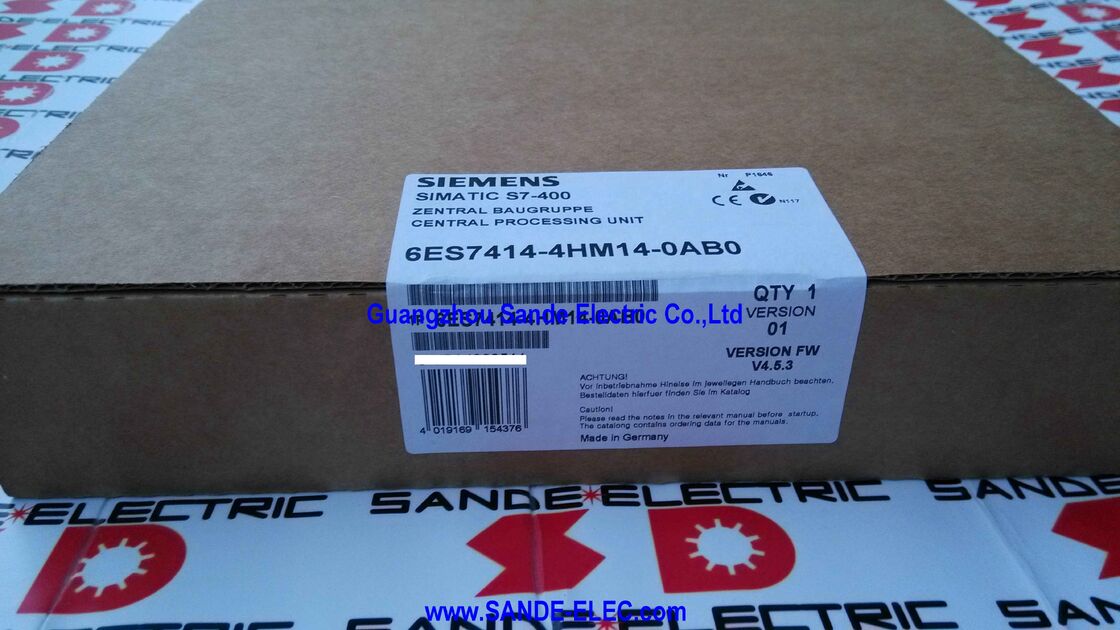
The S7-400H platform offers a progression of H-CPUs, each stepping up in memory, interface count, and processing capacity to match larger and more complex installations. The CPU 414H occupies a significant middle position in this family.
Its predecessor in the range — the CPU 412H (6ES7412-3HJ14-0AB0) — provides 768KB total memory.
The CPU 414H triples that to 2.8MB, split equally between data and program, and adds a second dedicated PROFIBUS DP interface that the 412H lacks. Above the 414H sit the CPU 417H variants, which scale to 20MB total memory with additional interfaces for the most demanding continuous process automation programmes.
For process plants where the automation programme must handle hundreds of PID control loops, extensive PROFIBUS I/O networks on multiple segments, and large data structures for process historian buffering and recipe management, the 414H's 2.8MB combined with two independent PROFIBUS DP interfaces is a meaningful step up from the entry-level H-CPU.
The second dedicated DP interface allows the controller to manage separate PROFIBUS networks — for example, one segment for drives and variable-speed equipment, another for instrumentation and transmitters — without sharing bus bandwidth between unlike device types.
| Parameter | Value |
|---|---|
| Total Memory | 2.8 MB (1.4 MB data + 1.4 MB program) |
| MPI/DP Interface | 1 × 12 Mbit/s RS-485 |
| DP Interface | 1 × 12 Mbit/s RS-485 |
| Sync Interfaces | 2 × (for IF 960 FO modules) |
| Max. Expansion Racks | 21 |
| Power Loss | 6W typical |
| Dimensions (H×W×D) | 290×50×219mm |
| Weight | 0.995 kg |
| System Types | S7-400H, S7-400F/FH |
| Status | Discontinued spare |
The two synchronisation module interfaces on the CPU 414H are the physical foundation of the entire H-system redundancy mechanism.
Each interface accepts a pluggable IF 960 synchronisation submodule — a fibre-optic transceiver that connects to the corresponding submodule in the partner CPU rack via a fibre-optic cable.
The fibre-optic medium is deliberate: it provides complete galvanic isolation between the two CPU racks, eliminates the common-mode voltage problems that can affect electrical synchronisation cables in industrial environments, and operates reliably over the distances (up to approximately 10m on the standard short-range versions) that typically separate the two racks in an H-system installation.
Two independent sync links are mandatory rather than optional.
The S7-400H's redundancy can only be maintained if the synchronisation channel itself is redundant — a single sync link failure that disabled the synchronisation mechanism would degrade a fully redundant H-system to a single-CPU system with no failover capability.
With two independent sync paths through two separate fibre cables, a failure in one sync path generates a maintenance alarm but does not impair the CPU pair's ability to synchronise and maintain hot-standby readiness.
The S7-400H's system diagnostics detect and report single sync path faults, giving maintenance staff time to restore the degraded link before any process-impacting event occurs.
The CPU 414H supports a maximum of 21 expansion racks in addition to the central rack — a total of 22 physical racks in the largest possible configuration.
Each rack accommodates signal modules, function modules, and communication processors, with each rack contributing up to 8 additional module slots to the station. At 8 modules per rack across 22 racks, a fully built-out CPU 414H station can host upwards of 176 module positions.
In practical terms, continuous process plant automation rarely builds S7-400H stations to their absolute maximum.
The 21-rack expansion capability exists to accommodate the scaling needs of large integrated process units — a refinery distillation unit, a chemical reactor complex, a large water treatment plant — where a single S7-400H station may control several hundred field instruments, multiple drives, and dozens of discrete equipment items.
The 414H's capacity is calibrated to handle these genuinely large programmes without requiring the station to be broken into multiple communicating controllers, which would add engineering complexity and potential failure points to the architecture.
The CPU 414H is certified for use in S7-400F/FH configurations — systems that combine the H-system's hardware redundancy (hot-standby CPU pairs) with IEC 61508-certified functional safety. In S7-400F/FH operation, the CPU executes both a standard user programme and a safety programme.
The safety programme implements the Safety Instrumented Functions (SIFs) defined in the facility's safety requirements specification, and runs on safety-rated F-CPUs with the PROFIsafe communication protocol extending certified safety across the PROFIBUS DP network to F-peripherals.
The F/FH configuration is the complete safety and availability solution for hazardous area process installations: the H-redundancy prevents unplanned shutdowns due to controller hardware faults, while the F-certification ensures that the safety instrumented functions achieve the required Safety Integrity Level (SIL 1, 2, or 3 depending on the application) as defined by the process hazard analysis.
In facilities like upstream oil and gas production platforms, refineries, and chemical plants, the combination of continuous availability and certified safety in the same controller is not a luxury feature but a regulatory and operational requirement.
The CPU 414H was discontinued by Siemens effective 01.02.2017, which means it is no longer manufactured or distributed through Siemens's standard sales channels. However, discontinued does not mean unavailable.
Siemens typically commits to spare parts availability for ten years post-discontinuation for critical industrial products — a policy that covers many currently operating S7-400H installations. Beyond the Siemens spare parts window, the industrial surplus and refurbishment market holds substantial stocks of tested and warranted CPU 414H units.
For sites operating S7-400H systems with CPU 414H units, the minimum recommended spare stock is one complete set of H-CPU modules — two units of the 6ES7414-4HM14-0AB0, since both racks require identical CPUs. An unmatched CPU pair (different firmware versions, or one original and one refurbished with slightly different production dates) can still function but may require firmware harmonisation.
Holding matched spare pairs simplifies emergency replacement and eliminates the need to manage firmware compatibility under time pressure during an unplanned outage.
Q1: The CPU 414H has two PROFIBUS DP interfaces — the MPI/DP combined interface and the dedicated DP interface. Are both available simultaneously, and can they connect to different PROFIBUS DP networks?
Yes, both PROFIBUS DP interfaces can operate simultaneously, and they can connect to separate, independent PROFIBUS DP networks. In the STEP 7 hardware configuration, each interface is assigned its own PROFIBUS network with its own bus parameters (bus address, transmission speed, timing parameters).
The CPU 414H operates as DP master on both networks independently — scanning slaves on network 1 and network 2 in interleaved fashion within each PLC scan cycle.
This dual-master capability is particularly valuable in large process plants where separating instrumentation (transmitters, analysers) from drive equipment (variable frequency drives, soft starters) onto independent bus segments reduces cross-network interference and simplifies troubleshooting by isolating fault domains.
The MPI/DP interface can also be configured in MPI mode rather than DP mode when a PROFIBUS DP master function is not needed on that physical interface — for example, to use it exclusively for programming terminal access and HMI connections.
Q2: What is the switching time (failover time) when the CPU 414H active CPU fails and the standby CPU takes over?
The failover time in a correctly configured S7-400H system with CPU 414H is within the PLC scan cycle — typically in the range of several milliseconds to a few tens of milliseconds depending on the system configuration, communication load, and the number of PROFIBUS DP slaves. During normal hot-standby synchronisation, both CPUs execute the same programme with the same data in each scan cycle.
The synchronisation mechanism ensures that the standby CPU's memory state — outputs, data blocks, timers, counters — mirrors the master CPU at every scan boundary.
When the master fails, the standby CPU declares itself active and begins controlling outputs immediately, without executing a restart sequence or re-reading inputs from a cold state.
From the field devices' perspective, the outputs continue to hold their last valid state with no perceptible interruption; from the PROFIBUS DP slaves' perspective, the master continues polling them without missing a cycle.
Q3: Can the CPU 414H operate in a single-CPU non-redundant mode if the second CPU is removed for maintenance, and what are the implications?
The CPU 414H can operate in single-CPU mode — when only one unit is installed in its rack, or when the synchronisation link between the two CPUs is absent, the S7-400H system continues running on the available CPU. This mode is referred to as single operation or degraded mode.
The system generates a diagnostic alarm indicating that full redundancy is not available, and the STEP 7/WinCC operator interface displays a corresponding status message.
In this degraded state, the functioning CPU continues all process control, PROFIBUS DP communication, and HMI data provision normally — but any hardware fault affecting that single CPU would result in a process shutdown, since there is no partner CPU to take over.
For planned maintenance — replacing a failed sync submodule, performing preventive maintenance on one CPU rack — operating in degraded mode for a brief, managed period is acceptable and designed for. Prolonged operation in degraded mode significantly increases the risk profile of the installation.
Q4: What is the significance of the memory split — 1.4MB data and 1.4MB program — for programme development, and can user data blocks consume programme memory or vice versa?
In the SIMATIC S7-400H, the working memory (RAM that the CPU uses for active programme execution) is divided at manufacture into a fixed code (programme) partition and a fixed data partition, and these partitions are not interchangeable. Programme code — OBs, FCs, FBs, the compiled instruction sequences — consumes code memory; data blocks (DBs), including instance DBs, shared DBs, and recipe storage — consume data memory.
A programme that has many complex control algorithms but relatively small data sets will fit comfortably within the 1.4MB code limit while using only a fraction of the 1.4MB data allocation.
Conversely, a programme with relatively simple control logic but large recipe tables, historian buffers, or extensive alarm data structures may fill the 1.4MB data memory while leaving code memory largely empty. Programme developers working with the CPU 414H should monitor both memory areas independently during development.
Load memory (Flash/EPROM or memory card) holds the saved copy of the programme; working memory holds the actively executing copy; only working memory partitioning matters for execution time sizing.
Q5: Is STEP 7 V5.x the only programming environment for the CPU 414H, or can TIA Portal be used?
The CPU 414H, as part of the classic SIMATIC S7-400H platform, is programmed using STEP 7 Professional V5.x — the traditional STEP 7 Classic environment.
TIA Portal does not support the S7-400H CPU family for programming; TIA Portal's S7-400 support covers standard S7-400 CPUs (non-H), and the current-generation high-availability platform supported in TIA Portal is the S7-1500H. Engineering a CPU 414H in TIA Portal is not possible.
If a site has standardised on TIA Portal for all other PLC programming, the S7-400H programme must still be maintained and extended using STEP 7 V5.5 or STEP 7 Professional. Siemens has committed to supporting STEP 7 V5.x for the existing installed base of S7-300 and S7-400 systems; updates and security patches continue to be available even as the primary development focus has shifted to TIA Portal.
![]()
Contact Us at Any Time