

 Home
>
Products
>
PLC Programmable Logic Controller
>
Home
>
Products
>
PLC Programmable Logic Controller
>

|
| Place of Origin | GERMANY |
| Brand Name | SIMENS |
| Certification | CE RoHS |
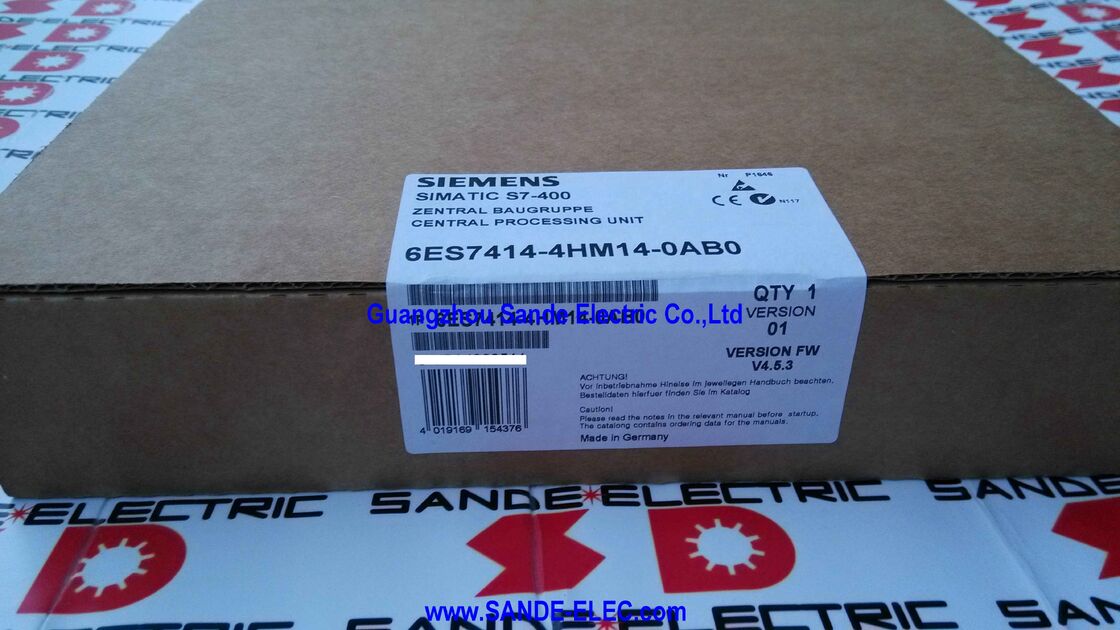
| Model Number | 6ES7414-4HM14-0AB0 |
In the S7-400H CPU family, the 414H occupies the capable middle ground. Entry-level CPU 412H tops out at 768KB. The 414H triples this to 2.8MB — enough for hundreds of PID loops, large data structures, recipe tables, and historian buffers common in continuous process automation. Its second dedicated PROFIBUS DP interface allows independent bus segments for drives and instrumentation, keeping unlike device types off each other's network.
Above the 414H sit the CPU 417H variants at up to 20MB. For most process plants — a distillation unit, a reactor complex, a large water treatment facility — the 414H's combination of memory, dual DP, and 21-rack expansion capacity is the practical ceiling before costs begin to outpace requirements.
| Parameter | Value |
|---|---|
| Total Memory | 2.8 MB (1.4 MB data + 1.4 MB program) |
| MPI/DP Interface | 1 × 12 Mbit/s |
| DP Interface | 1 × 12 Mbit/s |
| Sync Interfaces | 2 × (IF 960 fibre-optic) |
| Expansion Racks | 21 |
| Power Loss | 6W |
| Dimensions | 290 × 50 × 219mm |
| Weight | 0.995 kg |
| Compatible Systems | S7-400H, S7-400F/FH |
The CPU 414H's two synchronisation interfaces are where the H-system's failover capability physically resides. Each accepts a pluggable IF 960 submodule that connects to the matching submodule in the partner CPU via fibre-optic cable — galvanically isolated, immune to common-mode voltage, and reliable over the typical inter-rack distances in an H-system installation.
Two sync paths are not redundancy for comfort. They are a structural requirement. A single sync link failure would reduce the H-system from fully redundant to effectively non-redundant. With two independent fibre paths, a single sync failure generates a maintenance alert without degrading the CPU pair's hot-standby capability. Both CPUs continue executing the same programme in lockstep until the degraded link is restored.
The CPU 414H is certified for S7-400F/FH configurations — where Siemens combines the H-system's hot-standby hardware architecture with IEC 61508-certified functional safety. The CPU executes a standard programme alongside a safety programme that implements the facility's Safety Instrumented Functions. PROFIsafe extends certified safety across the PROFIBUS DP network to F-peripherals.
For upstream oil and gas platforms, refineries, and chemical plants, where regulatory requirements mandate both continuous availability and certified SIL compliance, the F/FH configuration is not optional — it is how the risk profile of the installation is met.
The CPU 414H was discontinued by Siemens effective 01.02.2017. Siemens typically provides spare parts availability for ten years post-discontinuation; beyond this window, tested and warranted units circulate through the industrial surplus market.
Sites operating S7-400H systems should hold a matched pair — two units of 6ES7414-4HM14-0AB0 with harmonised firmware — as minimum spare stock. Both racks of an H-system require identical CPUs. Mismatched firmware versions between a failed original and an emergency replacement can complicate restart under pressure.
Q1: Both PROFIBUS DP interfaces — can they run simultaneously on separate networks?
Yes. Both the MPI/DP interface and the dedicated DP interface operate simultaneously as independent PROFIBUS DP masters on separate networks. Each has its own STEP 7 network assignment, bus parameters, and slave list. The CPU 414H polls both networks within each scan cycle. Separating instrumentation and drive equipment onto different segments reduces inter-network interference and isolates fault domains for troubleshooting.
Q2: What is the failover time when the active CPU fails?
Failover occurs within the PLC scan cycle — typically several milliseconds to a few tens of milliseconds. During hot-standby synchronisation, both CPUs maintain an identical programme and data state at every scan boundary. When the master fails, the standby CPU declares itself active and continues output control immediately, without a restart sequence. Field devices and PROFIBUS slaves see no missed scan cycles.
Q3: Can the CPU 414H run alone if one unit is removed for maintenance?
Yes — as single operation (degraded mode). The running CPU continues all process control and communication normally, but any subsequent hardware fault on that CPU would cause a process shutdown with no failover partner. Planned degraded-mode operation for brief maintenance periods is intended in the H-system design. Prolonged operation in this state carries elevated risk.
Q4: Is the 1.4MB memory split between data and programme fixed?
Yes. The working memory partition between code (programme) and data is fixed at manufacture and cannot be reallocated. Code memory holds OBs, FCs, FBs, and compiled logic; data memory holds DBs, instance DBs, recipe tables, and alarm data. Developers should monitor both areas independently — a programme with large recipe structures may fill the data partition while code memory remains largely empty, or vice versa.
Q5: Can TIA Portal programme the CPU 414H?
No. The CPU 414H requires STEP 7 Professional V5.x (Classic). TIA Portal does not support S7-400H CPU programming. TIA Portal's S7-400 support covers standard (non-H) CPUs only; the current TIA Portal high-availability platform is S7-1500H. Sites that have standardised on TIA Portal for other PLCs must maintain a STEP 7 V5.x installation to programme and maintain S7-400H systems.
Contact Us at Any Time

