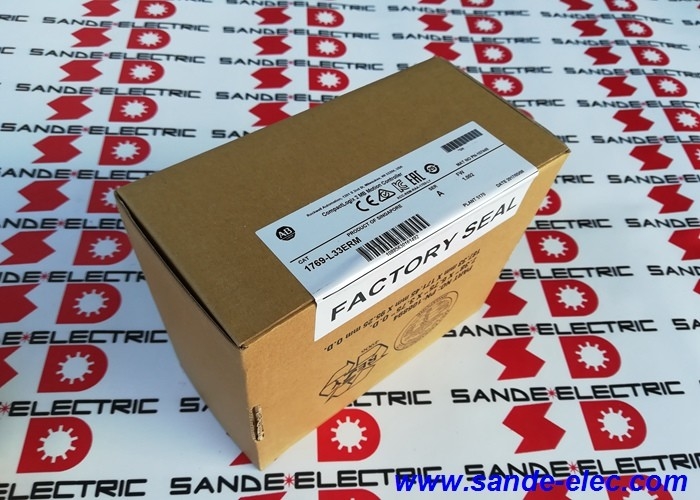
1769-L33ERM | CompactLogix 5370 L3 — 2MB / 8-Axis CIP Motion + Kinematics / Dual EtherNet/IP / DLR / 32 Nodes / 16 Local I/O
How the L33ERM Sits Above the L30ERM — and Why It Matters
The CompactLogix 5370 L3 range spans several models, and the 1769-L33ERM occupies the next tier above the 1769-L30ERM described elsewhere in this product set. The capacity difference between the two models is not incremental — it represents a doubling of nearly every functional specification:
| Specification |
1769-L30ERM |
1769-L33ERM |
| Memory |
1 MB |
2 MB |
| CIP Motion Axes |
4 |
8 |
| EtherNet/IP Nodes |
16 |
32 |
| Local I/O Modules |
8 |
16 |
For machines designed at the boundary of the L30ERM's capacity — those needing more than 4 servo axes, more than 16 network devices, or more programme and data memory than 1MB provides — the L33ERM is the correct specification from the start, not an upgrade later.
The 8-axis CIP Motion with kinematics capability defines which machine architectures are possible. Eight axes allows coordinated Cartesian gantries with 3 linear and 1 rotational axis, dual-robot pick-and-place cells with 3 axes each and two dedicated tool axes, or packaging machines with multiple servo-driven forming and cutting stations operating in synchronised cam profiles. CIP Motion runs over the same EtherNet/IP network as the machine I/O and HMI — no separate motion bus, no dedicated cable infrastructure.
Key Specifications
| Parameter |
Value |
| Memory |
2 MB |
| Ethernet Ports |
2 × EtherNet/IP |
| DLR |
Yes |
| EtherNet/IP Nodes |
32 |
| Local I/O |
16 modules |
| CIP Motion |
8 axes + kinematics |
| Width |
100mm |
| Power |
7.5W max |
| Isolation |
30V continuous |
| Status |
Active Mature |
Dual EtherNet/IP and DLR — Network Resilience at the Controller Level
Both RJ45 ports form an integrated two-port switch, enabling Device Level Ring (DLR) network topology. In a DLR ring, each EtherNet/IP device connects to the next in a closed loop. A single cable break anywhere in the ring is automatically rerouted through the surviving path — the ring heals itself within microseconds without any manual intervention or external switch involvement.
The 32-node EtherNet/IP capacity provides room for a fully populated production machine: 8 Kinetix servo drives (one per axis), 4 ET 200SP remote I/O stations, 2 vision systems, 1 robot controller, 1 weigh scale, 1 barcode scanner, and 1 HMI panel — all within the controller's node budget.
Application Scenarios
Automated assembly with multi-robot coordination: Two 4-axis SCARA robots in one CompactLogix project. Each robot's 4 kinematic axes run as a coordinated group. The L33ERM handles both groups — 8 axes total — plus all I/O and HMI from one controller.
Packaging machine with 6 servo stations: Film unwinding, registration control, forming, cutting, ejection, and reject handling — each a servo-controlled station. Six axes of CIP Motion with flying cut and cam synchronisation, with 2 axes remaining for future capability addition.
Material handling with distributed I/O: 32 EtherNet/IP nodes serve remote I/O stations across a 40-metre production line, conveyor drives, and barcode scanners. DLR ring topology ensures one cable fault does not stop the line.
FAQ
Q1: What is the main practical difference between the L33ERM and the L30ERM?
The L33ERM provides 2MB memory (vs 1MB), 8 CIP Motion axes (vs 4), 32 EtherNet/IP nodes (vs 16), and 16 local I/O slots (vs 8). Both support kinematic motion groups and DLR topology. Choose the L30ERM when 4 axes and 16 nodes are sufficient; choose the L33ERM when the machine architecture requires more axes, more networked devices, or more programme memory.
Q2: What software is used to programme the 1769-L33ERM?
Studio 5000 Logix Designer is the standard development environment for the CompactLogix family. CIP Motion axis configuration, kinematic group definition, and drive commissioning are all handled within the same Studio 5000 project. Connection is via the EtherNet/IP port or the USB port for direct programming terminal access.
Q3: How many Kinetix servo drives can connect to one L33ERM?
Up to 8 Kinetix servo drives can be configured as CIP Motion axes — one per axis. Kinetix 300, 350, 5100, 5300, 5500, and 5700 series drives with EtherNet/IP interfaces are compatible. Each drive consumes one EtherNet/IP connection from the controller's 32-node budget.
Q4: Is the L33ERM currently in production?
Yes — Active Mature status indicates the product is actively available and supported. The CompactLogix 5380 is the next-generation successor for new designs. For existing L33ERM installations requiring replacement, same-model continuity is the most reliable path to preserving the existing project without re-engineering.
Q5: Where is the 1769-L33ERM sourced?
Through the authorised distribution network for new units, and through the CompactLogix aftermarket — industrial automation spare parts dealers and tested surplus suppliers — for replacement units. Confirm the 1769-L33ERM catalog number (specifically -L33, not -L30 or -L32) before ordering to ensure the correct axis count and memory class.



 Your message must be between 20-3,000 characters!