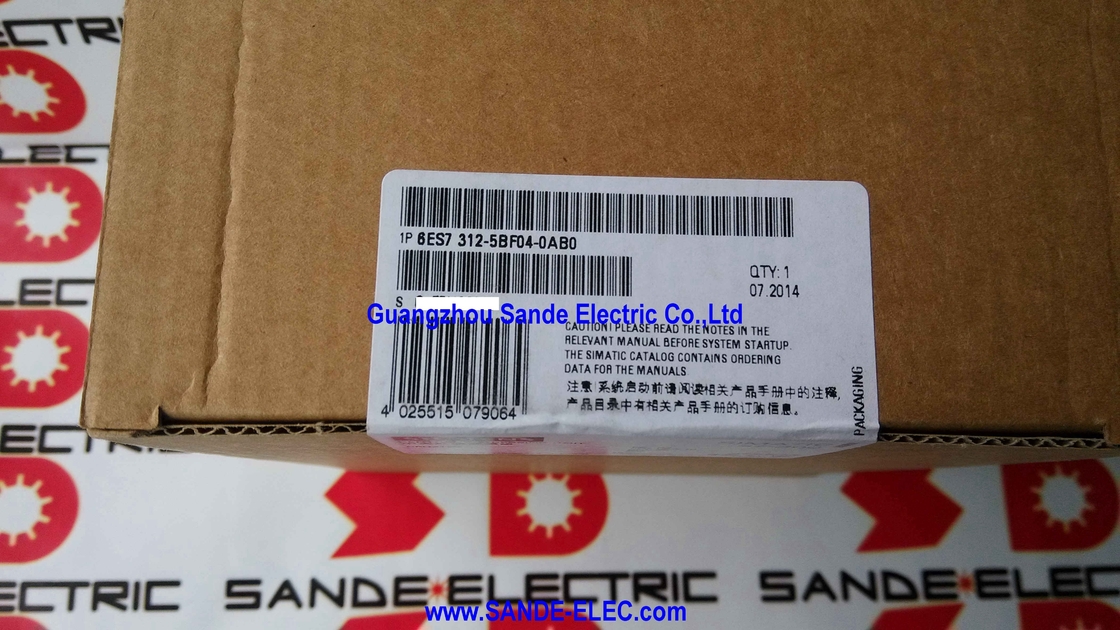
Siemens 6ES7312-5BF04-0AB0 | SIMATIC S7-300 CPU 312C — Compact / 10 DI + 6 DO / 2 × HSC 10kHz / 64KB / MPI / 24VDC / MMC Required / Phase-Out
Why "Compact" Changes the System Architecture
The "C" in CPU 312C marks the fundamental design difference from the standard CPU 312 — the C-series integrates I/O directly into the CPU module. Where the standard CPU 312 is a pure processor that requires separate signal modules for every I/O point, the CPU 312C provides 10 digital inputs, 6 digital outputs, and 2 high-speed counter inputs from the CPU housing itself.
In practice, this collapses three modules into one. A small machine that needs 10 sensors, 6 actuators, and two encoder inputs no longer requires a CPU module plus digital input module plus digital output module occupying three slots and requiring three sets of backplane connectors. The CPU 312C handles all three functions from 80mm of mounting rail. Panel space, wiring effort, and total component cost all decrease.
The CPU 312C is the right choice when the machine's I/O profile matches approximately 10 inputs and 6 outputs. For machines where the required I/O ratio differs significantly — primarily analogue signals, more outputs than inputs, or a need for relay outputs — the fixed I/O structure of the 312C is a constraint, and the standard CPU 312 or CPU 314 with freely selected signal modules is more flexible.
Key Specifications
| Parameter |
Value |
| Digital Inputs |
10 × 24V DC |
| Digital Outputs |
6 × 24V DC transistor |
| High-Speed Counters |
2 × 10kHz |
| Work Memory |
64 KB |
| Supply |
24V DC |
| Interface |
MPI |
| Execution |
0.1ms/1K instructions |
| Dimensions |
80 × 125 × 130mm |
| Status |
Phase-out |
High-Speed Counters — What 10kHz Actually Means
The two HSC inputs operate in dedicated hardware counters that run independently of the PLC scan cycle. A pulse at 10kHz completes in 100 microseconds — far shorter than any practical PLC scan. The CPU's normal digital input processing at 100ms filter time and 10ms scan cycle cannot reliably capture these signals; the hardware counters latch every pulse regardless of programme execution status.
At 10kHz the HSC inputs handle: encoders producing 10,000 pulses per revolution on a 60 RPM shaft, proximity switches counting 600 machine cycles per minute, and flow meters generating 10,000 pulses per litre at high flow rates. When faster signals or higher encoder resolution requires more than 10kHz, function modules such as the FM 350-2 (20kHz, 8 channels) provide the additional capability as separate S7-300 rack modules.
Configurable counter modes cover simple up-counting, up/down counting with a direction input, frequency measurement, and period measurement — each suited to different production monitoring and measurement tasks.
CPU 312C vs CPU 314 — Choosing Between Compact and Standard
|
CPU 312C |
CPU 314 |
| Integrated I/O |
10 DI + 6 DO + 2 HSC |
None |
| Work Memory |
64 KB |
96 KB |
| Interface |
MPI |
MPI |
| PROFIBUS DP |
No (CP 342-5 needed) |
No (CP 342-5 needed) |
| Slot Flexibility |
Fixed I/O |
Free module selection |
Both CPUs have MPI only and require a CP for PROFIBUS. The 312C saves slots and cost when its fixed I/O matches the application. The 314 provides 50% more memory and full slot flexibility but requires separate signal modules for every I/O point.
FAQ
Q1: Can additional I/O be added beyond the integrated 10 DI and 6 DO?
Yes. Standard S7-300 signal modules connect via the backplane bus on the same mounting rail. SM 321 digital inputs, SM 322 outputs, SM 323 combined DI/DQ, and SM 331/332 analogue modules all expand the system. One expansion rack via an IM 365 pair adds further capacity when the central rack is full.
Q2: Does the CPU 312C support PROFIBUS DP?
No. The MPI interface does not support PROFIBUS DP operation. For PROFIBUS DP master capability — to control distributed I/O or drive devices over PROFIBUS — a CP 342-5 communication processor module must be added to the mounting rail. For new designs requiring integrated DP, the CPU 314C-2 DP has a built-in PROFIBUS DP master/slave interface.
Q3: Can the 6 integrated outputs directly drive solenoid valves and relay coils?
Yes, for standard 24VDC loads. The transistor outputs source 24VDC and can drive 24VDC solenoid valve pilots (100–300mA) and 24VDC relay coils (50–200mA) directly. For AC loads (230VAC contactor coils) or loads exceeding the per-channel current rating, interposing relays are required. Verify the output current specifications against connected loads during design.
Q4: What is the HSC mode configuration process?
HSC modes are configured in STEP 7's HW Config parameter dialogue for the CPU 312C — selecting the mode (counting, frequency, period), the gate signal, the input address, and the counter value access. The configured parameters download with the hardware configuration. No special SFBs are needed for basic counting; for more complex counter operations, the SFB47 system function block controls the HSC from the user programme.
Q5: What is the migration path to a current Siemens platform?
Siemens recommends the S7-1500 compact CPU series — the CPU 1511C-1 PN or CPU 1512C-1 PN provide comparable integrated I/O with significantly improved performance, native PROFINET IO, and TIA Portal engineering. Migration requires rewriting the STEP 7 programme in TIA Portal; no automated direct conversion exists, but TIA Portal's migration support tools assist restructuring legacy programmes.



 Your message must be between 20-3,000 characters!