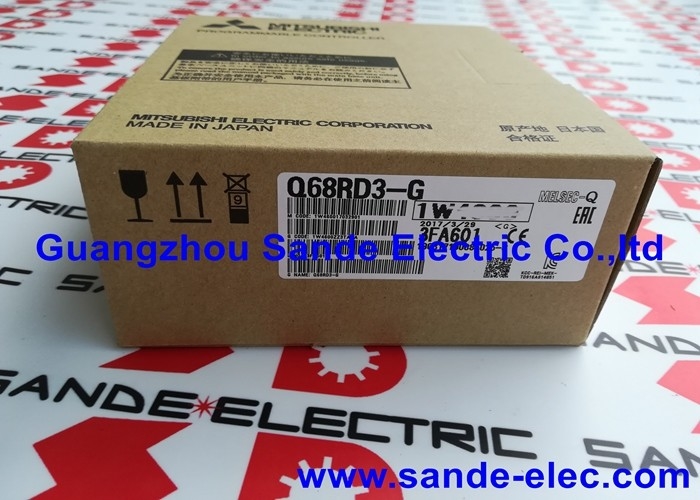
Mitsubishi Q68RD3-G | MELSEC-Q 8-Channel Channel-Isolated RTD Temperature Input Module — High Accuracy / Pt100 / System Q
Eight RTD Channels, Each Electrically Isolated
The Q68RD3-G is Mitsubishi's 8-channel high-accuracy RTD temperature input module for the MELSEC-Q (System Q) PLC platform. Eight input channels read platinum resistance thermometer signals — Pt100, JPt100, and Pt1000 sensor types connect directly. The "G" suffix identifies the channel-isolated version: each of the 8 input channels is electrically isolated from the others, and from the backplane.
This means each sensor can be connected without common potential constraints — sensors grounded at different points in the plant, sensors at different electrical potentials, and sensors in separate process zones all connect to the same module without ground loop interference or cross-channel noise.
In a standard non-isolated module, all input channels share a common reference. One sensor with a ground fault or a potential offset can corrupt readings on all other channels. Channel isolation removes this dependency — a fault on one sensor's wiring affects only that channel, leaving the remaining seven unaffected.
Key Specifications
| Parameter |
Value |
| Part Number |
Q68RD3-G |
| Platform |
MELSEC-Q (System Q) |
| Input Channels |
8 |
| Isolation |
Channel-to-channel isolated |
| Input Type |
Pt100, JPt100, Pt1000, JPt1000 RTD |
| Designation |
High accuracy (G suffix) |
| Mounting |
Q-series main base or extension base |
| Origin |
Japan |
RTD vs Thermocouple — Why Module Type Matters
The Q68RD3-G is specifically an RTD input module. RTD sensors (Pt100, JPt100) measure temperature by resistance change in a platinum wire — a more linear and more stable measurement method than thermocouples over the temperature ranges typical of industrial process equipment. Thermocouples cover higher temperatures and can measure faster transients, but RTDs provide better absolute accuracy and repeatability for sustained process temperature measurement.
The MELSEC-Q temperature module family offers both RTD input (Q68RD3-G) and thermocouple input (Q64TD, Q68TD-G series) options. Confirm the sensor type installed in the application — the two module types are not interchangeable.
FAQ
Q1: What is the benefit of channel-to-channel isolation in the Q68RD3-G?
Each of the 8 RTD input channels is independently isolated from all other channels and from the PLC backplane. A sensor with a ground fault, a potential offset, or wiring damage affects only that channel — the remaining 7 channels continue to measure accurately. In non-isolated modules, a grounding problem on one sensor can corrupt readings across all channels simultaneously.
Q2: What RTD sensor types are compatible with the Q68RD3-G?
The Q68RD3-G accepts platinum resistance thermometers: Pt100, JPt100 (Japanese standard), Pt1000, and JPt1000. These are the standard industrial RTD types used globally. Nickel RTDs and thermocouples are not compatible with this module — confirm the sensor type in the installation before specifying.
Q3: Can the Q68RD3-G be used on extension base racks, or only the main base?
The Q68RD3-G can be installed on both the Q-series main base and extension base racks. Verify the slot position and I/O assignment in the MELSEC-Q system configuration tool (GX Works2 or GX Developer) to ensure the module's address allocation does not conflict with other modules in the system.
Q4: What wiring method is recommended for Pt100 sensors on the Q68RD3-G?
3-wire RTD wiring is recommended for most industrial applications, as it compensates for lead wire resistance that would otherwise introduce measurement offset. 4-wire wiring provides the highest accuracy by completely eliminating lead resistance error. 2-wire wiring is simpler but introduces measurement error proportional to cable resistance — suitable only for short cable runs where the error is acceptable.
Q5: How is the Q68RD3-G configured and programmed in a MELSEC-Q system?
The module is configured in GX Works2 (or GX Developer for older Q-series projects). Module parameters — sensor type, averaging mode, temperature unit (°C or °F), alert settings — are set in the intelligent function module parameter editor. The Q-series CPU reads temperature data from the module's buffer memory using FROM/TO instructions or direct device access, depending on the CPU and programme structure.


 Your message must be between 20-3,000 characters!