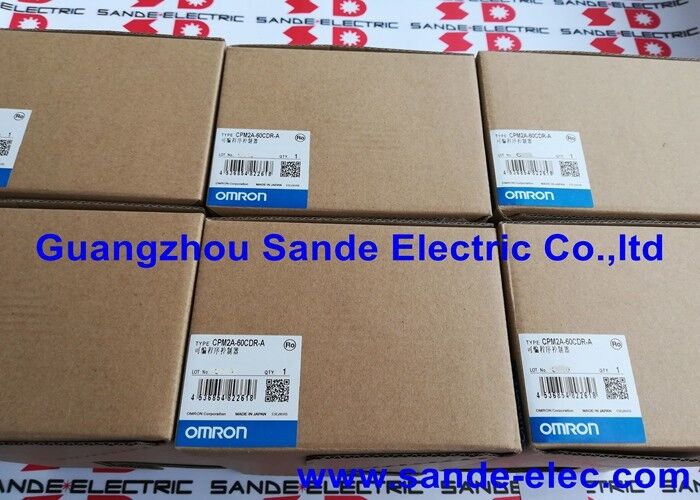
Omron CPM2A-60CDR-A | CPM2A Compact PLC — 36 DI / 24 Relay / 85–264VAC / 4K Programme / 20kHz Encoder / 0.26µs Logic / 90×195×90mm
60 Points Plus an Encoder Input — More Than a Basic Compact PLC
The CPM2A-60CDR-A packs 36 digital inputs and 24 relay outputs into a single AC-powered housing. For a compact PLC, this I/O count handles a complete machine sequence without expansion modules. Add the built-in 20kHz encoder input, and the CPM2A-60CDR-A moves beyond simple discrete control into encoder-based counting, length measurement, and speed monitoring — all within the base unit.
The 85–264VAC supply is a universal range. It connects to 100VAC, 120VAC, or 230VAC mains without hardware selection — the same unit ships to any market and powers on correctly from any standard industrial supply voltage within that range.
Logic execution at 0.26µs to 0.64µs per basic instruction is meaningfully faster than earlier CPM-series controllers. For programmes with complex ladder rungs and multiple PID or counter instructions, execution speed directly affects scan cycle time and system responsiveness.
Three expansion units can extend the CPM2A-60CDR-A system to a maximum of 120 I/O points. Expansion options include digital I/O (relay or transistor), analogue input, and analogue output units.
Key Specifications
| Parameter |
Value |
| Digital Inputs |
36 × DC |
| Digital Outputs |
24 × relay contact |
| Power Supply |
85–264V AC |
| Programme |
4K words |
| Data Memory |
2K words |
| Execution Speed |
0.26–0.64µs |
| Encoder Input |
1 ch, 20kHz |
| Expansion |
Up to 3 units (120 I/O max) |
| Dimensions |
90 × 195 × 90mm |
Built-in 20kHz Encoder Input — No Extra Module Required
The built-in encoder input accepts incremental encoder or high-speed pulse signals at up to 20kHz. This is the function that separates the CPM2A from the simpler CPM1A at the same I/O count. Position counting, conveyor length measurement, production batch counting, and shaft speed monitoring all use the hardware counter directly — without consuming a programme scan cycle to read the input and without requiring a separate high-speed counter expansion unit.
The programme accesses the encoder count value in a dedicated high-speed counter data area and can compare it to preset values, trigger outputs at specific counts, and reset the count — all using standard ladder instructions.
Application Scenarios
Conveyor length measurement: Encoder pulses from a measuring wheel connect to the 20kHz built-in counter. The programme triggers a cut or sort function when the count reaches the product length setpoint — no scan cycle delay for the trigger.
Packaging machine control: 36 sensors monitor film, product, and seal jaw positions. 24 relay outputs control actuators, motor contactors, and alarm contacts. Three expansion units add analogue channels for temperature and speed control.
Building services and HVAC: Universal supply accepts any panel voltage. Pressure, temperature, and flow switch inputs on the 36 DI channels; pump contactors, valve solenoids, and alarm outputs on the 24 relay contacts.
FAQ
Q1: How does the CPM2A-60CDR-A compare to the CPM1A-40CDR-A?
The CPM2A-60CDR-A has 60 I/O points (vs 40), 4K programme (vs 1K), a built-in 20kHz encoder input, and faster logic execution (0.26µs vs ~0.72µs). The CPM2A is the higher-capability successor platform. A programme written for the CPM1A requires verification and potential modification before running on the CPM2A due to differences in memory addressing and instruction set.
Q2: What programming software and connection is required?
CX-Programmer (CX-One suite) is the standard tool. Connection is via the built-in RS-232C peripheral port using a CPM1-CIF01 adapter and XW2Z-200S-CV (2m) or XW2Z-500S-CV (5m) cable to the PC's serial port. For USB-equipped laptops, a USB-to-RS-232C adapter presenting a virtual COM port is used.
Q3: What expansion units are compatible with the CPM2A-60CDR-A?
Compatible expansion units include CPM2A-20EDR (20-point relay output), CPM2A-20EDT (20-point transistor output), CPM2A-4AD (4-channel analogue input), and CPM2A-2DA (2-channel analogue output). A maximum of three units can be attached. The total system maximum is 120 I/O points.
Q4: Can the CPM2A-60CDR-A run PID control for process loops?
Yes. The CPM2A supports the PID instruction (PIDAT) for closed-loop process control. Analogue input values (from an expansion analogue unit) feed the process variable, the programme calculates the corrective output, and the result drives an analogue output channel. Multiple simultaneous PID loops are limited by programme memory and scan time.
Q5: Does the -A suffix refer to the power supply type?
Yes. The -A suffix identifies the AC power supply version (85–264VAC). The -D suffix indicates a DC supply version. Both use the same relay output structure and I/O count. Confirm the power supply suffix matches the installed unit before ordering a replacement.



 Your message must be between 20-3,000 characters!