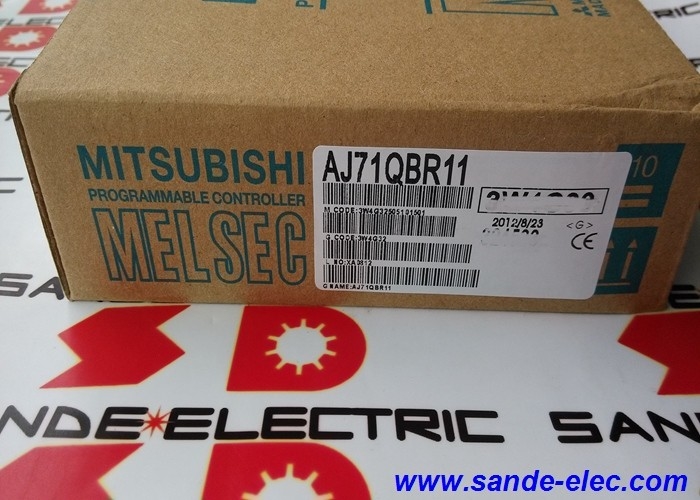
Mitsubishi AJ71QBR11 | MELSECNET/10 Coaxial Bus Network Module — 10 Mbps Token Bus
Part Number: AJ71QBR11
Manufacturer: Mitsubishi Electric (Japan)
Product Type: Coaxial Bus Network Module
Network: MELSECNET/10
Transmission: Single coaxial bus, token bus method
Speed: 10 Mbps
Keeping a Coaxial MELSECNET Network Running
The AJ71QBR11 is the coaxial bus variant of Mitsubishi's MELSECNET/10 network module family. It was designed for the 10 Mbps token bus networks that connected MELSEC-QnA PLCs in the 1990s and early 2000s — machine cells, production lines, and remote I/O architectures where the wiring was built around coaxial cable rather than fibre or twisted pair.
MELSECNET/10 runs on a token bus topology: the network passes a logical token between stations, and only the station holding the token transmits at any time. This gives the network deterministic, predictable behaviour — important for control applications where every station needs a defined update rate. At 10 Mbps over coaxial cable, the network handles both PLC-to-PLC cyclic data exchange and remote I/O with the same hardware.
The AJ71QBR11 specifically uses 3C-2V or 5C-2V coaxial cable — the thin coaxial types standard in Japanese industrial network installations of this period. The cable type, connector specification, and termination at both ends of the bus all need to be correct for the network to operate reliably. Mixing cable types or leaving termination incorrect are the two most common causes of MELSECNET/10 communication faults in aging installations.
The module appears in Mitsubishi's transition documentation as part of the migration path from older MELSEC-A/QnA hardware. That reference tells you something practical: many sites are running these networks long after the hardware was discontinued, and Mitsubishi has factored that into its support documentation. The AJ71QBR11 is very much a maintenance item at this point, sourced through the aftermarket to keep an existing coaxial network running while longer-term modernization plans are developed.
Key Specifications
| Parameter |
Value |
| Part Number |
AJ71QBR11 |
| Network |
MELSECNET/10 |
| Transmission Route |
Single coaxial bus |
| Communication Method |
Token bus |
| Speed |
10 Mbps |
| Cable Type |
3C-2V or 5C-2V |
| Application |
PLC-to-PLC, Remote I/O |
| Status |
Discontinued, aftermarket |
FAQ
Q1: What is the difference between AJ71QBR11 and fibre-optic MELSECNET/10 modules?
The AJ71QBR11 is the coaxial bus type — it uses 3C-2V or 5C-2V coaxial cable. The fibre-optic variants use optical loop wiring. Both operate on MELSECNET/10 at 10 Mbps, but the physical layer is completely different. The two types cannot be mixed in the same network segment. If the installed network uses coaxial cable, the replacement must also be the coaxial type.
Q2: The MELSECNET/10 network shows intermittent communication faults. Could the AJ71QBR11 be the cause?
Possibly, but verify the physical layer first. Coaxial MELSECNET/10 is sensitive to termination and cable condition. Confirm both ends of the bus are correctly terminated, check the cable connectors for corrosion or loose contacts, and verify no unterminated stubs or damaged cable segments exist on the trunk. Network-level faults in aging coaxial installations are more often physical-layer issues than module failures.
Q3: Can AJ71QBR11 be used with MELSEC-Q series PLCs?
The AJ71QBR11 is designed for MELSEC-QnA and compatible MELSEC-A systems. Current MELSEC-Q series PLCs use different network modules (QJ71BR11 for MELSECNET/10 coaxial). While MELSECNET/10 is the same network family, module form factors and backplane interfaces differ between QnA and Q series hardware.
Q4: What should be verified about the network configuration before replacing AJ71QBR11?
Confirm the station number (control station or normal station), the network number, and the cyclic refresh settings currently programmed in the installed module. These parameters need to be replicated in the replacement module or configured from documentation. Incorrect station setup is a common cause of post-replacement communication failures.
Q5: Where is AJ71QBR11 sourced now that it is discontinued?
Through the industrial automation aftermarket — legacy MELSEC specialist dealers and Mitsubishi PLC repair companies hold exchange stock for MELSECNET/10 modules. Request confirmation that the coaxial bus type (BR11) is available, as it is sometimes confused with fibre-optic variants in supplier listings. Functional testing on a MELSECNET/10 test rig before shipment is the best assurance of a working replacement.


 Your message must be between 20-3,000 characters!