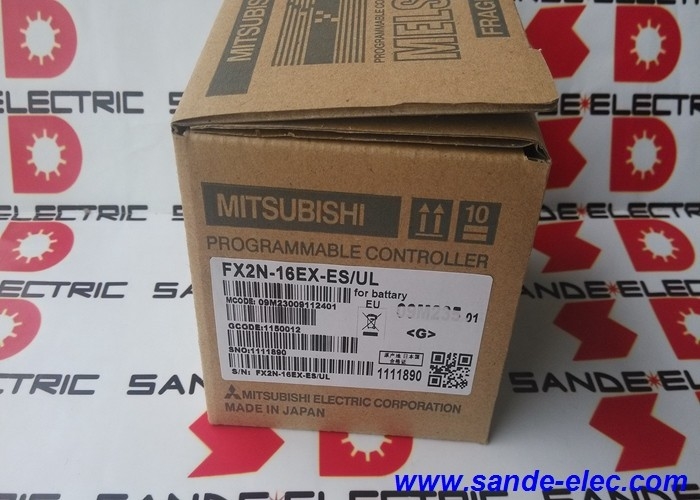
Mitsubishi FX2N-16EYT-ESS/UL | FX2N 16-Point Transistor Source Output Extension Block — 0.5A / 5–30VDC / 100–240VAC Supply / Photocoupler / UL/cUL
Extension Block with Its Own AC Supply
The FX2N-16EYT-ESS/UL is a 16-point transistor output extension block that connects to the right side of an FX2N base unit or expansion unit. What makes this block unusual is the built-in AC power supply — it accepts 100–240VAC and generates the internal regulated supply for the output driver circuits. No separate 24VDC output supply wiring is needed; connect the block to AC mains, plug it into the FX2N expansion chain, and all 16 output channels are ready.
The load itself (the field devices connected to the outputs) still requires its own 5–30VDC field supply. The module's internal AC supply powers the output stage logic, not the connected loads.
Key Specifications
| Parameter |
Value |
| Output Points |
16 |
| Output Type |
Transistor source (PNP) |
| Load Voltage |
5–30V DC |
| Per-Point Current |
0.5A |
| Isolation |
Photocoupler |
| Response |
≤0.2ms (200mA at 24VDC) |
| External Supply |
100–240VAC |
| Weight |
0.3 kg |
| Certifications |
UL / cUL |
Source (PNP) Output — High-Side Switching
Each of the 16 outputs is a sourcing (PNP) transistor — when commanded ON, it connects the positive supply to the load terminal. The load's return connects to 0V common. This is the "high-side switch" configuration used in European and many international machine tool wiring conventions where devices are wired with the return side to 0V common.
If the field devices are wired for NPN (sink) operation — positive supply fixed at the device, return to 0V switched — then a different FX2N output module variant with sink outputs would be required. Confirm the wiring convention before specifying this module.
Application Scenarios
North American market machine panels: UL-listed output expansion for FX2N systems in equipment certified for North American installation. The ESS/UL block satisfies panel-level UL documentation requirements.
PNP-wired valve arrays: 16 solenoid valve pilots on a pneumatic manifold, wired with 0V common and requiring a switched positive supply. The sourcing outputs connect directly.
FX2N expansion for extra outputs: An FX2N 40-point base unit needs more output channels. The FX2N-16EYT-ESS/UL adds 16 transistor output points with its own AC supply, extending the system without a separate power supply module.
FAQ
Q1: Is the FX2N-16EYT-ESS/UL sink or source type?
Source (PNP / sourcing) — the output terminal goes positive (to the load supply voltage) when active. The 0V side of the load connects to the common terminal. For NPN (sink) transistor outputs, a different FX2N output block model must be specified.
Q2: What FX2N base units can this extension block connect to?
The FX2N-16EYT-ESS/UL connects to FX2N series base units or to FX2N expansion units on their right side. The total number of I/O points (from base unit plus all expansion units and extension blocks) is limited by the FX2N base unit's maximum I/O capacity. Consult the FX2N hardware manual for the specific maximum.
Q3: The block has a 100–240VAC supply — does the load power also come from this?
No. The AC supply powers the module's internal logic and output driver circuits only. Field device loads (solenoid valves, relay coils, lamps) must be powered by a separate external DC supply (5–30VDC) connected to the appropriate output common terminals. The output transistors switch this external load supply, not the AC supply.
Q4: What is the maximum simultaneous output current from the 16-point common?
The per-point rating is 0.5A. The common terminal current limit must be confirmed from the FX2N-16EYT-ESS/UL hardware specifications — for the 16-point module, the outputs share a common with a total rating that limits simultaneous current. At 0.5A per point, not all 16 points can necessarily be simultaneously loaded at maximum; check the common current rating from the module datasheet.
Q5: What is the response time, and is it adequate for servo or high-speed control?
Response time is ≤0.2ms (200µs) at 200mA/24VDC. This is suitable for solenoid valves, contactors, relay coils, and indicator controls where millisecond response is adequate. For microsecond-precision output triggering in servo or high-speed motion applications, dedicated pulse output modules (not extension output blocks) are the correct specification.


 Your message must be between 20-3,000 characters!