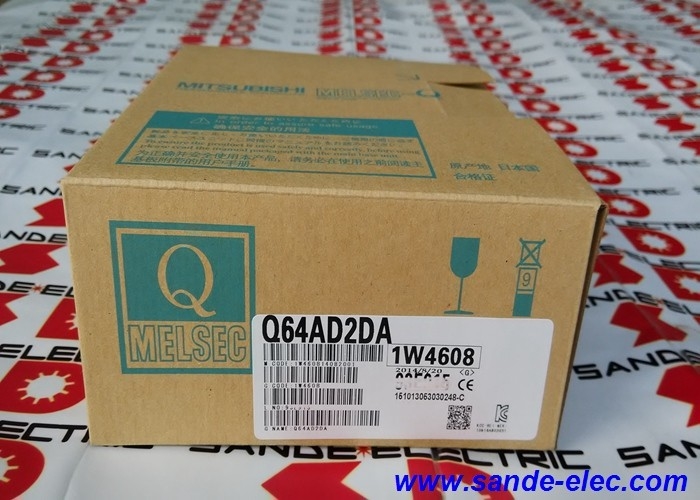
Mitsubishi Q64AD2DA | MELSEC-Q Combined Analog I/O — 4-Channel Input / 2-Channel Output / ±10V + 0–20mA / 500µs / Logging / 18-pt Terminal / 27.4mm
4 Inputs and 2 Outputs in One 27.4mm Slot
Most Q-series analogue modules are either pure input or pure output. The Q64AD2DA combines both functions in a single slot — four A/D input channels and two D/A output channels coexist in the same module. For applications that need both types of analogue signal at the same machine section, this halves the slot count and simplifies wiring compared to installing separate Q64AD and Q62DAN modules.
The split is practical for common control loop configurations: two input channels read process variable signals (pressure, temperature, flow), a third monitors a drive's analogue speed feedback, and the fourth handles a position transducer — while the two output channels drive a control valve and a variable speed drive setpoint simultaneously. All six channels run at 500µs, so no analogue conversion is waiting behind another.
Key Specifications
| Parameter |
Value |
| Analog Inputs |
4 channels |
| Analog Outputs |
2 channels |
| Input Ranges |
±10V DC, 0–20mA DC |
| Output Ranges |
±10V DC, 0–20mA DC |
| Input Resolution |
0–4000 / ±4000 / 0–12000 / 0–16000 / ±16000 |
| Output Resolution |
0–4000 / ±4000 / 0–12000 / ±16000 |
| Conversion Speed |
500µs per channel |
| Input Impedance (V) |
1 MΩ |
| Input Impedance (I) |
250 Ω |
| I/O Points |
16 |
| Terminal Block |
18-point |
| Logging |
Built-in |
| Dimensions |
98 × 27.4 × 112 mm |
| Weight |
0.23 kg |
Selectable Resolution — Five Input Modes, Four Output Modes
The Q64AD2DA is not locked to a single resolution setting. Each input channel independently selects from five digital output ranges:
0–4000: Covers the 0–20mA or 0–10V span with 4000 counts. Each count represents 0.25% of full scale.
±4000: Bipolar range for ±10V signals. The centre of the voltage range maps to 0; the extremes to ±4000.
0–12000: Extended count range. Provides finer resolution steps across the same physical signal span — useful when the programme uses the raw count directly in engineering calculations without additional scaling.
0–16000 / ±16000: Maximum resolution modes. Divides the full input range into 16,000 steps (or 32,000 steps over the bipolar range), minimising quantisation error for precision measurement.
Output channels select from 0–4000, ±4000, 0–12000, or ±16000 — the same logic applies. Setting the resolution is done through the intelligent function module parameters in GX Developer or GX Works2.
Application Scenarios
Closed-loop process control: Two input channels read pressure and temperature transmitters (4–20mA). One output channel drives a control valve (0–10V). The Q64AD2DA handles the complete measurement-to-control signal chain without separate input and output modules.
Multi-sensor machine monitoring: Four process variable inputs (force, displacement, pressure, temperature) in one module. Logging captures waveform data during machine cycles for quality and diagnostic records.
Speed regulation with feedback: Output channel provides ±10V analogue speed reference to a servo amplifier. Input channel reads the actual speed signal from the drive's analogue output for closed-loop verification.
FAQ
Q1: Can the Q64AD2DA be used in both Q-series and QnU-series systems?
Yes. The Q64AD2DA is compatible with the MELSEC-Q series main base units and with QnU-series CPUs and their base units. Both CPU families support the same intelligent function module interface, and the Q64AD2DA occupies 16 I/O points in either system's I/O map.
Q2: Can input channels and output channels be configured independently for voltage or current?
Yes. Each channel selects its signal type (voltage or current) independently through hardware wiring and software parameter settings. Input channel 1 can be set for 0–20mA current while input channel 2 operates on ±10V voltage, and the two output channels can similarly mix types.
Q3: How is the logging function accessed in the CPU programme?
The CPU reads the logging buffer from the Q64AD2DA's buffer memory (BFM) using FROM instructions. The specific BFM addresses for logging data, sampling interval, and log status are defined in the Q64AD2DA user manual's buffer memory list. GX Works2 also provides a graphical monitor screen for viewing logged waveforms directly during online diagnostic sessions.
Q4: What is the difference between the Q64AD2DA and the Q68AD2DA?
The Q64AD (the "64" part) has 4 input channels and 2 output channels in the combined version (Q64AD2DA). The Q68AD has 8 input channels. For the combined variant (8 input + 2 output), the Q68AD2DA would be specified. Choose the Q64AD2DA when four input channels are sufficient; choose the Q68AD2DA for eight-channel input requirements.
Q5: Does conversion speed change when both inputs and outputs are active simultaneously?
Each channel converts at 500µs independently. All active input channels convert at their individual 500µs rates, and both output channels also update at 500µs per channel. Total conversion cycle for all six channels in the module is not a single sequential scan — each channel's conversion hardware runs in parallel. The 500µs figure applies per channel regardless of how many channels are enabled.


 Your message must be between 20-3,000 characters!