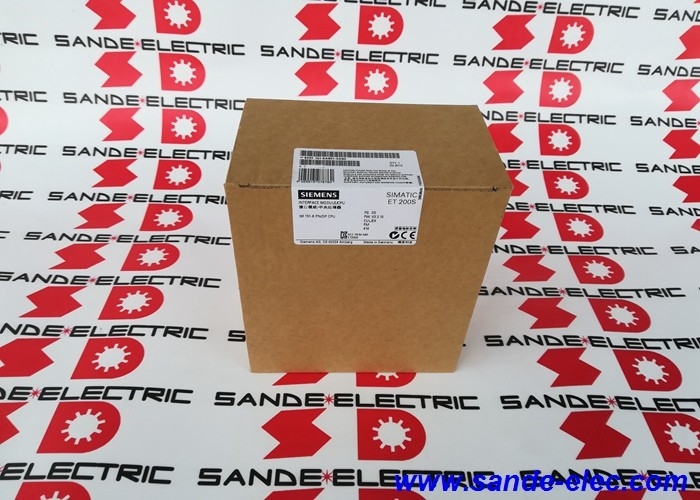
Siemens 6ES7151-8AB01-0AB0 ET 200S IM151-8 PN/DP CPU
Overview
The 6ES7151-8AB01-0AB0 is a SIMATIC ET 200S IM151-8 PN/DP CPU, positioned as a CPU within the ET 200S distributed I/O environment rather than as a simple remote interface slice.
Published Siemens data describes it as a spare-part model with 192 KB work memory, an integrated PROFINET interface with three RJ45 ports, 24 V DC supply, and the use of a Micro Memory Card.
The same datasheet shows firmware version V3.2 and hardware functional status 01 for this code.
What makes this unit particularly useful is the way it combines distributed I/O form factor with CPU-level control capability.
In practical automation design, that gives users a compact route to decentralized machine control without moving to a larger rack CPU in every cabinet.
A unit like this is especially attractive where a remote station needs local intelligence, networked communications, and direct integration into a PROFINET environment at the same time. This is an engineering inference based on the model’s CPU identity, integrated three-port PROFINET, and ET 200S system role.
Technical Data
| Parameter |
Value |
| Part Number |
6ES7151-8AB01-0AB0 |
| Manufacturer |
Siemens |
| Product Type |
CPU / I/O Module |
| System Family |
SIMATIC ET 200S |
| Model |
IM151-8 PN/DP CPU |
| Work Memory |
192 KB |
| Integrated Interface |
PROFINET, 3 × RJ45 |
| Supply Voltage |
24 V DC |
| Supply Range |
20.4 to 28.8 V DC |
| Power Loss |
Typical 5.5 W |
| Backplane Bus Current |
Max. 700 mA at 5 V DC |
| Memory Card |
MMC required, up to 8 MB |
| Firmware Version |
V3.2 |
| Product Position |
Spare part / distributed CPU |
Application Value
The 6ES7151-8AB01-0AB0 is well suited to distributed machine sections, modular equipment skids, decentralized control cabinets, and ET 200S-based automation stations where compact local control is preferred over a purely passive remote I/O node.
Siemens data shows that the unit can act as an IO Controller, supports up to 128 connectable IO devices, and provides PROFINET communications with up to three RJ45 ports, which makes it relevant in systems where multiple field devices and decentralized architecture need to coexist.
It is also valuable in lifecycle support. Because the product is listed as a spare part and still carries a complete technical datasheet, it is especially relevant to users maintaining existing ET 200S/IM151 installations rather than starting a new standard around older hardware.
In those situations, keeping the same CPU family can preserve engineering compatibility and reduce the amount of network and hardware redesign needed after replacement.
This is an engineering inference based on the spare-part designation and the detailed published CPU capabilities.
Replacement and Selection Perspective
For replacement work, this model should be matched by CPU type, PROFINET role, memory class, and ET 200S system position, not just by the ET 200S label. Buyers should verify the installed part number, the need for the IM151-8 PN/DP CPU, the engineering software environment, the MMC requirement, and the existing PROFINET/DP architecture. On distributed control platforms, those details directly affect whether the unit will fit the machine’s original network and program structure.
This is an engineering recommendation grounded in the Siemens datasheet for this exact part number.
FAQ
Q1: What kind of product is 6ES7151-8AB01-0AB0?
It is an ET 200S IM151-8 PN/DP CPU, which means it is a CPU-level control unit inside the ET 200S distributed I/O platform, not just a passive interface module.
Q2: What makes this unit useful in decentralized automation?
Its value comes from combining local CPU capability, integrated PROFINET with three RJ45 ports, and a compact ET 200S form factor.
In practice, that helps support decentralized control architectures without a large rack controller at every station.
This is an engineering inference based on the published CPU and PROFINET features.
Q3: What applications fit this model best?
It fits distributed machine stations, modular skids, remote automation cabinets, and ET 200S-based decentralized systems where local intelligence and network connectivity are both required.
This is an engineering inference based on its CPU identity and published IO-controller capability.
Q4: Why do the three RJ45 ports matter?
Because they support the integrated PROFINET architecture and give the unit practical networking flexibility inside decentralized systems.
On replacement projects, preserving that same network layout can be just as important as matching the memory size.
This is an engineering inference based on the published integrated three-port PROFINET interface.
Q5: What should be checked before ordering?
Check the installed part number, the ET 200S station role, the required CPU function, the MMC requirement, and the existing PROFINET/DP engineering setup.
Those checks usually matter more than general family similarity on distributed CPUs.



 Your message must be between 20-3,000 characters!