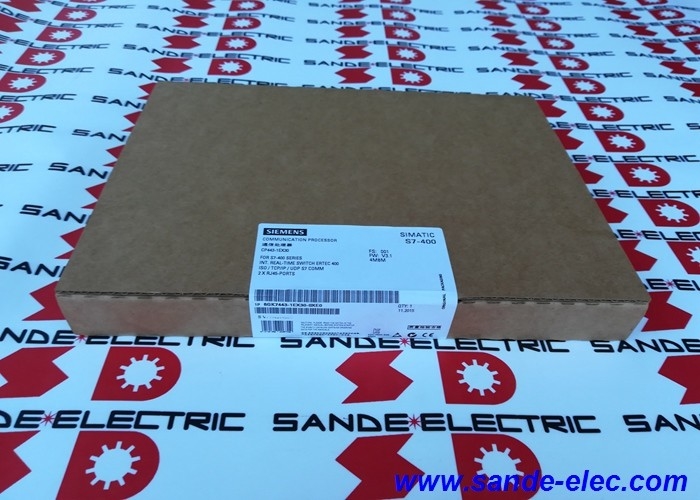
Siemens 6GK7443-1EX30-0XE0 | SIMATIC NET CP 443-1 — S7-400 PROFINET IO Controller / Dual RJ45 / 100 Mbit/s / ERTEC 400 / PROFIenergy / IP ACL
Why the S7-400 Needs a CP — And What the CP 443-1 Adds
The S7-400 CPU range, including the flagship CPU 417H, includes MPI and PROFIBUS DP interfaces at the CPU level. What it does not include is an Ethernet or PROFINET port. Every Ethernet connection from an S7-400 requires a CP 443-1 in the rack.
The CP 443-1 is not a passive network adapter — it is an independent communications processor with its own ERTEC 400 network chip, its own RAM, and its own firmware that handles all Ethernet tasks without consuming any of the S7-400 CPU's processing time.
A CPU running a demanding PID cascade programme is unaffected by PROFINET IO cyclic exchanges, TCP/IP transactions, or S7 PUT/GET requests. The CP 443-1 absorbs all of these independently and presents the results to the CPU via the S7-400 backplane at defined intervals. For a process controller running 24/7 in a critical plant application, this architectural separation between process control and network communication is a genuine operational advantage.
Key Specifications
| Parameter |
Value |
| Part Number |
6GK7443-1EX30-0XE0 |
| Network Processor |
ERTEC 400 (dedicated) |
| PROFINET Role |
IO Controller |
| Ports |
2 × RJ45 (integrated switch) |
| Speed |
10/100 Mbit/s |
| Protocols |
ISO, TCP/IP, UDP/IP |
| Features |
PROFIenergy, IP ACL, Web diagnostics |
| Power Loss |
9W |
| Dimensions |
25 × 290 × 210mm |
| Status |
Active |
Integrated 2-Port Switch — Line Topology Without External Switches
The CP 443-1's two RJ45 ports are not two independent network connections — they form a 2-port integrated Ethernet switch. For PROFINET IO installations, this enables line (daisy-chain) topology: the network cable runs from one device's RJ45 port into the next without any intermediate switch at each station. A twenty-device production line runs on a single cable path; no panel space consumed by intermediate switches, no additional hardware cost per segment.
For larger plant installations where star topology through a central managed switch is more appropriate, both RJ45 ports connect into the star through either port.
PROFINET IO Controller — Transparent to the CPU Programme
The CP 443-1 manages the complete cyclic data exchange with all configured PROFINET IO devices. ET 200SP, ET 200M, ET 200MP distributed stations, PROFINET-capable drives, and safety devices exchange process data cyclically with the CP 443-1. The CP maps incoming device data into the S7-400 CPU's process image and writes the CPU's output commands back to the devices. The S7-400 programme reads and writes standard PLC I/O addresses — no communication blocks, no network primitives. Configuration uses the device's GSDML file in STEP 7 or TIA Portal.
PROFIenergy — Coordinated Standby Management
During planned production pauses, PROFIenergy commands all connected devices to enter defined low-power states simultaneously — drives coast down and disable cooling fans; IO stations reduce internal supply outputs; devices with mechanical components lock positions. A single wake command restores all devices to operational readiness in a controlled sequence.
This coordinated approach avoids the simultaneous power surge when every device starts at once. For facilities targeting ISO 50001 compliance or managing energy cost as a meaningful operational expense, PROFIenergy through the CP 443-1 provides the controller-level infrastructure for structured energy savings.
FAQ
Q1: Can multiple CP 443-1 modules be installed in the same S7-400 rack?
Yes, up to 4 CP 443-1 modules can operate as PROFINET IO controllers in a single S7-400 station (combined with other module type limits). Each CP manages its own assigned PROFINET IO devices independently. If one CP 443-1 reaches its device or I/O data volume limit, distributing devices across two CPs reduces the load per CP and shortens IO update cycle times proportionally.
Q2: Does the CP 443-1 work in S7-400H redundant systems?
Yes for S7 communication (PUT/GET, supervisory connections). For PROFINET IO in H-systems, IO devices with System Redundancy S2 or R1 capability maintain simultaneous connections to two CP 443-1 controllers — one on the active CPU rack and one on the standby. When the active CPU fails, IO devices redirect PROFINET communication to the standby CP without data loss. Not all IO devices support this H-system PROFINET redundancy; verify from each device's GSDML compatibility documentation.
Q3: What is Fast Startup and when does it matter?
Fast Startup pre-configures an IO device's network parameters in non-volatile storage, bypassing the standard IP discovery and topology negotiation phases at power-on. Startup time drops from several seconds to under a second. This matters where machine restart time affects production: automotive assembly stations, packaging machines, and applications where any delay after e-stop re-activation costs cycle time. For standard fixed installations where a few extra seconds at startup are inconsequential, standard PROFINET startup is adequate.
Q4: What information does the built-in web diagnostics display?
A standard web browser on the plant network accesses the CP 443-1's built-in web server — no software installation needed. The display covers: CP status and configuration, all configured IO device connection states, module-level diagnostics for ET 200S/ET 200M stations, and the S7-400 CPU's diagnostic buffer. Engineers can also create custom web pages that display process data values from S7-400 CPU data blocks, usable as basic operator displays without an HMI client installation.
Q5: When should UDP be used instead of TCP for S7-400 communication?
TCP provides reliable, ordered delivery with automatic retransmission — correct for S7 PUT/GET, FTP file transfers, and any exchange where every byte must arrive. UDP provides no retransmission guarantee but lower latency — used for real-time process data broadcasting (where the next update follows immediately if one is lost), time synchronisation (NTP/SNTP), and fast SCADA polling where timeliness outweighs delivery certainty. The CP 443-1 supports both; the appropriate protocol is selected per communication relationship in STEP 7.



 Your message must be between 20-3,000 characters!