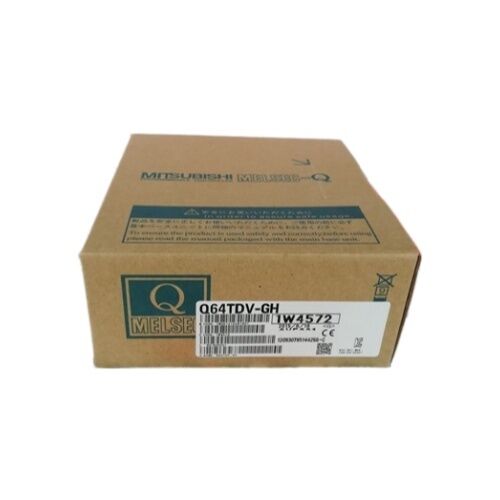
Mitsubishi Q64TDV-GH | MELSEC-Q Channel-Isolated Thermocouple / Micro Voltage Input Module — 4-Channel / B R S K T E J N Types / ±100mV / 40ms/ch / Wire Break / CE
Two Measurement Modes in One Module
The Q64TDV-GH serves two distinct measurement needs from the same 4-channel slot.
Thermocouple temperature input: Connects directly to any of eight standard thermocouple types — B, R, S, K, T, E, J, or N. The module handles cold junction compensation internally, so no external cold junction circuit is required. The measured temperature becomes a 16-bit signed binary value scaled ×10 (so 25.4°C = 254 in the digital word). The usable temperature range depends on the thermocouple type: the B type covers the highest temperatures; the T and K types cover the most common industrial ranges.
Micro voltage input: Measures signals in the −100 to +100mV range with a 2MΩ or higher input impedance. This opens the module to signal types beyond thermocouples — load cells, strain gauges, low-output pressure transducers, and other bridge or precision low-voltage sensors that would be below the range of standard ±10V or 4–20mA analogue input modules.
The conversion result is a 16-bit signed binary value from −25000 to +25000, spanning the full ±100mV range with fine resolution.
Both modes operate in parallel across the 4 channels — channel 1 can measure a K thermocouple while channel 2 reads a load cell micro voltage signal, from one module in one slot.
Key Specifications
| Parameter |
Value |
| Channels |
4 + cold junction compensation |
| Thermocouple Types |
B, R, S, K, T, E, J, N |
| Micro Voltage Range |
±100mV |
| Input Resistance |
≥2 MΩ |
| Accuracy (25±5°C) |
±0.2mV |
| Accuracy (0–55°C) |
±0.8mV |
| Absolute Max Input |
±5V |
| Temp Output |
16-bit (−2700 to 18200) |
| Voltage Output |
16-bit (−25000 to 25000) |
| Thermocouple Standard |
JIS C1602-1995 |
| Conversion Speed |
40ms/channel |
| Isolation |
Channel-to-channel |
| I/O Points |
16 |
Channel-to-Channel Isolation — Why It Matters
Many analogue input modules share a common signal ground across all channels — cross-channel interference and ground loop currents can corrupt readings when field sensors are grounded at different potentials. The Q64TDV-GH isolates each channel from every other channel galvanically.
In industrial temperature measurement installations, different thermocouples are often physically attached to different metallic structures — furnace zones, reactor vessels, motor housings — each of which may be at a different earth potential. Without channel isolation, potential differences between these structures appear as common-mode interference on the signal. With channel-to-channel isolation, each channel's measurement is electrically independent, so potential differences between thermocouple attachment points do not corrupt adjacent channel readings.
The same principle applies to micro voltage measurements from strain gauges in multi-point load monitoring — each bridge circuit may reference a different ground point on the machine structure.
Application Scenarios
Furnace zone temperature control: Four K-type thermocouples connected to the Q64TDV-GH monitoring separate heating zones. Channel isolation prevents cross-zone ground loops from appearing as temperature measurement errors. Wire break detection alerts if any sensor connection fails mid-process.
Multi-point strain/load monitoring: Load cells on four press tooling stations measured as micro voltage signals (±100mV range). Channel isolation prevents mechanical crosstalk on the measurement circuit from corrupting individual load readings.
Mixed thermocouple and micro voltage: Two channels reading thermocouple inputs (process temperature); two channels reading low-output pressure transducers (±50mV output). One module handles both sensor types simultaneously without additional hardware.
FAQ
Q1: What is the difference between the Q64TDV-GH and the Q64TD?
Both are 4-channel channel-isolated MELSEC-Q thermocouple input modules with the same thermocouple type coverage. The Q64TDV-GH adds micro voltage input capability (±100mV per channel) that the Q64TD does not have. The GH also supports higher accuracy micro voltage measurement with 16-bit signed binary output in the −25000 to +25000 range. Choose the Q64TDV-GH when micro voltage signals (load cells, strain gauges) must be measured alongside thermocouples, or when micro voltage input is the only requirement.
Q2: How is cold junction compensation handled on the Q64TDV-GH?
The module includes an internal cold junction compensation channel that continuously monitors the temperature at the thermocouple connection terminals on the module. All thermocouple measurement calculations automatically apply this compensation to produce the correct measured temperature value. No external cold junction reference or compensation circuit is required when using the module with standard thermocouple wiring. The cold junction compensation applies only to channels in thermocouple input mode, not to channels in micro voltage input mode.
Q3: Can individual channels independently switch between thermocouple and micro voltage input modes?
Yes. Each channel is configured independently for either thermocouple or micro voltage input using the intelligent function module switch settings in GX Developer or GX Works2. The switch settings assign the input type per channel. A channel configured for micro voltage input will not perform cold junction compensation or thermocouple linearisation — it reports the raw ±100mV signal as a ±25000 digital value.
Q4: What happens to the Q64TDV-GH's output value if an input voltage exceeds ±100mV?
The module's specified input range is ±100mV, with an absolute maximum protection of ±5V. Signals within ±5V will not damage the module, but measurements above ±100mV will be reported at the upper or lower limit of the digital output range (±25000). Any signal exceeding ±5V risks hardware damage to the input circuit. Use appropriate signal conditioning or protection if field signals may exceed ±100mV under fault conditions.
Q5: How many Q64TDV-GH modules can be installed in one MELSEC-Q system?
The Q64TDV-GH occupies 16 I/O points in the Q CPU's I/O assignment and counts as one Special I/O Unit. The MELSEC-Q system allows up to 10 Special I/O Units of the same type (unit numbers 0–9). Up to 10 Q64TDV-GH modules can coexist in a single Q system, providing up to 40 isolated thermocouple or micro voltage measurement channels, subject to the total power supply budget of the system configuration.



 Your message must be between 20-3,000 characters!