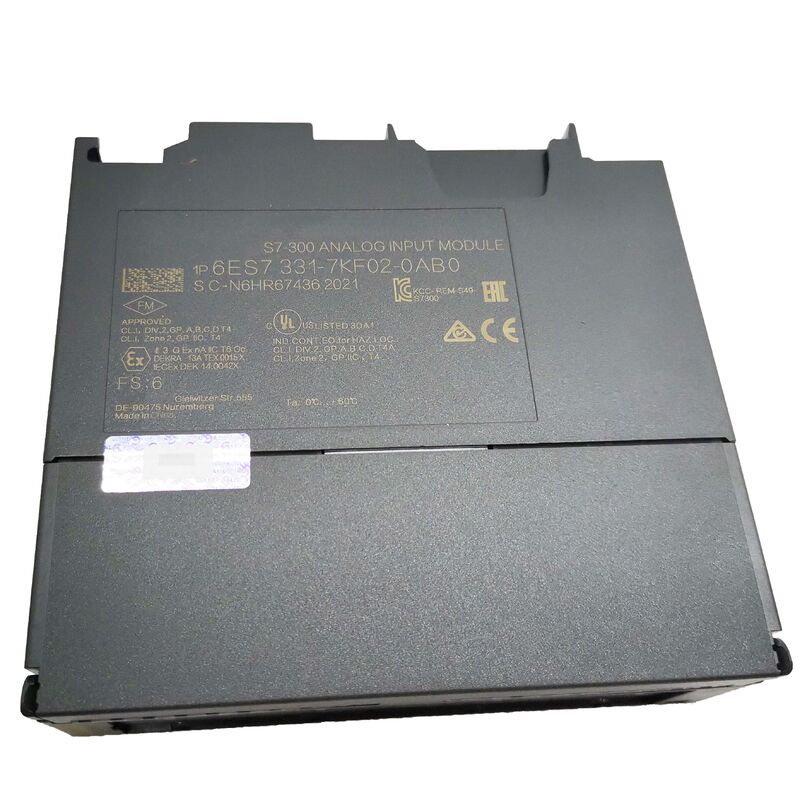
Siemens 6ES7331-7KF02-0AB0 | SIMATIC S7-300 SM 331 Analog Input — 8 Isolated Channels / 9/12/14-Bit / Voltage + Current + Thermocouple + RTD / Diagnostics
One Module, Four Signal Types — The Case for the SM 331 7KF02
Most analog input modules handle one signal category. The SM 331 7KF02 handles four — voltage, current, thermocouple, and RTD — simultaneously on the same module, with each channel pair independently configured in STEP 7. A single 40mm slot can read pressure transmitters at 4–20mA on channels 0–1, a flow meter at 0–10V on channels 2–3, Type K thermocouples on channels 4–5, and Pt100 RTDs on channels 6–7. No signal conditioners, no adapters, no separate specialised modules.
The thermocouple and RTD handling is done in hardware. The SM 331 applies the ITS-90 linearisation tables for each configured TC type (E, J, K, L, N) and the Callendar-Van Dusen equation for Pt100 linearisation — converting non-linear millivolt signals directly to degrees Celsius before the value reaches the process image. The S7-300 programme reads a standard integer in engineering units with no additional signal processing in user code.
For thermocouple inputs, internal cold junction compensation is applied automatically: the module measures its own terminal temperature and adds the compensation value to each thermocouple reading. In a temperature-stable control cabinet (20–40°C), this internal compensation is adequate for most process control applications.
Key Specifications
| Parameter |
Value |
| Channels |
8 (4 pairs, independently configurable) |
| Resolution |
9 / 12 / 14-bit |
| Voltage |
±80mV to ±10V |
| Current |
±3.2mA, 0–20mA, 4–20mA |
| Thermocouple |
E, J, K, L, N |
| RTD |
Pt100, Ni100 |
| Isolation |
Optical (galvanic) |
| Connector |
20-pole, hot-swap |
| Diagnostics |
Wire-break + limit alarms |
| Supply |
24VDC |
Resolution vs. Conversion Speed — Getting the Integration Time Right
The SM 331's resolution is not fixed — it is a programmable parameter per channel pair that controls the ADC's integration time and, by extension, its mains noise rejection:
9-bit / 2.5ms — Fastest setting, no meaningful mains noise rejection. Rarely used for steady-state process measurement.
12-bit / 20ms (50Hz systems) or 16.67ms (60Hz systems) — Standard for most 4–20mA and voltage measurements. The integration time spans exactly one complete mains cycle, which cancels mains-frequency interference through synchronous suppression. Getting the integration time wrong for the local mains frequency (selecting 50Hz mode on a 60Hz supply) substantially degrades noise rejection.
14-bit / 100ms — Highest resolution. Used for thermocouple and RTD measurements where millivolt-level signals and thermal drift precision matter more than update speed. Temperature processes change slowly enough that 100ms is entirely acceptable.
Optical Isolation — Protecting Measurements in Electrically Noisy Installations
The SM 331's optical isolation between field circuits and the S7-300 backplane is the correct specification for most real-world process plants. Where field instruments are distributed across the plant, different grounding points develop different potentials — ground loops. Without isolation, these potential differences appear as common-mode voltage on the differential input and corrupt measurements. The optical barrier blocks common-mode voltages up to 250VAC between field circuit and PLC backplane without affecting the differential signal.
In installations with variable frequency drives, large motor starters, and transformer-coupled devices sharing cable infrastructure, optical isolation is the difference between stable measurements and unexplained drift.
Diagnostics — Wire-Break and Process Interrupts
For 4–20mA loops, the SM 331 detects signals below 3.6mA as a wire-break (below the live-zero baseline) and triggers OB82. For thermocouple inputs, a small bias current monitors input impedance — an open-circuit TC junction triggers OB82 immediately. Process limit violations trigger OB40 with channel number and overflow/underflow status.
Both OB82 and OB40 must be programmed in the S7-300 application. If either OB is absent and the corresponding interrupt fires, the CPU transitions to STOP — unhandled interrupts are treated as fatal errors in the S7-300 system.
FAQ
Q1: Can different channel pairs use different signal types simultaneously?
Yes — this is the module's defining capability. Channels are grouped in pairs (0–1, 2–3, 4–5, 6–7), and both channels within a pair share the same measurement type and resolution. Different pairs operate independently — pair 0–1 can run 4–20mA at 12-bit while pair 4–5 runs Type K thermocouple at 14-bit, all simultaneously on the same module. The pair grouping is the only constraint.
Q2: Why does mains frequency matter for integration time selection?
The integrating ADC cancels interference that completes an integer number of cycles during the integration period. For 50Hz mains (Europe, Asia, Australia), select 20ms integration — exactly one 50Hz cycle. For 60Hz mains (North America), select 16.67ms. Selecting the wrong setting leaves the mains interference partially uncancelled, significantly degrading noise rejection.
Q3: Can standard copper cable be used for thermocouple connections?
No. Thermocouple extension or compensating cable is required — conductors must match or be thermoelectrically equivalent to the thermocouple alloy. Any copper junction in a thermocouple circuit creates an additional thermoelectric junction that introduces measurement error. Use shielded thermocouple extension cable, grounded at the SM 331 end only.
Q4: Are hardware interrupts available for limit violations?
Yes. When process interrupts are enabled in STEP 7, the SM 331 triggers OB40 when a measured value crosses a configured upper or lower limit. OB40 receives the channel number and limit direction. OB82 fires for wire-break and hardware faults. Both OBs must be present in the programme — absent interrupt OBs cause CPU STOP when the interrupt fires.
Q5: How does the 7KF02 differ from the simpler 1KF00-0AB0?
The 1KF00 is non-isolated, lower cost, and supports voltage and current only — no thermocouple or RTD. Use the 1KF00 where all signals are voltage or current, the installation is electrically clean, and ground loop isolation is not needed. Use the 7KF02 when thermocouple or RTD inputs are required, when the installation includes VFDs or large motors, when instruments are distributed across the plant with different grounding points, or when 14-bit resolution is needed.



 Your message must be between 20-3,000 characters!