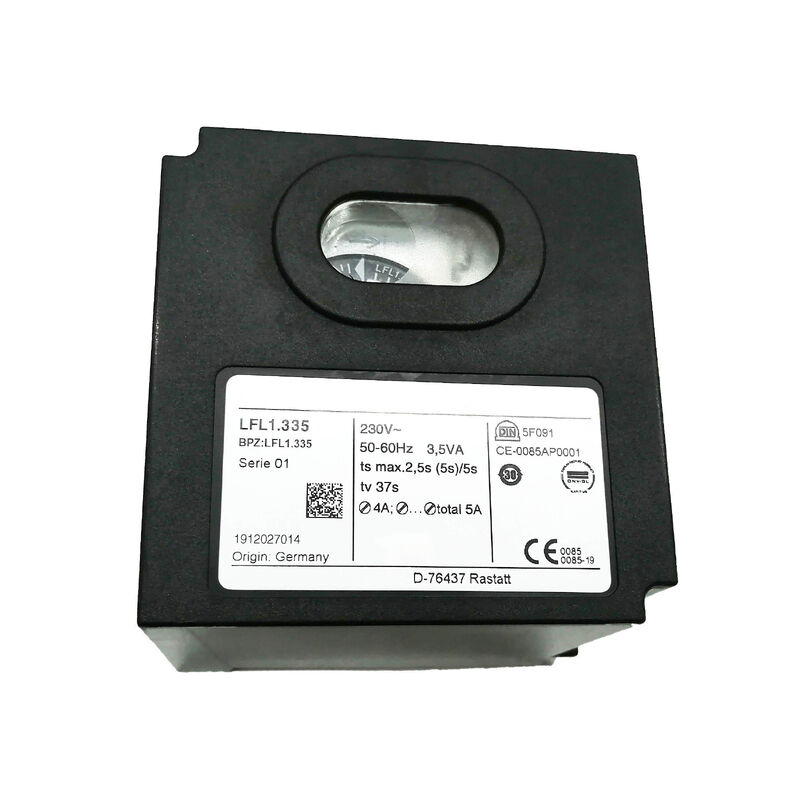
Siemens LFL1.335 | Burner Control — 110VAC / Forced-Draft / Gas + Oil + Dual-Fuel / Intermittent / t1=37s / TSA=2.5s / t9=5s
Flame Supervision, Sequencing, and Safe Shutdown — What a Burner Control Does
A burner control is not a general relay or programmable controller — it is a dedicated safety sequencer designed specifically for combustion equipment. The LFL1.335 manages the complete startup-to-shutdown sequence of a forced-draft burner: pre-purge, ignition, flame establishment confirmation, supervised running mode, and safe lockout response when a fault occurs. These functions must execute in a defined, legally required order to meet combustion safety standards.
The three published timing parameters define the LFL1.335's specific sequence:
t1 = 37 seconds — pre-purge time: Before ignition is attempted, the forced-draft fan runs for 37 seconds to flush any unburned fuel or gas from the combustion chamber and flue. This purge prevents a fuel-rich atmosphere from being ignited by the spark. The 37-second pre-purge is a design choice matched to the burner's combustion chamber volume.
TSA = 2.5 seconds — safety time for ignition (Sicherheitszeit): Once ignition is attempted, the flame must be detected within 2.5 seconds. If the flame detector does not confirm flame establishment within this window, the LFL1.335 de-energises the fuel valve and goes to lockout. A 2.5-second TSA is appropriate for direct gas ignition applications where flame response is fast.
t9 = 5 seconds — post-purge time: After a normal shutdown, the fan continues running for 5 seconds to clear combustion products from the heat exchanger and flue before the fan stops.
These timing values are fixed in the LFL1.335's hardware — they are not field-programmable. Selecting the correct LFL1 variant means selecting the correct pre-purge and safety times for the specific burner.
Key Specifications
| Parameter |
Value |
| Supply Voltage |
110V AC, 50/60Hz |
| Application |
Gas / oil / dual-fuel |
| Burner Type |
Forced-draft |
| Operating Mode |
Intermittent |
| Pre-Purge (t1) |
37 seconds |
| Safety Time (TSA) |
2.5 seconds |
| Post-Purge (t9) |
5 seconds |
| Capacity |
Medium to high |
Intermittent Operation — What It Means for the Installation
"Intermittent operation" has a specific meaning in burner control terminology: the burner undergoes at least one controlled shutdown (via the burner control's normal shutdown sequence) within every 24-hour operating period. This is distinguished from "continuous operation" where the burner runs without cycling for extended periods.
Many industrial and commercial heating systems naturally cycle — industrial furnaces, packaged boilers, air heaters, and process heat systems that modulate output or stage capacity. For these systems, intermittent operation is the normal duty cycle and the LFL1.335 is designed accordingly. For burners required to run continuously without any cycling shutdown for days or weeks, a burner control rated for continuous operation is the correct specification.
Application Scenarios
Industrial boilers and packaged steam generators: Pre-purge, gas valve opening, spark ignition, flame confirmation via ionisation or UV detector, modulating control during run — all sequenced by the LFL1.335.
Process air heaters and heat exchangers: Forced-draft burner providing heat for drying, curing, or process heating. The LFL1.335 ensures safe startup after each production batch shutdown.
Dual-fuel burner systems: Gas/oil switchover capability allows the burner to operate on either fuel. The LFL1.335 supervises flame regardless of which fuel is active.
FAQ
Q1: What is the difference between the LFL1.335 and other LFL1 variants like LFL1.322 or LFL1.338?
LFL1 variants differ primarily in their timing parameters — pre-purge time (t1) and safety time (TSA). The LFL1.322 has t1=12s/TSA=2s; the LFL1.338 has t1=37s/TSA=5s. These times are fixed in hardware and define the correct variant for a specific burner. Substituting a variant with different timing can cause nuisance lockouts (too short a safety time) or fail to meet combustion safety standards (insufficient pre-purge). Always match the exact LFL1.xxx designation from the installed unit.
Q2: What flame detectors are compatible with the LFL1.335?
The LFL1 family is compatible with Siemens QR, QRA, and QRC series UV flame detectors, and with ionisation probes for gas flame supervision. The specific flame detector type installed in the burner determines which detector interface the LFL1.335 uses — UV detector or ionisation input. Confirm the flame detection method with the burner's design documentation before replacement.
Q3: What happens when the LFL1.335 goes to lockout?
On lockout, the LFL1.335 de-energises all fuel valves and the ignition transformer immediately. A lockout indicator illuminates (typically a red pilot lamp or indicator on the control). The burner cannot restart until the lockout is manually reset — typically by pressing a reset button on the LFL1.335 itself or a remote reset point. This manual reset requirement is intentional: it forces an operator to acknowledge and investigate the cause before allowing a restart.
Q4: Can the LFL1.335 timing parameters be adjusted?
No. The pre-purge time (t1 = 37s), safety time (TSA = 2.5s), and post-purge time (t9 = 5s) are fixed in the LFL1.335's hardware — they are not adjustable by external parameters or switches. Changing the timing requires selecting a different LFL1 variant with the required values.
Q5: Where is the LFL1.335 sourced?
Through combustion controls specialists, HVAC and burner equipment suppliers, and industrial heating system spare parts distributors. Siemens Building Technologies (now Siemens Smart Infrastructure) provides LFL1 controls through its combustion controls distribution network. Confirm the exact part number LFL1.335 and the 110VAC supply version before ordering — higher voltage variants (220VAC) have different order numbers and are not interchangeable.



 Your message must be between 20-3,000 characters!