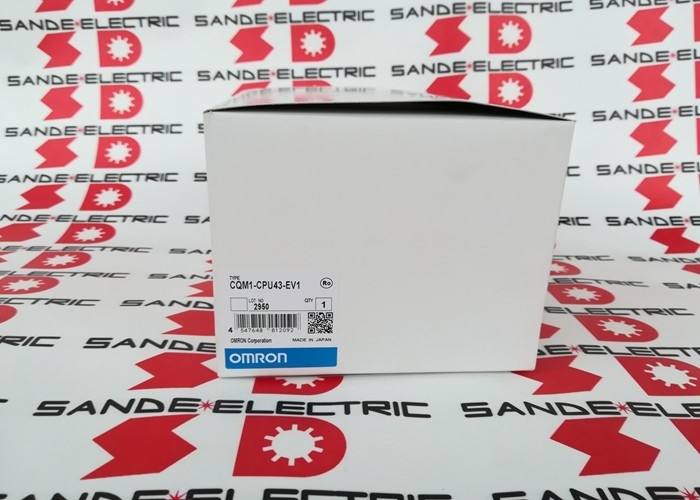
Omron CQM1-CPU43-EV1 | CQM1 CPU Unit — 256 I/O / 7.2K Program / Built-In Pulse I/O 50kHz / RS-232C
CQM1 CPU with Built-In Pulse I/O — The EV1 Distinction
The CQM1-CPU43-EV1 is the CQM1 CPU unit with a built-in pulse input and output function — the feature that distinguishes it from other CQM1 CPU variants in the same platform. Two dedicated ports on the CPU body handle high-speed counter inputs and pulse outputs simultaneously, without requiring a separate Special I/O unit for motion tasks.
High-speed counter inputs accept single-phase pulses at up to 50kHz and two-phase (quadrature) pulses at up to 25kHz. This covers direct connection of rotary encoders for position feedback and velocity measurement without external counter hardware. Pulse outputs reach up to 50kHz from the same ports — appropriate for commanding a stepping motor driver for positioning applications.
The 16 built-in inputs are present on the CPU body itself. Up to 11 I/O or Special I/O Units can be added to reach the full 256-point maximum. The configuration snaps together mechanically — units lock side by side and the system scales from the minimum CPU-only configuration to the full 11-unit I/O expansion.
Key Specifications
| Parameter |
Value |
| I/O Points |
256 max |
| Built-In Inputs |
16 |
| Program Memory |
7.2K words |
| Data Memory |
6K words |
| High-Speed Counter (single-phase) |
50kHz |
| High-Speed Counter (two-phase) |
25kHz |
| Pulse Output |
50kHz max |
| Current Consumption |
980mA at 5V DC |
| RS-232C Port |
Yes |
| Max I/O Units |
11 |
| Interrupts |
Input / Scheduled / High-speed counter |
| Clock |
Built-in |
Three Interrupt Types and Communications
The CQM1-CPU43-EV1 supports three independent interrupt types. Input interrupts respond to short external signals — minimum detectable pulse width is 0.1ms. Scheduled interrupts use an internal high-speed interval timer for periodic tasks. High-speed counter interrupts trigger on encoder counts, enabling immediate programme response to position events without waiting for the next scan cycle.
Two serial ports are available: a peripheral port for programming tools and a dedicated RS-232C port for external device communication — barcode readers, measurement instruments, printers, or 1-to-1 data links with another CQM1. The host link protocol supports communication with a PC or Programmable Terminal through the same RS-232C port.
FAQ
Q1: What makes the CQM1-CPU43-EV1 different from CQM1-CPU41-EV1 or CPU42-EV1?
All CQM1 EV1 variants share the same 256-point I/O capacity, 7.2K program memory, and RS-232C port. The CPU41-EV1 has no special built-in function. The CPU42-EV1 adds four analog setting volume controls. The CPU43-EV1 adds the built-in pulse I/O function — 50kHz high-speed counter inputs and 50kHz pulse outputs from dedicated ports. The CPU44-EV1 replaces the pulse I/O with two absolute encoder (ABS) interfaces.
Q2: Can the built-in high-speed counter be used for encoder position tracking?
Yes. The two dedicated ports accept quadrature A/B encoder signals at up to 25kHz two-phase, plus a Z reference pulse. High-speed counter interrupts trigger immediately on count events without scan cycle delay. For stepping motor control, the CQM1-CPU43-EV1 can close a position loop using encoder feedback on the counter input and pulse output to the driver simultaneously.
Q3: How is the CQM1-CPU43-EV1 programmed?
Using Omron's CX-Programmer (or the earlier SSS programming software). The peripheral port connects to a PC for programme download, online monitoring, and parameter configuration. Ladder logic is the standard programming language. The stored programme resides in internal battery-backed RAM — replace the battery before it depletes to avoid programme loss.
Q4: Can the 256-point I/O maximum be reached with the CQM1-CPU43-EV1?
Yes. The 16 built-in inputs on the CPU unit count toward the total. Up to 11 I/O or Special I/O Units can be connected to the right of the CPU unit. The total number of words allocated to I/O and Special I/O Units must be 15 words or less in the combined allocation.
Q5: The CPU43-EV1 shows a battery warning. What is the correct procedure?
Replace the battery within one week of the warning appearing — battery depletion causes programme memory loss. The CQM1 uses a standard lithium battery. Replace with the CPU unit powered on if possible, to preserve the programme. After replacement, verify the programme is intact by comparing with a backup.



 Your message must be between 20-3,000 characters!