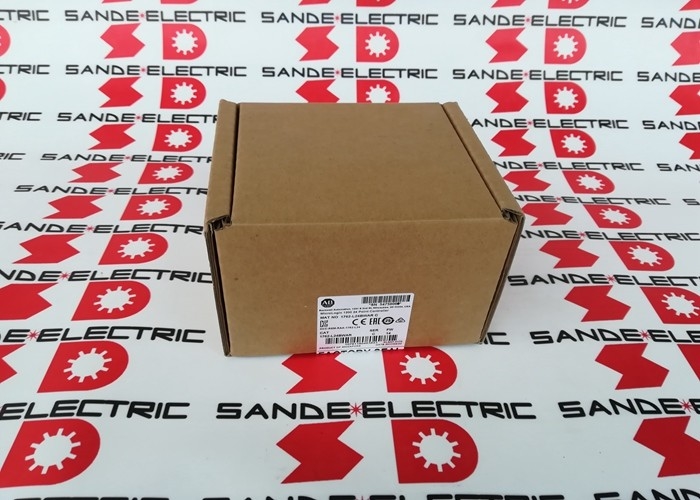
1762-L24BWAR | MicroLogix 1200 — 120/240VAC / 14 DI (10 Std + 4 Fast) / 10 Relay / Extra HMI + Programming Port / Discontinued 2022
1762-L24BWAR vs 1762-L24BWA — The Port That Makes the Difference
The 1762-L24BWAR and the 1762-L24BWA share the same I/O configuration: 14 inputs (10 standard + 4 fast) and 10 relay outputs, the same AC power supply, and the same memory and instruction set. The functional difference is in the suffix "R" — an additional dedicated port for HMI or programming connections.
The standard L24BWA provides one RS-232C port that serves all communication needs: programming access, HMI connection, Modbus RTU to drives, and ASCII for peripheral devices. Each connection requires switching the port's protocol configuration. The L24BWAR adds a second port specifically for simultaneous HMI operation: one port maintains the programming connection or Modbus drive communication while the other sustains the HMI panel link without protocol switching.
For machine installations with a permanent operator panel (PanelView or similar RS-232C-connected HMI) that must stay continuously connected while the machine is operating and while a laptop connects for programme monitoring or modification, the L24BWAR removes the need to disconnect the HMI to plug in the programming cable. Both connections coexist.
Key Specifications
| Parameter |
Value |
| Power Supply |
120/240V AC |
| Standard DC Inputs |
10 × 24V DC |
| Fast DC Inputs |
4 × 24V DC |
| Total Inputs |
14 |
| Relay Outputs |
10 |
| Extra Port |
Yes — additional programming/HMI port |
| Memory |
6 KB |
| Protocols |
DF1, DH-485, Modbus RTU, ASCII |
| Discontinued |
2022 |
10 Standard + 4 Fast Inputs — Two Signal Speeds From One Controller
The 10 standard inputs respond at the normal input filter rate — suitable for pushbuttons, limit switches, photoelectric sensors, and all typical machine sequencing signals. The 4 fast inputs reduce filter time to capture high-frequency pulse signals that the standard inputs might alias or miss: production counters from high-speed sensors, encoder reference pulses, or short-duration trigger signals.
The 10 relay outputs provide voltage-independent field switching. Motor starter coils at 230VAC, 24VDC solenoid valve pilots, and 24VDC indicator lamps all connect to the same relay output section — the relay contacts are isolated from the PLC supply, accepting whatever field voltage is wired to them within the contact rating.
Application Scenarios
Compact conveyor with permanent HMI: A production conveyor with a fixed operator touchscreen connected via the HMI port. Service engineers access the programme for online monitoring via the second port during production, without interrupting the operator display.
Packaging station with encoder counting: 10 standard inputs for material presence, seal completion, and conveyor status. 4 fast inputs count high-speed product pulses from a photoelectric sensor and accept encoder reference signals. 10 relay outputs control film advance, sealing element, cutter, and reject gate.
Maintenance spare for MicroLogix 1200 BWAR systems: The L24BWAR's dual-port capability was specified in machine designs where simultaneous HMI and programming connections were required. A direct L24BWAR replacement preserves the original port architecture without rewiring or protocol reconfiguration.
FAQ
Q1: What is the functional difference between the R and non-R variants of the 1762-L24BWA?
The 1762-L24BWA has one RS-232C communication port. The 1762-L24BWAR adds a second port, specifically designated for HMI or programming connections. The second port allows simultaneous connection of an HMI panel on one port and a programming laptop or Modbus device on the other — without requiring the machine to stop or be disconnected during programme access.
Q2: What protocols does the extra HMI/programming port support?
Both ports support the same protocol set: DF1 full-duplex, DF1 half-duplex, DH-485, Modbus RTU, and ASCII. The port selection for each protocol is configured in the controller's channel configuration. Typically, one port is assigned DF1 for programming access and the other is assigned DF1 or DH-485 for HMI communication, but either protocol can be assigned to either port.
Q3: Can expansion I/O be added to the 1762-L24BWAR?
Yes. The MicroLogix 1200 supports 1762-series expansion I/O modules connected to the right-side expansion port. Digital input, digital output (relay and transistor), analogue I/O, and RTD/thermocouple modules are available. The total expansion capacity is constrained by the controller's power budget — verify total current draw including all expansion modules before commissioning.
Q4: What programming software is used for the 1762-L24BWAR?
RSLogix 500 is the programming environment for the MicroLogix 1200 family. Connection is via either RS-232C port using an appropriate serial cable with a USB-to-serial adapter for modern laptops. RSLogix 500 supports the MicroLogix 1200 instruction set including high-speed counter (HSC), PID, and ASCII string instructions.
Q5: Is the 1762-L24BWAR compatible with the same programme as a 1762-L24BWA?
Yes. The I/O addressing, instruction set, memory organisation, and programme structure are identical between the L24BWA and L24BWAR. A programme developed for the L24BWA runs directly on the L24BWAR without modification. The only difference is the additional port, which requires channel 1 communication configuration if it is to be used. Existing channel 0 communication configurations carry over without changes.


 Your message must be between 20-3,000 characters!