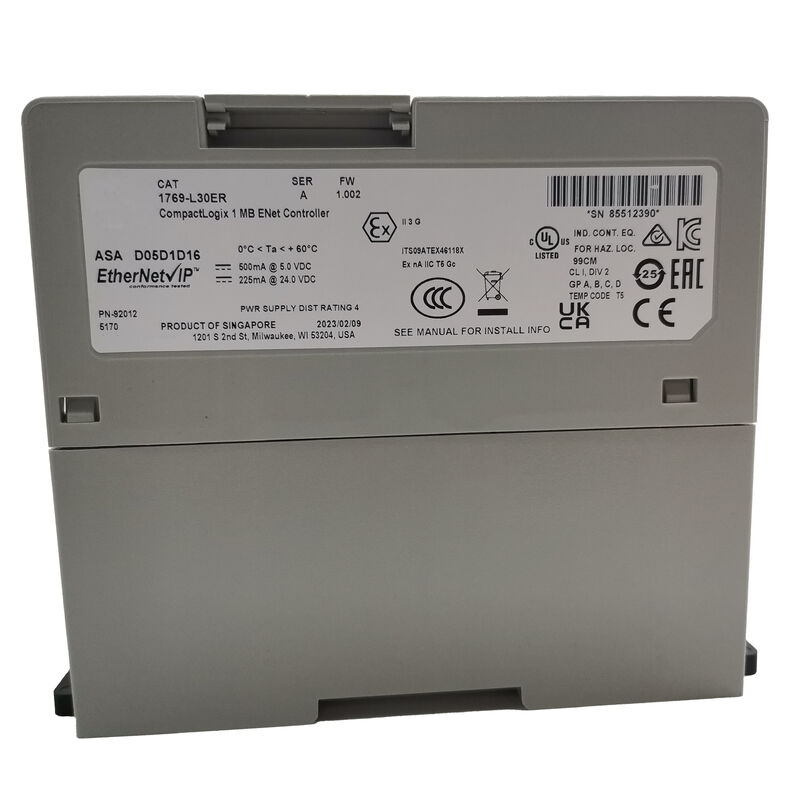
1769-L30ER | CompactLogix 5370 L3 — 1MB / Dual EtherNet/IP DLR / 16 Nodes / 8 I/O Modules / 32 Tasks / USB / 30V Isolation / DIN or Panel Mount
1769-L30ER vs Adjacent L3 Variants — Choosing the Right One
The CompactLogix 5370 L3 range includes several variants that share the same 1MB memory, dual EtherNet/IP, and 8 local I/O slot specifications. The differences are functional rather than capacity-based:
| Variant |
Motion |
Supercap (RTC) |
Typical Use |
| 1769-L30ER (this) |
No |
Yes |
Standard sequencing, non-hazardous |
| 1769-L30ERM |
Yes (4 CIP axes) |
Yes |
CIP motion control |
| 1769-L30ER-NSE |
No |
No |
Hazardous locations (Cl.I Div.2) |
The 1769-L30ER is the baseline L3 configuration: full EtherNet/IP networking and DLR capability, 1MB programme memory, 8 expansion slots, dual Ethernet with DLR — but no CIP Motion axis capability. For machine control, sequencing, distributed I/O management, and HMI connectivity without servo axis coordination, the L30ER provides the complete feature set at a lower cost than the motion-capable L30ERM.
The built-in supercapacitor retains the real-time clock (RTC) value during power loss — a feature absent in the NSE variant, which makes the standard L30ER the correct specification for non-hazardous applications that need accurate time-stamped data or time-based programme execution after power restoration.
Key Specifications
| Parameter |
Value |
| User Memory |
1 MB |
| Ethernet Ports |
2 × EtherNet/IP with DLR |
| Protocols |
EtherNet/IP, CIP Motion, CIP Sync, Modbus TCP |
| Max. EtherNet/IP Nodes |
16 |
| Local I/O Expansion |
Up to 8 × 1769 |
| Typical Scan |
< 1ms (small programmes) |
| Tasks |
32 / 100 programmes each |
| Supply |
DC 24V (±20%) |
| Current |
500mA @ 5V; 225mA @ 24V |
| Power |
4.5W max |
| Dimensions |
130 × 80 × 110mm (H×W×D) |
| IP Rating |
IP20 |
| Isolation |
30V continuous |
| Safety |
SIL2 / PLd (with safety I/O) |
| Mounting |
DIN rail or panel |
CIP Sync — Coordinated Time Across the EtherNet/IP Network
The 1769-L30ER supports CIP Sync, which distributes a common time reference across all EtherNet/IP devices in the network using the IEEE 1588 Precision Time Protocol. With CIP Sync active, timestamps on events recorded at different nodes — drives, I/O adapters, HMI terminals — are all referenced to the same clock. For post-event analysis and production tracking, this makes the sequence of events across the distributed system readable and reliable.
Application Scenarios
High-speed packaging lines: Film feed, cutting, sealing, and reject mechanisms coordinated over EtherNet/IP. CIP Motion handles servo synchronisation; CIP Sync timestamps every event across the line.
Automated warehouse systems: Stacker cranes, conveyors, and barcode scanners operating as EtherNet/IP nodes under L30ER coordination. Up to 16 devices on the ring; DLR protects against cable faults.
Water treatment stations: Level sensors, flow meters, and pump valve actuators on distributed I/O stations. The L30ER gathers process data and controls pump sequences from a central panel.
Collaborative multi-controller systems: The L30ER runs as a local intelligent node within a larger ControlLogix or CompactLogix network — managing a machine section's local I/O while exchanging data with the system-level controller via EtherNet/IP.
Installation and Wiring Notes
- Expansion I/O modules must not exceed 8 total; overall power budget must be verified across all modules
- Use industrial shielded twisted-pair cable for all EtherNet/IP connections; keep separated from power cabling
- The SD card stores programme backups and firmware updates — it does not serve as a runtime execution medium
- Panel environment: ambient humidity ≤85% RH (non-condensing); ensure adequate ventilation
- Confirm IP address configuration before first power-on to avoid network conflicts on shared segments
FAQ
Q1: What is the practical difference between the 1769-L30ER and 1769-L30ERM?
The L30ERM adds CIP Motion controller capability (4 servo axes) to the same hardware platform. The L30ER has no CIP Motion function — it cannot control Kinetix servo drives as coordinated CIP Motion axes. If the application requires only discrete and process control (no servo motion coordination), the L30ER is the correct and more cost-effective specification. If servo axis coordination is required, the L30ERM is needed.
Q2: What programming software connects to the 1769-L30ER?
Studio 5000 Logix Designer is the programming environment for the CompactLogix 5370 family. Connection uses the USB port for direct laptop access or either EtherNet/IP port for network programming. Studio 5000 supports Ladder Diagram, Structured Text, Function Block Diagram, and Sequential Function Chart. The 1769-L30ER supports Logix Designer version 20 and later.
Q3: How many local I/O points does 8 expansion modules provide?
The point count depends on the specific 1769 Compact I/O modules selected. An 8-slot expansion with mixed 16-point digital I/O modules provides 128 I/O points locally. High-density 32-point modules in all 8 slots provide 256 local I/O points. The 8-slot limit is the hardware constraint; within that limit, module selection determines total point count.
Q4: What is the 30V continuous isolation rating used for?
The 30V continuous isolation is the rated voltage for basic insulation between the controller's USB, Ethernet, and internal bus interfaces. It defines the electrical separation that protects against common-mode voltage differences between the controller and connected devices. In practice, this rating means the controller's communication ports are not isolated for high-voltage applications — for connections to field circuits at higher potentials, appropriate isolation hardware must be used between the controller and field wiring.



 Your message must be between 20-3,000 characters!