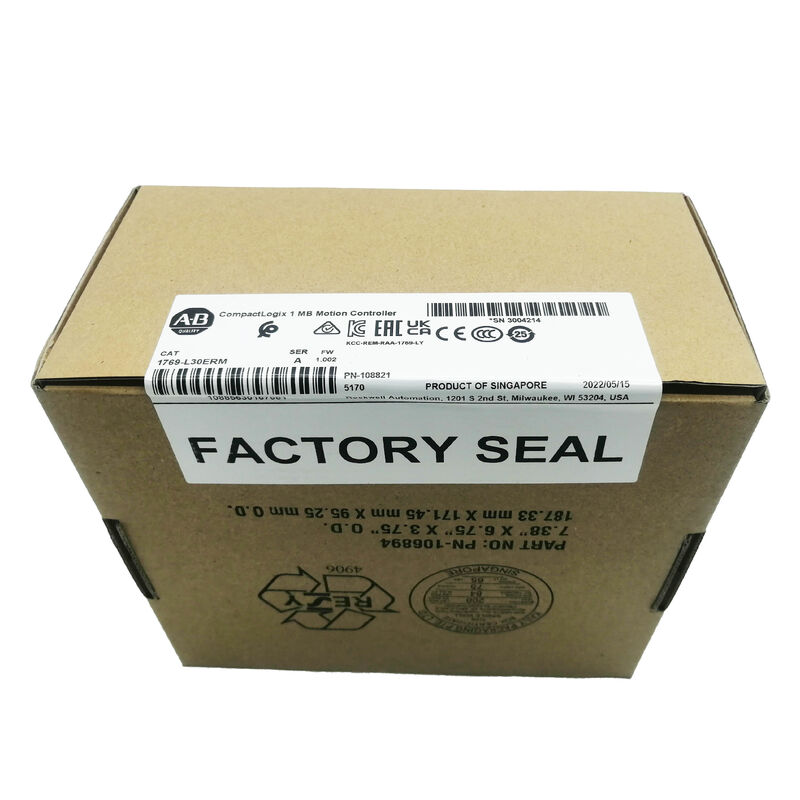
Allen-Bradley 1769-L30ERM | CompactLogix 5370 L3 — 1MB / 4-Axis CIP Motion + Kinematics / Dual EtherNet/IP / DLR / 16 Nodes / 8 Local I/O Modules
CIP Motion with Kinematics — What Separates the L30ERM from Standard CompactLogix
Every CompactLogix L3 controller provides EtherNet/IP communication and Compact I/O integration. What the "ERM" designation adds to the 1769-L30ERM is integrated CIP Motion over EtherNet/IP — and within that, kinematics support that the basic ERM controllers without full kinematics do not provide.
CIP Motion uses EtherNet/IP as the motion control network, synchronising servo drives over standard Ethernet using time-synchronised control loops. Drives with CIP Motion support (Kinetix series) communicate directly with the controller over the same Ethernet network used for machine I/O and HMI — no separate motion bus, no dedicated encoder cables from the controller. The motion axes are programmed and coordinated in Studio 5000 Logix Designer using the same project environment as the machine logic.
Kinematics extends this further. While standard CIP Motion moves individual axes independently, kinematics enables coordinate transformation — programming motion in Cartesian tool coordinates (X, Y, Z) rather than individual motor positions. This is the capability required for delta robot pick-and-place, SCARA arm positioning, H-bot (Cartesian gantry) systems, and any machine where the mechanical geometry translates between joint angles and tool-tip position. The L30ERM handles up to 4 axes in coordinated kinematic groups.
For a packaging machine with a delta robot pick head, or an assembly station with a 3-axis Cartesian system, specifying a standard CompactLogix without kinematics means adding an external motion controller or rearchitecting the motion control. The 1769-L30ERM avoids this by providing kinematic coordination natively.
Key Specifications
| Parameter |
Value |
| Memory |
1 MB |
| Ethernet Ports |
2 × EtherNet/IP |
| DLR |
Yes |
| Local I/O Modules |
8 |
| EtherNet/IP Nodes |
16 |
| Motion Axes |
4 (CIP Motion) |
| Kinematics |
Yes |
| USB |
1 |
| Weight |
0.34 kg |
Dual EtherNet/IP and DLR — Network Resilience Built In
The two EtherNet/IP ports form an integrated two-port switch within the controller. This allows the 1769-L30ERM to participate in Device Level Ring (DLR) topology — an EtherNet/IP ring architecture where each device has two Ethernet connections that form a closed loop. If any cable in the ring breaks, DLR reroutes network traffic through the surviving path within milliseconds. A single cable fault that would stop communication in a linear Ethernet topology becomes a recoverable event in a DLR ring.
For machine automation where cable damage from mechanical interference, vibration, or installation error is a realistic risk, DLR provides network-level resilience without requiring external managed switches or redundant network paths.
Application Scenarios
Delta robot pick-and-place: 3-axis delta robot coordinated as a kinematic group. The 1769-L30ERM programs the motion in Cartesian tool coordinates; the kinematic model translates these to individual servo axis commands. Product pick positions and place offsets are programmed in real-world units, not motor encoder counts.
Compact automated assembly stations: 4 servo axes — two for XY positioning, one for Z, one for rotation — coordinated with machine I/O for part presentation and fixturing. All motion and logic in one controller, one Studio 5000 project.
Packaging and filling machines: Indexing conveyors plus servo-driven filling heads, with DLR network topology ensuring machine I/O reliability even if a cable is disturbed during changeover.
FAQ
Q1: What is the difference between CIP Motion and standard EtherNet/IP I/O on this controller?
Standard EtherNet/IP I/O exchanges data asynchronously — each device communicates when polled, at defined rates, but not synchronised to each other. CIP Motion adds IEEE 1588 time synchronisation across all participating nodes, enabling drives to synchronise their control loops to the same timestamp as the controller's motion processor. This time-locked coordination is what enables multi-axis synchronised motion — one drive cannot drift relative to another in a CIP Motion system.
Q2: What drives are compatible with the 1769-L30ERM's CIP Motion?
Rockwell Automation's Kinetix servo drive series (Kinetix 300, 350, 5100, 5300, 5500, 5700) supports CIP Motion over EtherNet/IP and is compatible with the 1769-L30ERM's motion axes. Third-party drives with CIP Motion profile implementation can also be used. Confirm the specific drive's CIP Motion support and firmware compatibility from the Kinetix and CompactLogix compatibility documentation before specifying.
Q3: Can the 1769-L30ERM be replaced with a later CompactLogix 5380 L3 controller?
The CompactLogix 5380 is the successor generation. Project migration from 5370 to 5380 requires evaluation of memory allocation, I/O module compatibility, and motion axis configuration — not all Studio 5000 projects migrate without modification. For motion-capable installations, verify that the 5380 replacement also supports the same kinematic groups and axis count before migrating. For like-for-like replacement of a failed 1769-L30ERM in an existing machine, same-model replacement is the safest path.
Q4: How many EtherNet/IP I/O nodes does the 16-node limit apply to?
The 16-node limit applies to EtherNet/IP I/O connections — point I/O, Compact I/O remote adapters, PROFINET-to-EtherNet/IP bridges, and other EtherNet/IP I/O devices consumed from the controller's connection table. CIP Motion drives also consume connections — each drive axis typically requires one or more EtherNet/IP connections depending on configuration. The total connections (motion + I/O) must stay within the controller's supported connection count.
Q5: Where is the 1769-L30ERM sourced?
Through Rockwell Automation's distribution network (authorised Allen-Bradley distributors) and the established CompactLogix aftermarket — industrial automation spare parts dealers and tested surplus suppliers. Confirm the 1769-L30ERM model number (not adjacent models without kinematics) before ordering. In motion-capable installations, an incorrect CompactLogix replacement lacking CIP Motion or kinematics support will not run the original programme without significant re-engineering.



 Your message must be between 20-3,000 characters!