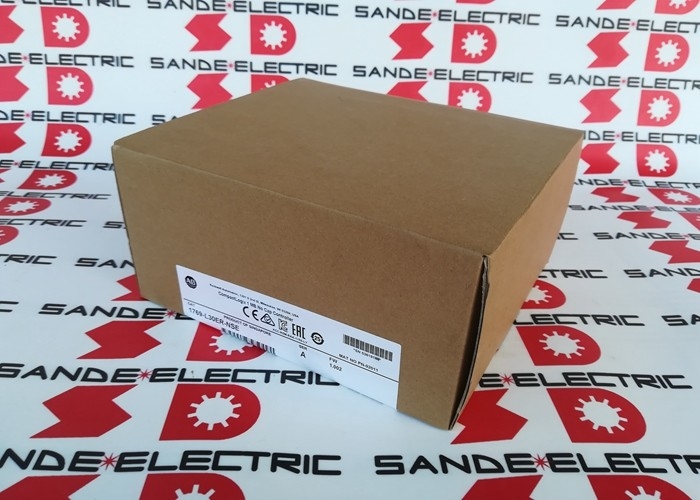
1769-L30ER-NSE | CompactLogix 5370 L3 — 1MB / Dual EtherNet/IP DLR / 16 Nodes / 8 I/O Modules / No Supercap / Hazardous Location / USB / 1GB SD
NSE — No Supercap — The Specification That Defines This Model
The 1769-L30ER-NSE and the standard 1769-L30ER are functionally identical in memory, Ethernet capability, I/O expansion, and programming. One specification separates them: the NSE variant does not contain a supercapacitor for real-time clock (RTC) energy backup.
Standard CompactLogix 5370 controllers use an internal supercapacitor to maintain the real-time clock during power loss. A supercapacitor is an energy storage device capable, under fault conditions, of releasing charge rapidly — which in certain environments constitutes an arc or ignition risk.
For installations in Class I Division 2 (Div 2) or Zone 2 hazardous locations — where flammable gases or vapours may be present under abnormal conditions — equipment must be non-incendive or rated for the hazardous area. Eliminating the supercapacitor removes the potential ignition source. The 1769-L30ER-NSE is the CompactLogix 5370 L3 specification that meets this requirement.
If real-time clock backup during power loss is needed in the hazardous location application, the SD card provides programme storage continuity. The RTC itself resets on power loss in the NSE variant.
Key Specifications
| Parameter |
Value |
| User Memory |
1 MB |
| Ethernet Ports |
2 × EtherNet/IP with DLR |
| Max. EtherNet/IP Nodes |
16 |
| Local I/O Expansion |
Up to 8 × 1769 modules |
| SD Card |
1 GB (supports 2 GB) |
| Supercapacitor |
None (NSE) |
| Backplane Current |
500mA @ 5V; 255mA @ 24V |
| Wire |
22–14 AWG (solid); 22–16 AWG (stranded) |
| Tasks |
32 tasks / 100 programmes |
| Series |
A and B |
Dual EtherNet/IP with DLR — 16-Node Network Capacity
Both Ethernet ports form an integrated two-port switch supporting Device Level Ring (DLR) topology. A DLR ring connects EtherNet/IP devices in a closed loop — a single cable break anywhere reroutes traffic through the surviving path without any manual intervention. Up to 16 EtherNet/IP node connections cover the distributed I/O, drive, and HMI requirements of most compact machine installations.
Eight local 1769 Compact I/O expansion module positions handle local I/O without consuming EtherNet/IP node budget. The USB port provides local programming access and firmware updates without occupying network bandwidth.
Application Scenarios
Hazardous location panel control: Petrochemical process panels classified as Class I Division 2 require non-incendive control hardware. The NSE variant eliminates the supercapacitor arc risk while providing full CompactLogix 5370 L3 functionality — dual EtherNet/IP, DLR resilience, and 1MB programme memory.
Oil and gas wellhead or processing automation: Where flammable vapour may occasionally be present, the NSE controller installs without requiring an additional explosion-proof enclosure to contain the standard supercapacitor-equipped variant.
Direct replacement for existing NSE installations: Matching the NSE suffix when replacing an installed controller preserves the hazardous location compliance without re-evaluation.
FAQ
Q1: What does NSE mean, and why does it matter?
NSE stands for No Supercap Energy — this controller does not contain a supercapacitor. Standard CompactLogix 5370 controllers use a supercapacitor to maintain the real-time clock during power loss. In Class I Division 2 and Zone 2 hazardous area classifications, a supercapacitor represents a potential arc/ignition source. Removing it allows the NSE variant to qualify for use in those locations without additional enclosure.
Q2: Does removing the supercapacitor affect the controller's programme or data retention?
Programme retention is handled by the SD card, not the supercapacitor. Programmes survive power loss as long as the SD card is installed. What is lost on power loss in the NSE variant is the real-time clock value — the clock resets when power is restored. If RTC accuracy is required in the application, an external network time synchronisation source provides the clock reference after power restoration.
Q3: What wire types are compatible with the terminal block?
22–14 AWG solid copper or 22–16 AWG stranded copper wire rated at 90°C. The replacement terminal block is 1769-RTBN18. These specifications cover the standard 24VDC field wiring used in compact control panels.
Q4: What programming software is used for the 1769-L30ER-NSE?
Studio 5000 Logix Designer is the standard programming environment for the CompactLogix 5370 family. Connection is via the USB port for direct programming or via either EtherNet/IP port for network-based programme download. The 1769-L30ER-NSE supports all four IEC 61131-3 programming languages: Ladder Diagram, Structured Text, Function Block Diagram, and Sequential Function Chart.
Q5: Can the 1769-L30ER-NSE replace the standard 1769-L30ER in a non-hazardous location?
Yes. The NSE variant is functionally equivalent to the standard 1769-L30ER in all capabilities except RTC backup during power loss. In non-hazardous locations where real-time clock accuracy after power restoration is required, the standard variant with supercapacitor is a better specification. For applications that do not require RTC accuracy or use network time synchronisation, the NSE variant works identically.



 Your message must be between 20-3,000 characters!