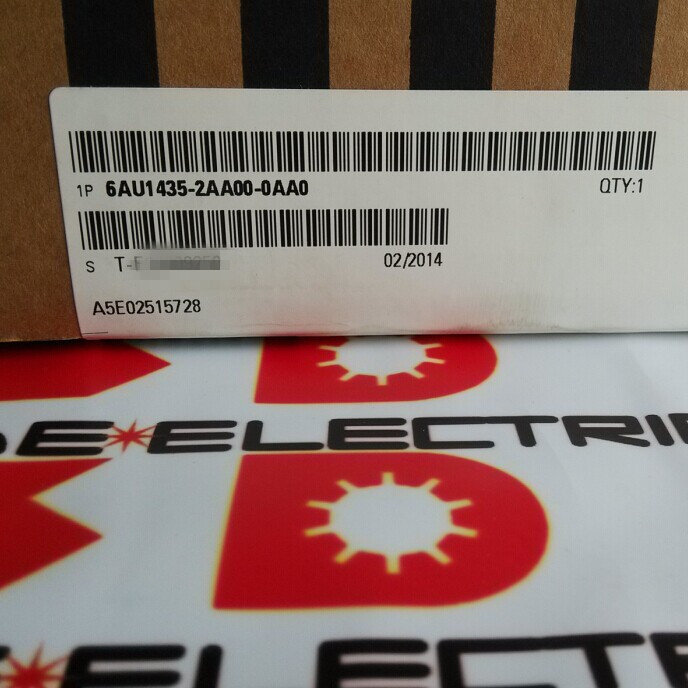
Siemens 6AU1435-2AA00-0AA0 | SIMOTION D435-2 DP — Drive-Based Motion Controller / Standard Performance / 6 DRIVE-CLiQ / 2 PROFIBUS / 3 Ethernet / Dual Fan
Motion Controller Inside the Drive — One Housing, No Fieldbus Between Them
The SIMOTION D435-2 DP collapses what would normally be two separate hardware assemblies into one. In a conventional servo machine, a motion controller sends axis commands over a fieldbus to separate drive amplifiers. In a SIMOTION D system, the D435-2 DP installs as the Control Unit slot of a SINAMICS S120 drive chassis — the motion controller and the drive's intelligence share the same enclosure, connected by DRIVE-CLiQ at the servo cycle rate.
DRIVE-CLiQ is Siemens's internal servo communication network. At 125µs or 250µs cycle times, the D435-2 DP sends position setpoints to Motor Modules and receives actual speed and current data back — without fieldbus overhead, without frame jitter, at the hardware cycle rate. Motor Modules (single-axis and double-axis power electronics), Sensor Modules (for external linear scales and rotary encoders on the machine mechanism), and Terminal Modules (for additional I/O in the drive cabinet) all connect via the six DRIVE-CLiQ ports.
This architecture eliminates the communication latency between a separate motion computer and the drives, reduces cabinet footprint by removing the motion controller and its fieldbus hardware, and simplifies commissioning by keeping motion and drive parameterisation in one software tool (SIMOTION SCOUT).
Key Specifications
| Parameter |
Value |
| Performance |
Standard |
| DRIVE-CLiQ Ports |
6 |
| Fixed DI |
12 × 24V DC |
| Configurable DI/DO |
16 |
| PROFIBUS |
2 × RS-485 |
| Ethernet |
3 × 100 Mbit/s |
| USB |
2 |
| Fan |
Dual (redundant) |
| Battery |
Included |
| Weight |
4.5 kg |
Where D435-2 DP Sits in the SIMOTION D Range
The SIMOTION D family progresses through performance levels: D425 (entry, fewer axes), D435 (standard, this unit), D445 and D455 (high performance, more simultaneous axes and faster update cycles). Standard performance covers the majority of production machine requirements — 8 to 32 coordinated servo axes running flying cut, cam-based motion profiles, registration control, and web tension simultaneously, depending on motion profile complexity and the configured servo cycle time. SIMOTION SCOUT's performance monitoring tool confirms the computing budget during commissioning.
I/O and Communication Interfaces
12 fixed digital inputs (24VDC): Connect directly to the motion controller — homing switches, registration sensors, safety zone monitors. These signals are read synchronously with the servo cycle without fieldbus latency.
16 configurable DI/DO: Each channel configures independently as input or output — drive enable signals, brake controls, and machine actuators under direct motion programme control.
Two PROFIBUS ports: Connect to the plant's S7 supervisory PLC, to distributed I/O slaves, or to both on separate PROFIBUS segments. This dual port allows the D435-2 DP to operate as both a PROFIBUS master (to I/O slaves) and slave (to the supervisory PLC) simultaneously.
Three Ethernet ports: SIMOTION SCOUT engineering access, HMI communication (WinCC, WinCC Flexible, basic panels), and IT-level integration via OPC UA server.
Dual Fan and Battery — Reliability Provisions
Dual fan: Two independent cooling fans serve the D435-2 DP's thermal management. A single fan failure — a common wear-out failure in continuously operating machines — leaves the unit operational while the SIMOTION runtime generates a diagnostic warning for planned maintenance. Without a second fan, one fan failure would require immediate shutdown to prevent thermal damage.
Battery: Retains SRAM contents (retentive variables — axis positions, production counters, recipe data) through power loss. Without the battery, every power interruption requires machine re-homing and re-initialisation. Battery service life is approximately three years; SIMOTION monitors battery voltage and warns before retention capability is lost. Replacement is performed hot — the dual-battery holder design allows battery swap without interrupting SRAM power.
FAQ
Q1: What is the difference between D435-2 DP (this unit) and D435-2 DP/PN?
The D435-2 DP has 2 PROFIBUS ports and Ethernet for engineering/HMI but no PROFINET IO controller function. The D435-2 DP/PN adds PROFINET IO controller and device capability, allowing ET 200SP and PROFINET-capable drives as IO devices. For existing PROFIBUS infrastructure, the DP-only variant is the appropriate selection. For new installations or systems migrating to PROFINET, specify the DP/PN variant.
Q2: Can SIMOTION D435-2 DP run SIMATIC PLC functions alongside motion control?
Yes. The SIMOTION runtime integrates IEC 61131-3 PLC programmes (LAD, FBD, ST) directly alongside motion technology objects in the same task framework. Machine sequencing, I/O control, and HMI communication run on the D435-2 DP without a separate S7 PLC. Both motion and PLC programmes are configured and managed in SIMOTION SCOUT.
Q3: How many servo axes does standard performance support?
At 2ms servo update cycle, the D435-2 DP supports 16–32 servo axes depending on motion profile complexity per axis. Simple velocity axes support the higher count; applications with multi-axis interpolation paths, electronic gearing, and per-axis cam profile calculation use more processing budget per axis. SIMOTION SCOUT's cycle load indicator confirms headroom during commissioning.
Q4: What programming environment is used?
SIMOTION SCOUT handles hardware configuration (DRIVE-CLiQ topology, axis parameters, PROFIBUS/Ethernet), motion object parameterisation, and application programming in IEC 61131-3 and SIMOTION's MCC (Motion Control Chart) graphical language. STARTER or TIA Portal Startdrive handles SINAMICS S120 Motor Module parameterisation within the SCOUT environment. Communication is via Ethernet from the engineering PC.
Q5: Where is the 6AU1435-2AA00-0AA0 sourced?
Through Siemens SIMOTION service channels and the established SIMOTION D aftermarket — specialist drive and motion system dealers and tested surplus suppliers. Confirm the D435-2 DP variant (not DP/PN) and verify firmware version compatibility with the installed machine's SIMOTION SCOUT project before ordering. Battery and fan availability as separate spare parts should also be confirmed when planning maintenance for an installed D435-2 DP system.


 Your message must be between 20-3,000 characters!