logo
Send Message
Guangzhou Sande Electric Co.,Ltd.
Email Sales01@sande-elec.com TEL: 86--18620505228
Home > Products > PLC Programmable Logic Controller >
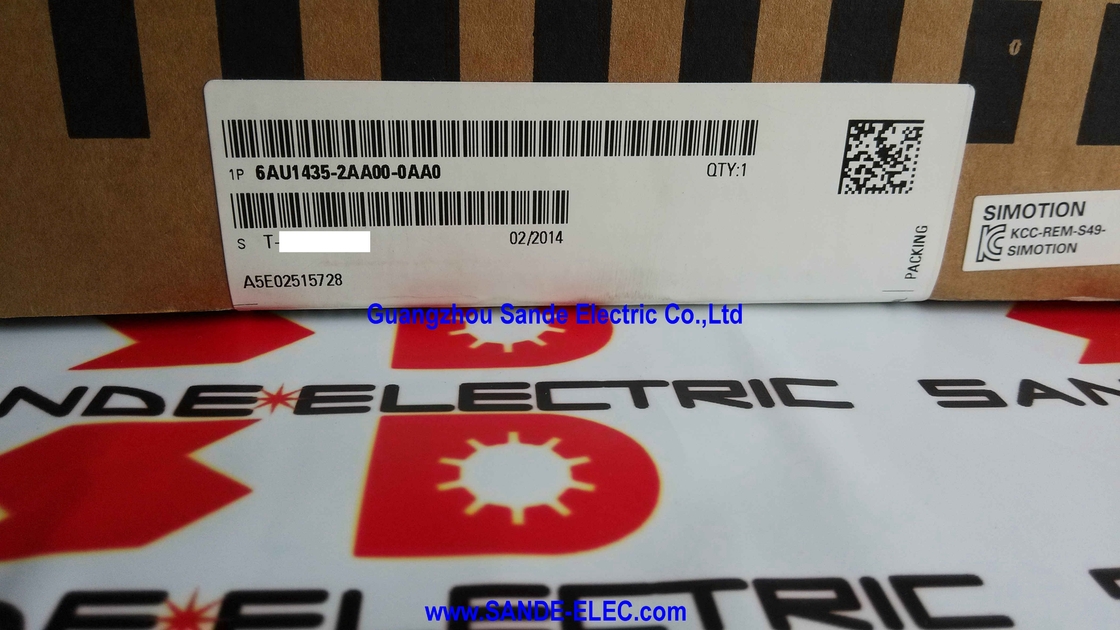
SIMOTION Drive-based Control Unit 6AU1435-2AA00-0AA0 6AU1 435-2AA00-0AA0 6AU1435-2AAOO-OAAO
  • SIMOTION Drive-based Control Unit  6AU1435-2AA00-0AA0  6AU1 435-2AA00-0AA0  6AU1435-2AAOO-OAAO

SIMOTION Drive-based Control Unit 6AU1435-2AA00-0AA0 6AU1 435-2AA00-0AA0 6AU1435-2AAOO-OAAO

Place of Origin Germany
Brand Name SIMENS
Certification CE RoHS
Model Number 6AU1435-2AA00-0AA0
Product Details
Condition:
New Factory Seal(NFS)
Item No.:
6AU1435-2AA00-0AA0
MFG:
Simens
Origin:
Germany
Net Weight:
3.7kG
Highlight: 

SIMOTION Drive-based Control Unit

,

PLC Programmable Logic Controller with warranty

,

SIMOTION Drive-based Control Unit 6AU1435

Payment & Shipping Terms
Minimum Order Quantity
1 pcs
Packaging Details
original packing
Delivery Time
0-3 days
Payment Terms
T/T,PayPal,Western Union
Supply Ability
100 pcs/day
Product Description

Siemens 6AU1435-2AA00-0AA0 | SIMOTION D435-2 DP — Drive-Based Motion Controller, Standard Performance, 12 DI + 16 DI/DO, 6 DRIVE-CLiQ, 2 PROFIBUS, 3 Ethernet, Dual Fan, Battery


Overview

The Siemens 6AU1435-2AA00-0AA0 is the SIMOTION D435-2 DP — the drive-based motion controller that runs the SIMOTION runtime environment directly inside a SINAMICS S120 drive chassis, eliminating the separate hardware distinction between the motion controller and the servo drive amplifier.

On a machine with multiple controlled axes, this integration means one physical unit handles both the motion program execution and the power conversion for the axes connected via DRIVE-CLiQ — reducing cabinet footprint, simplifying wiring, and removing the communication latency that exists when a separate motion controller sends commands to a separate drive over a fieldbus.

The D435-2 DP takes its position in the SIMOTION D family as the standard-performance unit — positioned above the D425 (fewer axes, less memory) and below the D445/D455 variants that provide higher processing capacity for applications with more simultaneous axes or faster update cycles.

Standard performance covers the majority of real production machine applications: multi-axis packaging with 8–16 coordinated servo axes running flying cut, registration control, and cam-based motion profiles; printing machines with web tension control and register correction loops; and winding systems with diameter-compensated speed control across multiple winding stations.

The drive-based architecture works because SIMOTION D is built on the SINAMICS S120 Control Unit hardware platform. The D435-2 DP's DRIVE-CLiQ ports connect to SINAMICS Motor Modules (single-axis and double-axis power electronics), Sensor Modules (for external encoders), and Terminal Modules (for additional I/O), building the complete servo drive system in a DRIVE-CLiQ ring or star topology.

The motion controller communicates with each power module over DRIVE-CLiQ at the internal servo cycle rate — 125µs or 250µs — without any fieldbus overhead, because the connection is direct hardware within the same cabinet.


Key Specifications

Parameter Value
Performance Standard
Memory 109,000 KB (~106 GB)
Fixed Digital Inputs 12 × 24V DC
Configurable DI/DO 16 channels
DRIVE-CLiQ Ports 6
PROFIBUS Ports 2 × RS-485
Ethernet Ports 3 × 100 Mbit/s
USB Ports 2
Option Slot 1
Fan System Dual (redundant)
Battery Included
Dimensions (H×D) 380×270mm
Weight 4.5 kg
Country of Origin Germany

SIMOTION D Architecture — Controller and Drive as One

The SIMOTION D concept deserves a clear explanation because it changes how machine system architects think about the hardware bill of materials. In a conventional servo machine, the bill includes: a motion controller (PLC or dedicated motion computer), a fieldbus card, communication cables, a drive chassis, servo amplifier modules, and encoder interface cards.

In a SIMOTION D system, the list collapses: the D435-2 DP replaces the motion controller and its fieldbus card entirely, sitting directly inside the SINAMICS S120 drive chassis as the CU (Control Unit) slot.

DRIVE-CLiQ is the internal network that connects the D435-2 DP to everything else in the drive cabinet. Motor Modules receive speed setpoints and return actual current and speed data over DRIVE-CLiQ at the servo cycle rate.

Sensor Modules bring external encoder signals (from linear scales, rotary encoders mounted on the machine mechanism rather than the motor shaft) into the same DRIVE-CLiQ network, where they appear to the motion controller as additional feedback devices. 

Terminal Modules add digital and analog I/O to the DRIVE-CLiQ topology, putting additional signal channels in the drive cabinet without routing them back to the D435-2 DP's own I/O connector.

The six DRIVE-CLiQ ports on the D435-2 DP define the maximum number of direct DRIVE-CLiQ connections the unit can host — a limit that in practice is rarely reached because one Motor Module can serve two axes (double-axis modules), and DRIVE-CLiQ hubs can extend the topology beyond six connections.

The standard performance rating determines the number of active servo axes and the complexity of the motion profile calculations that can run within the configured servo update cycle time.


Interface Breakdown — 12 DI, 16 DI/DO, and the External Connectivity

The D435-2 DP's I/O interface covers both local machine signals and plant-level communication:

Fixed digital inputs (12 channels, 24V DC): These connect directly to machine-level signals that the motion controller needs to read synchronously with the servo cycle — homing switches, registration mark sensors, safety zone monitors, and other high-speed binary signals that feed into motion program logic.

Being direct inputs to the control unit rather than fieldbus-routed I/O, these signals are available to the motion program within the servo cycle without PROFIBUS or Ethernet latency.

Configurable DI/DO (16 channels): Each channel in this group can be individually configured as either a digital input or a digital output, providing flexibility to match the specific machine's signal count in each direction without forcing a fixed split.

Outputs in this group can command drive enable signals, brake controls, and other machine actuators under direct motion program control.

Two PROFIBUS ports: Connect the D435-2 DP to the plant's PROFIBUS DP master (typically an S7-300 or S7-400 acting as the machine's PLC supervisory controller), to PROFIBUS DP slaves (distributed I/O, additional drives), or to both simultaneously on two independent PROFIBUS segments.

PROFIBUS DP is the primary fieldbus for SIMOTION D systems that predate the PROFINET variants (-2AD suffix), and the dual port allows both a master connection and a slave connection to coexist.

Three Ethernet ports: Industrial Ethernet connectivity for SIMOTION SCOUT engineering software connection, SIMATIC HMI communication (WinCC Flexible, WinCC, or basic panels via PROFINET), and IT integration (OPC UA server, web server).

The D435-2 DP variant has Ethernet but not PROFINET IO — it uses Ethernet for engineering and HMI access, while drive and distributed I/O integration runs over PROFIBUS DP and DRIVE-CLiQ.


Dual Fan and Battery — Operational Reliability Features

The dual fan system is the D435-2 DP's mechanical reliability provision: two independent cooling fans serve the control unit's thermal management. If one fan fails — a common failure mode in any fan-cooled electronics after years of production — the remaining fan continues providing airflow and the unit remains operational.

The SIMOTION runtime monitors each fan's status and generates a diagnostic warning when a fan failure is detected, giving the maintenance team time to schedule a planned fan replacement during the next maintenance window rather than experiencing an unplanned shutdown when the second fan eventually fails under increased thermal stress.

The included battery module serves a specific function: retaining the contents of the SIMOTION D435-2's SRAM during power loss.

SRAM is used for retain data — variables in the motion program marked as retentive, which must maintain their values across power cycles. Without the battery, retentive data is lost on power failure, which in many machine applications means the machine must be homed and re-initialised after every power interruption.

With the battery, the machine's state (axis positions, production counters, recipe data held in retentive variables) survives power loss and the machine can resume from where it stopped after restoration of power.

The battery has a defined service life and should be replaced according to the schedule in the SIMOTION D documentation.


FAQ

Q1: What is the difference between the D435-2 DP (6AU1435-2AA00-0AA0) and the D435-2 DP/PN (6AU1435-2AD00-0AA0)?

The two variants are identical in mechanical dimensions, I/O count (12 DI, 16 DI/DO), DRIVE-CLiQ ports (6), Ethernet ports (3), USB ports (2), memory, and performance level.

The difference is the communication interface complement: the D435-2 DP has 2 PROFIBUS ports and no PROFINET IO Controller function — Ethernet is available for engineering and HMI but not for PROFINET IO device control. 

The D435-2 DP/PN adds PROFINET IO Controller and IO Device capability alongside its PROFIBUS ports, allowing ET 200SP, ET 200S, or PROFINET-capable drives to be integrated as PROFINET IO devices.

For new installations, the DP/PN variant is more versatile. 

For systems with an existing PROFIBUS DP infrastructure, the DP-only variant is the appropriate and typically less expensive selection.


Q2: How many servo axes can the D435-2 DP control simultaneously at standard performance?

The exact maximum axis count depends on the servo update cycle time (servo cycle Tservo), the complexity of each axis's motion profile, and the type of technology objects (axis TO, path interpolation TO, cam TO) configured.

At the standard servo update cycle of 2ms, the D435-2 DP supports a practical configuration of up to 16 to 32 servo axes depending on the motion profile complexity per axis. Simpler applications (velocity axes without complex cam profiles) can support the higher end; applications with multi-axis interpolation paths, electronic gearing across many axes, and cam profile calculations per cycle use more processing budget per axis.

SIMOTION SCOUT's performance tool provides cycle load indicators during commissioning to confirm the system is within its computing budget.


Q3: Can the SIMOTION D435-2 DP run SIMATIC PLC functions alongside motion control?

Yes. The SIMOTION runtime environment integrates a SIMATIC PLC runtime directly alongside the motion control technology objects. IEC 61131-3 programs written in LAD, FBD, or ST (Structured Text) run on the SIMOTION D as standard PLC programs, executing in the same task framework as the motion programs.

This eliminates the need for a separate SIMATIC S7 PLC for machine sequencing, I/O control, and operator communication — the D435-2 DP handles both the high-speed motion control and the machine-level PLC functions in a single unit.

The PLC functions are configured and programmed in SIMOTION SCOUT alongside the motion objects.


Q4: What software is required to commission and program the D435-2 DP?

SIMOTION SCOUT is the primary engineering tool — it handles hardware configuration (DRIVE-CLiQ topology, axis parameters, PROFIBUS/Ethernet configuration), motion object parameterisation (axis types, velocity limits, position control parameters), and application programming in IEC 61131-3 and SIMOTION's own MCC (Motion Control Chart) graphical language.

SIMOTION SCOUT requires a standard engineering PC with Windows OS and communicates with the D435-2 DP via Ethernet (or PROFIBUS via CP 5611/5622 card).

The STARTER drive commissioning tool (or its TIA Portal equivalent, Startdrive) handles the SINAMICS S120 Motor Module parameterisation within the SCOUT environment.


Q5: The battery is listed as included. How long does the battery last, and what is the replacement procedure?

The SIMOTION D battery module has a nominal service life of approximately three years under typical operating conditions.

The SIMOTION runtime monitors battery voltage and generates a warning message when the battery approaches the end of its service life, providing advance notice before data retention capability is lost.

Battery replacement is performed with the D435-2 DP powered — the unit remains in operation during the swap because the dual-battery holder design allows the old battery to be removed and the new one inserted without interrupting the power supply to the SRAM.

The replacement battery is a standard lithium button cell (type specified in the SIMOTION D operating instructions), available as a standard Siemens spare part.

Battery replacement should be treated as a scheduled maintenance task performed on the three-year cycle, not as a reactive response to a battery alarm.


SIMOTION Drive-based Control Unit  6AU1435-2AA00-0AA0  6AU1 435-2AA00-0AA0  6AU1435-2AAOO-OAAO 0

Contact Us at Any Time

+86 18620505228
10/F,Jia Yue Building, Chebei Road,Tianhe district,Guangzhou,China
Send your inquiry directly to us