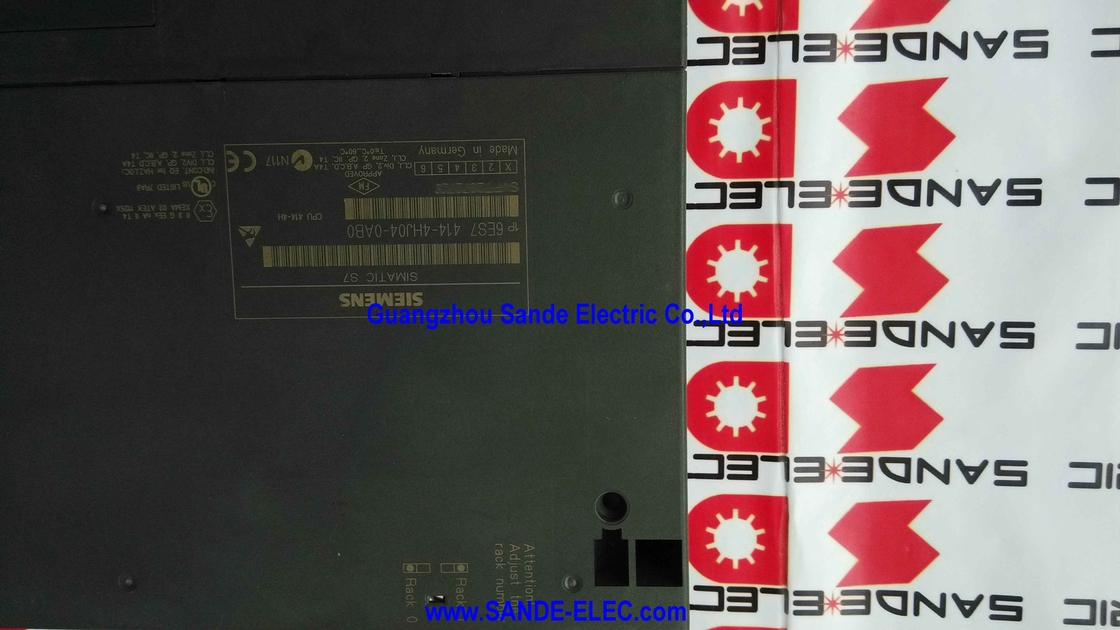
Siemens 6ES7414-4HJ04-0AB0 | SIMATIC S7-400H CPU 414H — 1.4MB / Dual PROFIBUS DP / 2 Sync Interfaces / 4.5W / S7-400H/F/FH
The Entry-Level 414H — Where It Fits in the S7-400H Range
The S7-400H offers a progression of H-CPUs matched to programme size. The CPU 412H starts at 768KB with a single MPI/DP interface. The 6ES7414-4HJ04-0AB0 steps up to 1.4MB and adds a second dedicated PROFIBUS DP master port — a meaningful jump when two independent field device networks need to be managed from the same redundant controller. Above it sits the 6ES7414-4HM14-0AB0 at 2.8MB for larger programmes, and the CPU 417H variants at up to 20MB for the largest continuous process automation tasks.
The 1.4MB of the 4HJ04 variant divides equally — 700KB data and 700KB programme. Process control programmes lean heavily on data memory: PDOs, alarm tables, historian buffers, and recipe structures consume data memory faster than pure Boolean logic does. The 700KB/700KB split reflects this balance. For a mid-scale process unit — a distillation stage, a reactor section, a water treatment module — 700KB of programme memory accommodates several hundred PID loops, associated alarm logic, and SCADA communication handling comfortably.
At 4.5W, the thermal contribution to the rack is modest. In multi-rack S7-400H installations where cabinet thermal management is a real engineering consideration, the CPU 414H's efficiency leaves headroom for the signal modules, communication processors, and function modules sharing the same enclosure.
Key Specifications
| Parameter | Value |
|---|
| Part Number | 6ES7414-4HJ04-0AB0 |
| Total Memory | 1.4 MB (700KB data + 700KB program) |
| MPI/DP Interface | 1 × 12 Mbit/s |
| DP Interface | 1 × 12 Mbit/s |
| Sync Interfaces | 2 × IF 960 fibre-optic |
| Power Loss | 4.5W |
| Dimensions | 219 × 50 × 290mm |
| Weight | 1.07 kg |
| Systems | S7-400H, S7-400F/FH |
Two DP Interfaces — Independent Network Segments
The MPI/DP combined interface and the dedicated DP interface allow the CPU 414H to manage two separate PROFIBUS networks simultaneously. In process plants, separating drive equipment (variable-speed pumps, motor starters) from instrumentation (pressure, flow, temperature transmitters) onto independent bus segments is a standard design practice.
Drives generate high-frequency bus traffic with rapid speed and torque data updates; instrumentation runs at slower update rates. On a shared segment, drive traffic competes with instrumentation updates and reduces the effective update rate for transmitter data.
Two separate DP master interfaces eliminate this competition. Each segment runs at its own optimised baud rate and cycle time, independent of the other.
Replacing the 6ES7414-4HJ04-0AB0 in a Running System
The S7-400H supports online CPU replacement. The procedure: power off the rack with the failed CPU, replace the module, restore power. The replacement CPU synchronises automatically with the still-running partner through the sync links, recovers the current programme and data state, and re-enters hot-standby without a programme download. Matching the replacement CPU's firmware version to the running partner is recommended to ensure synchronisation compatibility.
FAQ
Q1: How does the 4HJ04 compare to the 4HM14 (2.8MB) variant?
The 4HJ04 provides 1.4MB total (700KB data + 700KB programme); the 4HM14 provides 2.8MB (1.4MB each). Both carry the same dual DP, dual sync interface configuration. Choose the 4HJ04 for process units where programme and data fits within the 1.4MB envelope. Choose the 4HM14 when larger programme structures, more extensive data objects, or more process units sharing a single controller require the additional capacity.
Q2: Can the CPU 414H run alone without a partner?
Yes — as single (degraded) operation. The CPU runs the programme and manages both PROFIBUS networks normally, but automatic failover is unavailable. The system generates a diagnostic alarm. Single operation is intended for planned maintenance periods. Prolonged degraded-mode operation significantly raises the risk profile for the controlled process.
Q3: Is TIA Portal supported?
No. The CPU 414H requires STEP 7 Professional V5.4 SP4 or later. TIA Portal supports standard S7-400 CPUs but not the S7-400H family. For new high-availability projects, Siemens offers the S7-1500H as the TIA Portal-compatible successor platform — though migration involves full hardware redesign and programme re-engineering.
Q4: What does online CPU replacement involve?
Power off the failed CPU's rack; replace the module; restore power. The replacement CPU automatically synchronises with the running partner through the fibre-optic sync links, receives the current programme and data state, and re-enters hot-standby. No manual programme download is required. Confirm firmware version match between the new module and the running partner before installation.
Q5: When should the CPU 412H be chosen over the CPU 414H?
The CPU 412H is the right choice when the process programme fits within approximately 640KB (leaving some operational margin), and when a single PROFIBUS DP network is sufficient for all field devices. The 414H is justified when either the programme needs more memory than the 412H provides, or when separating field devices across two independent PROFIBUS segments requires a second DP master interface.



 Your message must be between 20-3,000 characters!