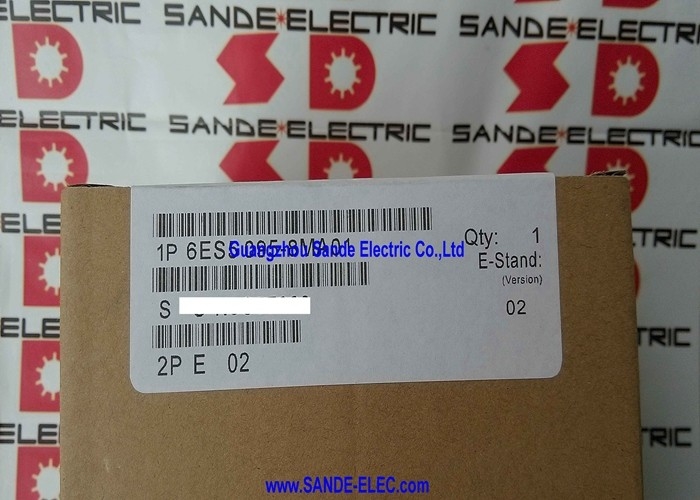
Siemens 6ES5095-8MA01 | SIMATIC S5-95U Compact Controller — 16 DI / 16 DO / 8 AI / 1 AO / PID / Alarm + Counter DI / SINEC L2
Everything in One Housing — The S5-95U's Defining Design
The S5-95U compact controller integrates CPU, power supply, digital I/O, analogue I/O, and an onboard PID controller into a single DIN rail housing. No separate rack. No separate power supply module. No backplane to assemble. For the control applications it was built for — compact machines, pump stations, HVAC systems, small process units — this integration eliminated the infrastructure overhead of Siemens's larger rack-based S5 platforms (S5-135U, S5-155U) and allowed a complete functional controller to be wired directly at the machine.
The depth of onboard capability set the S5-95U apart from simpler compact PLCs of its era. Sixteen digital inputs and outputs handled standard discrete I/O. Eight analogue inputs covered the full range of process measurements — temperature, pressure, flow, level. One analogue output drove a VFD, control valve, or positioner directly. The integrated PID block closed the control loop entirely within the S5-95U without any external function module. This is what made the S5-95U the default choice for single-loop closed-loop control in small process installations through the 1990s.
Key Specifications
| Parameter |
Value |
| Part Number |
6ES5095-8MA01 |
| Digital Inputs |
16 × 24VDC |
| Digital Outputs |
16 × 24VDC |
| Analog Inputs |
8 |
| Analog Output |
1 |
| Alarm DI |
4 (hardware interrupt) |
| Counter DI |
2 (hardware) |
| PID |
Integrated firmware block |
| Networking |
SINEC L2 |
| Expansion |
Up to 32 S5-100U modules |
| Status |
Discontinued spare |
Alarm and Counter Inputs — Faster Than the Scan Cycle
Standard digital inputs are polled once per PLC scan. A pulse shorter than one scan is invisible to the programme. The four alarm inputs bypass this limitation completely — each generates a hardware interrupt on every edge transition, suspending the normal scan and executing a dedicated interrupt routine in microseconds. Emergency stops, safety limits, and any fault condition requiring immediate response use these inputs, not the standard input channels.
The two counter inputs accumulate pulses from flow meters, incremental encoders, and production counters at frequencies beyond what any scan-cycle input can reliably capture. The hardware counter runs independently; the programme reads the current count value each scan.
Onboard PID — Closed-Loop Control Without Additional Hardware
The eight analogue inputs feed directly into the S5-95U's integrated PID firmware block. Configurable P, I, and D gains and a programmable sample interval allow straightforward single-loop temperature, flow, and level control entirely within the S5-95U. The result writes to the single analogue output, driving the control element. For the applications the S5-95U was designed for, this self-contained closed-loop capability was one of its strongest competitive advantages — no function module, no additional cost, no additional programming complexity.
FAQ
Q1: What programming software and connection method does the S5-95U require?
STEP 5 only — not STEP 7 or TIA Portal. Physical connection uses the PG interface via a USB-to-TTY (AS511) adapter. STEP 5 runs natively on Windows XP; Windows 7/10/11 requires a virtual machine. No direct USB connection to modern laptop programming environments is available.
Q2: How many and what types of expansion modules can be added?
Up to 32 S5-100U family expansion modules via the dedicated expansion bus. Available types include digital I/O modules, analogue I/O modules, Ex-rated modules for hazardous areas, fast counter modules, and closed-loop control modules. The S5-95U uses its own expansion bus and cable — not the S5-100U rack system.
Q3: Is the backup battery required for normal operation?
Not for programme execution — the programme is in EPROM and is retained without battery power. The battery maintains retentive data (counters, timers, flags marked retentive) through power interruptions only. Without a battery, all retentive values reset at each power-up. Applications tracking cumulative production counts or elapsed time require a functional battery. Replace proactively every 3–5 years with the specified 3.6V lithium cell.
Q4: What does the integrated PID block require in terms of configuration?
The PID is a STEP 5 firmware function block called at a configurable sample interval, typically tens to hundreds of milliseconds. It reads from a selected onboard analogue input, compares to a setpoint, calculates a corrective output with P/I/D gain parameters set in the programme, and writes to the single analogue output. No additional hardware is required for single-loop control.
Q5: What is the migration path from S5-95U to a modern Siemens platform?
The SIMATIC S7-1200 is the recommended target — comparable compact DIN-rail form factor, current product lifecycle, and TIA Portal engineering. Migration requires rewriting the STEP 5 programme in TIA Portal (conversion tools assist; manual validation is always required), replacing SINEC L2 networking with PROFINET, and updating connected operator panels. For a typical small S5-95U installation, plan 10–30 person-hours over a maintenance shutdown.



 Your message must be between 20-3,000 characters!