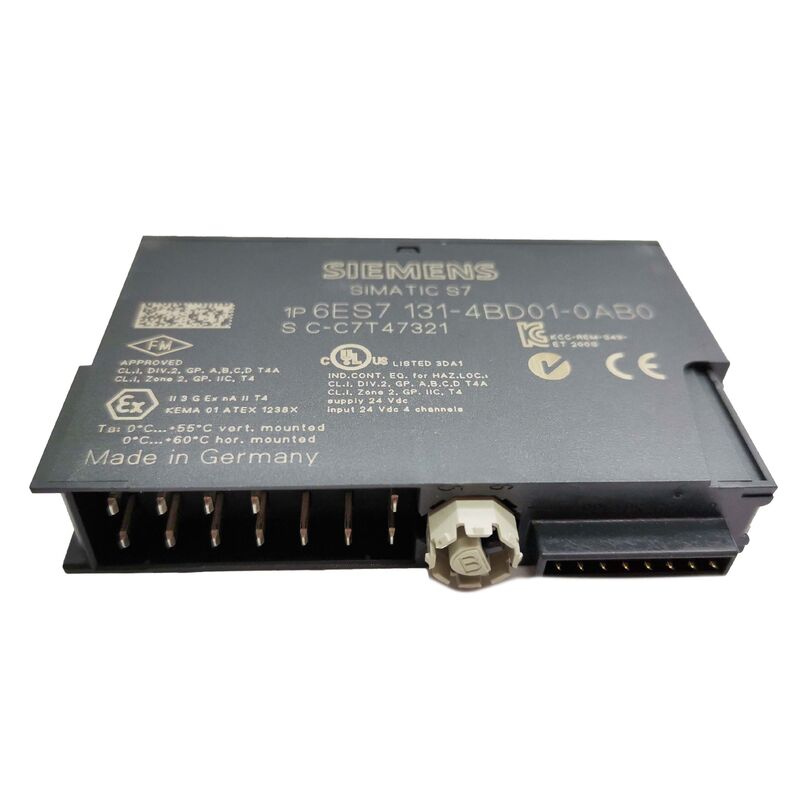
6ES7131-4BD01-0AB0 | ET 200S 4DI DC24V HF — 4 Inputs / 24VDC / High Feature / 15mm / Hot-Swap / Wire-Break Diagnostic
High Feature vs Standard — The Decision That Determines Diagnostic Capability
The ET 200S 4DI DC24V comes in two variants sharing identical hardware dimensions, terminal module compatibility, and basic input function. The distinction lies entirely in what happens beyond the basic 0/1 reading:
Standard variant 6ES7131-4BD01-0AA0, suffix -0AA0: Fixed function — reads 4 inputs, reports 0/1 states, illuminates channel LEDs. No configurable parameters, no channel-level diagnostics. Sufficient when the application simply needs to know whether a sensor is active.
High Feature variant 6ES7131-4BD01-0AB0, suffix -0AB0, this module: Adds parameterisation via PROFIBUS DP or PROFINET configuration. Most practically, this enables wire-break and short-circuit diagnostic detection per channel: when a sensor's supply wire breaks, the module detects the fault and generates a diagnostic interrupt to the S7 CPU rather than silently reading 0. Applications where a sensor failure must be actively reported — rather than assumed to be a machine condition — require the HF variant.
The HF module is more expensive. The Standard module costs less and is sufficient for the majority of standard digital input applications. Specify HF when channel-level fault detection is an engineering requirement; specify Standard when the application simply needs contact closure reading.
Key Specifications
| Parameter | Value |
|---|
| Channels | 4 |
| Input Voltage | 24V DC |
| Input Current | ~7mA |
| Response Time | ~3ms |
| Width | 15mm |
| LED | 1 per channel |
| Hot Swap | Yes |
| Cable | Up to 1,000m |
| Status | Discontinued spare |
Terminal Module System — Wiring Stays, Electronics Swap
The ET 200S separates the electronics module, this unit, the active signal processing, from the terminal module, the passive DIN-rail-mounted wiring base. This split is the system's most practical maintenance feature.
Field wiring connects once to the terminal module's screw terminals and stays connected permanently. When the electronics module fails, it unclips from the terminal module in seconds — no wires to disconnect, no labels to verify, no rewiring risk. The replacement 6ES7131-4BD01-0AB0 clips in, and all four input channels are immediately back in service.
Compatible terminal modules include TM-P15S23-A1, TM-P15C23-A1, and TM-P15N23-A1 — the specific selection depends on whether screw, spring-clamp, or other terminal type is specified for the installation. Terminal modules for the Standard and HF variants are identical; the same terminal module accepts either -0AA0 or -0AB0 electronics without wiring changes.
Sensor Compatibility — What Connects to the 4DI HF
Three-wire PNP sourcing proximity sensors connect directly — the sensor's switching output drives the input positive when active. The 7mA input current is within the sink capability of all standard 24VDC PNP proximity switches. Mechanical contacts and reed switches connect in two-wire positive-signal configuration. Two-wire sensors with 24VDC self-powered output are compatible if the sensor's leakage current in the open state stays below the module's turn-on threshold — typically well below 1mA for modern two-wire sensors.
Application Scenarios
Registration and position sensing: Four limit switches at a machine section monitoring axis positions. If a cable is cut or pulls loose, the HF module's wire-break diagnostic reports the fault immediately to the CPU's OB82, rather than allowing the machine to continue on a silent false-zero.
Conveyor sensor groups: A photoelectric sensor, an encoder reference, a safety door switch, and a product presence sensor at one conveyor point — all four in one 15mm slot.
ET 200S maintenance spare: For existing ET 200S installations still in production, the 4DI HF remains the correct replacement for a failed module. The same terminal module wiring stays in place; the electronics swap takes seconds.
FAQ
Q1: Is the response time of 3ms the total latency from sensor to PLC?
No. The 3ms is the electronics module's own input filter time — the delay between the input terminal voltage changing state and the module's internal register updating. Total latency from sensor to S7 CPU process image = input filter time ~3ms + PROFIBUS DP bus cycle time 1–10ms typical + CPU scan cycle time. For precise timing analysis, all three must be summed.
Q2: Can this module work in a PROFINET ET 200S station?
Yes. ET 200S electronics modules, including this 4DI HF, communicate via the ET 200S backplane bus to whichever interface module is installed — IM 151-1 for PROFIBUS DP or IM 151-3 PN for PROFINET. Changing the head module from PROFIBUS to PROFINET does not require changing signal modules.
Q3: Is the ET 200S platform still available, and what is the successor platform?
The ET 200S is discontinued. The current-generation successor for new installations is ET 200SP — similar modular I/O concept with more compact module widths and PROFINET as the primary interface. For existing ET 200S stations in maintenance, the 6ES7131-4BD01-0AB0 is available through the industrial aftermarket.
Q4: Can HF modules replace Standard modules in an existing station?
Yes. The HF and Standard 4DI modules use the same terminal module interface and field wiring pinout. A station wired for Standard modules accepts HF modules without wiring changes. The additional diagnostic capability becomes available once the HF module is configured through STEP 7 or TIA Portal hardware configuration — the terminal module wiring requires no modification.



 Your message must be between 20-3,000 characters!