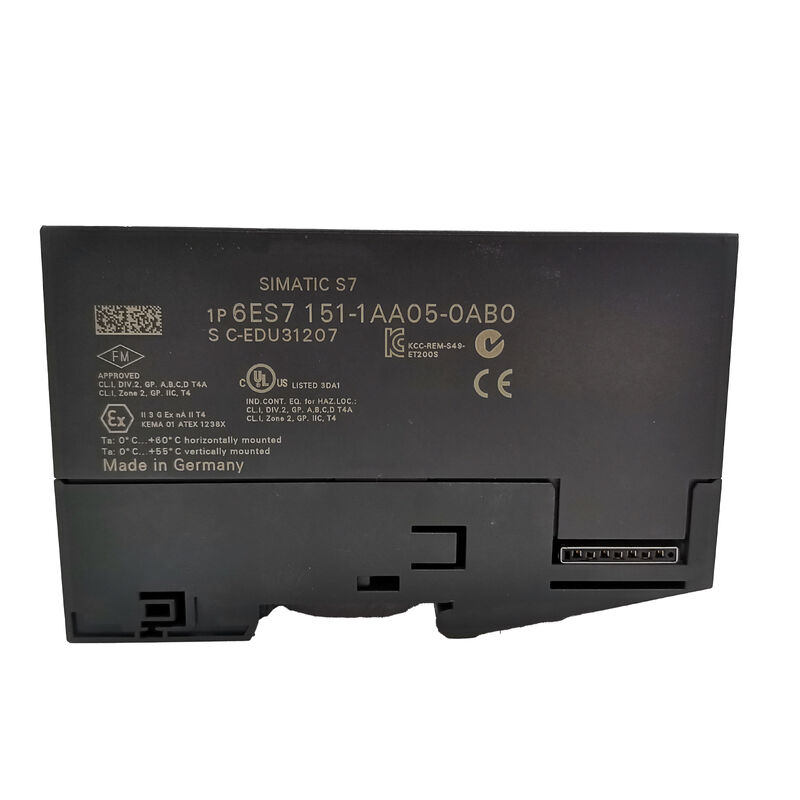
6ES7151-1AA05-0AB0 | ET 200S IM 151-1 Standard — PROFIBUS DP / 12 Mbit/s / 244 Bytes I/O / DPV0 + DPV1 / Direct Data Exchange / 63 Modules
The Station Head — What the IM 151-1 Standard Handles
Every ET 200S station begins with an interface module at its left end. The IM 151-1 is that module — the station's sole connection to the PROFIBUS DP network, and the only path through which all I/O data, diagnostics, and parameters travel between the DP master and the station's installed electronics modules.
The "Standard" designation means this module covers the full PROFIBUS DP requirement for the overwhelming majority of distributed I/O applications. Cyclic data exchange at up to 12 Mbit/s (DP V0), acyclic parameter access and online diagnostics (DP V1), option handling for flexible machine variants, and — added in the AA05 revision — direct data exchange in publisher mode. For applications that don't require isochronous synchronisation with the machine cycle, the Standard IM 151-1 does everything the station needs.
Key Specifications
| Parameter |
Value |
| Part Number |
6ES7151-1AA05-0AB0 |
| Revision |
AA05 |
| Interface |
RS-485, 9-pin Sub-D |
| Transfer Rate |
Up to 12 Mbit/s |
| I/O Data |
244 bytes in / 244 bytes out |
| Max. Modules |
63 |
| Protocol |
DP V0 + DP V1 |
| Supply |
24VDC 20.4–28.8V |
| Power Loss |
3.3W |
| Dimensions |
45 × 119.5 × 75mm |
| Status |
Discontinued spare |
What DP V0 and DP V1 Each Provide
DP V0 is the cyclic layer — input and output data exchange between the DP master and the ET 200S station happens automatically every bus cycle, without explicit programme instructions. The exchange is continuous, deterministic at the configured baud rate, and transparent to the PLC programme, which simply reads and writes the I/O data areas assigned in the hardware configuration.
DP V1 adds acyclic services on top. With DP V1 active, the DP master can read data records from individual ET 200S modules DS_READ and write parameters to them DS_WRITE while the cyclic exchange continues uninterrupted. This is the mechanism behind online modification of analogue module scaling, temperature module engineering units, and any module parameter that can be updated without taking the station offline. The maximum DP V1 parameter transfer is 240 bytes per slot — enough for the most heavily parameterised ET 200S function modules.
Direct Data Exchange Publisher — Added in AA05
The AA05 revision's most significant addition over its predecessors is the direct data exchange publisher function. In publisher mode, the IM 151-1 AA05 broadcasts its 244-byte input data onto the PROFIBUS bus at a defined point in the DP cycle. Other devices on the same segment — configured as subscribers — read this data directly without routing it through the DP master's programme.
In conveyor and transfer systems where multiple motion controllers share sensor or position data, publisher mode reduces DP master processing overhead and shortens the effective update latency for subscriber devices. The AA05 is backwards compatible with all AA00–AA04 installations — it installs as a drop-in replacement without hardware configuration changes.
Option Handling — Managing Multi-Variant Machines
When Option Handling is enabled in the STEP 7 parameter set, the DP master accepts module slots occupied by RESERVE modules rather than the configured electronics module — without generating a diagnostic fault. This is the mechanism that allows a single hardware configuration to serve machines with optional modules: a high-end variant has the measurement module installed; the base variant has a RESERVE module in that slot. Both start normally without separate hardware configurations.
Without Option Handling, the DP master checks every configured slot against the physical station at startup. Any mismatch — an optional module absent — prevents the station from entering RUN.
FAQ
Q1: The AA06 has superseded the AA05. Are they interchangeable?
Yes. The AA06 replaces the AA05 physically and functionally without configuration changes. Dimensions, PROFIBUS connector, and functional behaviour are identical. The AA06 contains minor firmware refinements but appears identically to any DP master's hardware configuration. An AA06 installed in place of a failed AA05 enters service without reconfiguration.
Q2: How is the PROFIBUS station address set?
Via a rotary selector on the module's front face, accessible with a small screwdriver. The selector sets the address from 1 to 125 in hardware. The physical address must match the value assigned to this slave in the DP master's STEP 7 hardware configuration. A mismatch illuminates the BF Bus Fault LED and prevents the station from joining the bus cycle.
Q3: What cable length is allowed at 12 Mbit/s?
Maximum segment length at 12 Mbit/s is 100m. At 1.5 Mbit/s the limit extends to 200m; at 187.5 kbit/s it reaches 1,000m; at 9.6 kbit/s, 1,200m. These are segment lengths — repeaters allow longer total bus runs. Correct PROFIBUS cable Type A per IEC 61158 with proper shielding and bus termination at each segment end is required at all speeds.
Q4: Can the firmware on the AA05 be updated in the field?
Yes, via PROFIBUS DP using STEP 7's firmware update function. The update file is downloaded to the module over the live PROFIBUS connection; the module applies it and restarts. No additional hardware is needed. Verify product documentation for the specific firmware version before proceeding, as AA05-generation firmware updates may have different availability from AA06.
Q5: What data does publisher mode broadcast?
Publisher mode broadcasts the complete 244-byte input area of the ET 200S station — everything in the station's process input image: digital input states, analogue measurements, motor starter feedback data. Subscriber devices on the same PROFIBUS segment read this data directly without master programme involvement.



 Your message must be between 20-3,000 characters!