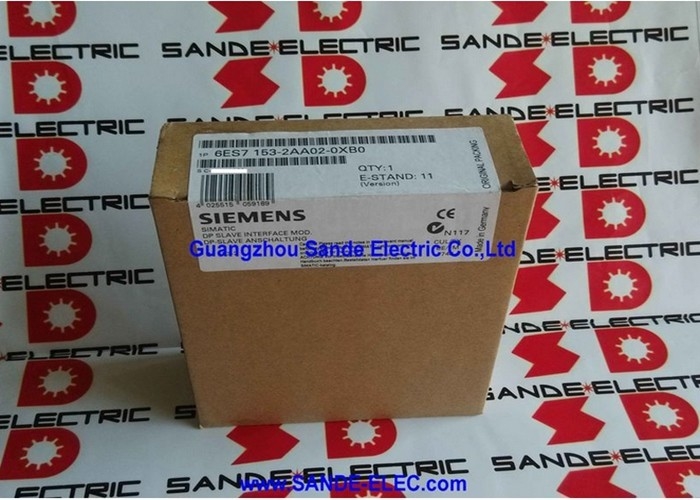
6ES7153-2AA02-0XB0 | SIMATIC ET 200M IM 153-2 — PROFIBUS DP / 8 Modules / Redundancy / 10ms Timestamping / ATEX Zone 2 + Div 2 / 24VDC
Choosing Between IM 153-2AA and IM 153-2BA — What Changes Between Them
The ET 200M interface module family offers several IM 153-2 variants. Getting the right one depends on three questions: module count, DP/PA Link compatibility, and station capacity. The table below places the 6ES7153-2AA02-0XB0 in context:
| Variant |
Max. Modules |
Redundancy |
Timestamping |
DP/PA Link |
| IM 153-1 (1AA03) |
8 |
No |
No |
No |
| IM 153-2AA (this module) |
8 |
Yes |
Yes |
No |
| IM 153-2BA (2BA series) |
12 |
Yes |
Yes |
Yes |
The 2AA02 provides redundancy and timestamping in an 8-module station — the same physical capacity as the simpler IM 153-1, but with the reliability and event-recording features of the higher-end 2BA series. For stations that do not need the 2BA's 12-module capacity or DP/PA Link integration, the 2AA02 is the correct and more cost-effective specification.
Critical limitation: The 6ES7153-2AA02-0XB0 cannot function as an interface module in DP/PA Link or Y-Link architectures. Those configurations require the 2BA series.
Key Specifications
| Parameter |
Value |
| Max. Modules |
8 (SM + FM + CP combined) |
| PROFIBUS |
12 Mbit/s, auto baud detect |
| Supply |
24V DC (20.4–28.8V) |
| Current |
550 mA max |
| I/O Addressing |
128 bytes in / 128 bytes out |
| Mains Buffering |
5ms |
| Redundancy |
Yes |
| Timestamping |
10ms, up to 128 inputs |
| ATEX |
Zone 2 / Class I Div 2 |
| Dimensions |
40 × 125 × 117mm |
Redundancy — Dual IM Configuration for High-Availability Stations
In a redundant ET 200M station, two IM 153-2 modules occupy the same rack — one active, one in standby. Both connect to the PROFIBUS DP cable; only the active module handles cyclic data exchange. When the active IM 153-2 fails, the standby monitors this continuously and switches to active mode within the DP master's watchdog tolerance. I/O modules in the rack continue operating through the transition without data loss.
A single IM 153-2 failure in a non-redundant station means the entire station drops off the PROFIBUS bus — all 128 input and output bytes go dark. In a redundant configuration, the same fault generates a maintenance alarm while the station stays operational. The cost difference between one IM and two is small relative to the cost of an unplanned production stop.
10ms Timestamping — Event Sequence Recording
The IM 153-2's timestamping function records rising and falling edges of digital inputs with 10ms resolution, storing events in an internal buffer (15 buffers, up to 20 messages each) that the DP master reads acyclically. Up to 128 inputs across the 8-module station can participate.
Cyclic scan data records input state at the end of each scan cycle. It cannot answer: "which input changed first?" or "what was the exact sequence of events before the machine stopped?" Timestamped event records can. This matters in post-incident analysis, batch audit records, and energy monitoring applications where the sequence of events — not just the final state — is the engineering question.
FAQ
Q1: Can function modules and communication processors be installed alongside signal modules?
Yes. The eight slots accept any combination of S7-300-compatible signal modules (SM), function modules (FM), and communication processors (CP) released for ET 200M use. FM 350-1/2 counters and FM 352 cam controllers operate in ET 200M with the same parameterisation as in a central rack. Total count of SM + FM + CP combined must not exceed eight per 2AA02 station.
Q2: How is the PROFIBUS station address set?
Via a two-row DIL switch on the IM 153-2 front face, encoding the address in binary. Valid range: 1–125. The address takes effect at power-up immediately — no power cycle after changing the switch. The physical switch address must match the address assigned in the DP master's hardware configuration.
Q3: Does this module support hot swap of I/O modules under power?
Yes, for signal modules released for this function. When a module is removed, the IM 153-2 reports the slot as empty to the DP master. When a replacement is inserted, data exchange resumes for that slot. Not all S7-300 modules support hot swap — verify each module type's documentation before relying on this in a live installation.
Q4: Can this module be used in a DP/PA Link or Y-Link?
No. The 2AA variant is for direct ET 200M station use only. DP/PA Link and Y-Link require the 2BA series variants. Specifying a 2AA module in a DP/PA Link application will not work — the 2BA series must be specified.
Q5: Where is the 6ES7153-2AA02-0XB0 sourced?
Through the ET 200M PROFIBUS interface module aftermarket — specialist industrial automation parts dealers and tested surplus suppliers. Confirm the 2AA02-0XB0 variant: the 2BA variants have different module capacity and DP/PA Link compatibility. When sourcing for hazardous area use, verify ATEX documentation accompanies the unit.



 Your message must be between 20-3,000 characters!