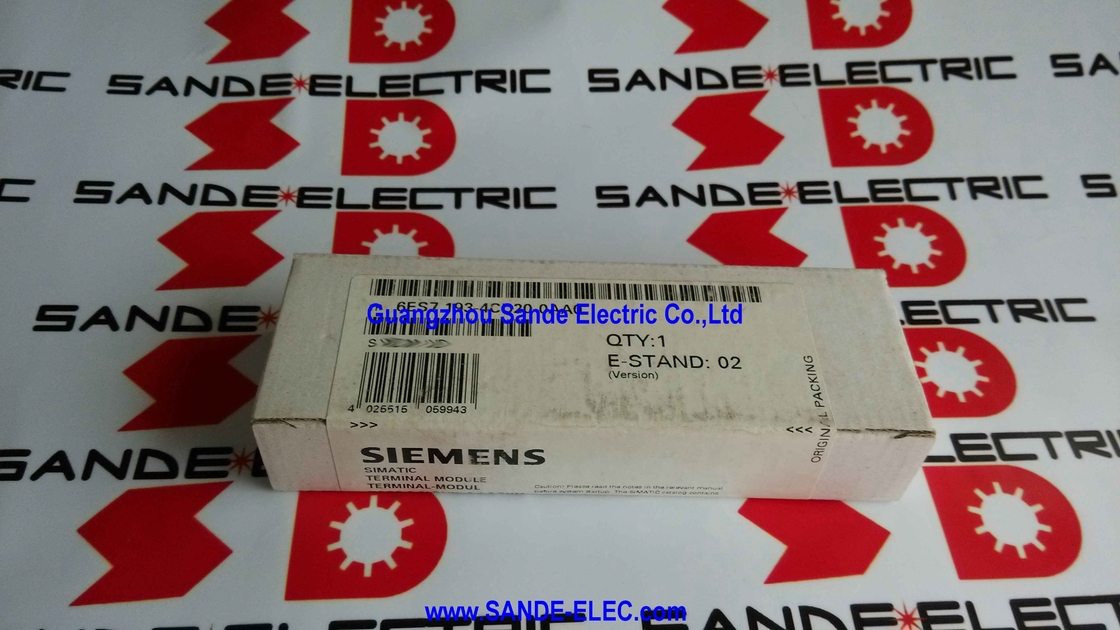
Siemens 6ES7193-4CD20-0AA0 | SIMATIC ET 200S Terminal Module TM-P15S23-A0 — Power Modules / 15mm / Screw / 2×3 Terminals / AUX1 Access + Interrupted
The TM-P15S23-A0 and the AUX1 Interruption — Why It Matters
In the ET 200S station architecture, the AUX1 bus is the auxiliary 24V DC supply rail that runs through the station from a power module, distributing supply voltage to the electronic I/O modules in that power zone. At every power module position, the station designer must decide: does the AUX1 bus continue through uninterrupted, or does it break here to start a new zone?
The TM-P15S23-A0's "A0" designation gives the answer for this terminal module: AUX1 is interrupted. The AUX1 supply from the left does not pass through to the right. Whatever power module is mounted on this terminal module defines a new, independent AUX1 supply for the modules to its right. Combined with the terminal access ("A" in A0 indicates that a wiring terminal for AUX1 is provided at this position), the station designer can connect a new 24V DC source at this point, creating independently controlled power zones within the same ET 200S station.
This matters operationally. Two groups of I/O modules — one controlling a machine section that must be de-energised for safe access, another controlling equipment that must remain operational — can occupy the same ET 200S station with each group powered from a separate power module mounted on its own TM-P15S23-A0. Cutting the field supply to the first group leaves the second group fully operational.
Key Specifications
| Parameter |
Value |
| Designation |
TM-P15S23-A0 |
| For |
ET 200S power modules |
| Width |
15mm |
| Terminals |
2×3 (6 total, screw) |
| AUX1 |
Access provided; interrupted |
| Dimensions |
15 × 132 × 43mm |
| Weight |
65g |
| Status |
Spare part |
TM-P15S23-A0 vs Adjacent Variants — Choosing the Right One
| Designation |
Width |
Terminals |
AUX1 |
| TM-P15S22-01 |
15mm |
2×2 (4 terminals) |
No access — continuous |
| TM-P15S23-A0 |
15mm |
2×3 (6 terminals) |
Access provided — interrupted |
| TM-P15S23-A1 |
15mm |
2×3 (6 terminals) |
Access provided — continuous |
| TM-P15C23-A0 |
15mm |
2×3, spring-clamp |
Access provided — interrupted |
The TM-P15S22-01 has 4 terminals and passes AUX1 through without access. The TM-P15S23-A0 has 6 terminals and breaks AUX1 — giving the designer both an accessible AUX1 terminal and a zone boundary. The TM-P15S23-A1 provides AUX1 access without breaking the bus. Specify the correct variant from the station's power zone design before ordering.
Why the Terminal Module Exists — No-Rewiring Module Swap
The entire reason the ET 200S uses separate terminal modules and electronic modules is field maintenance efficiency. All field wiring terminates on the terminal module, which stays fixed on the DIN rail. When the power module fails, the electronic unit is removed and a replacement snaps in — inheriting all field connections instantly. No wiring to disconnect, no terminals to identify, no risk of reconnection errors. What would take several minutes with conventional wiring takes seconds.
This TM-P15S23-A0 provides that same advantage specifically for the power module position — the mains and supply wiring remains intact, and only the power module electronics need replacement.
FAQ
Q1: Can this terminal module accept ET 200S I/O electronic modules?
No. TM-P terminal modules are mechanically and electrically specific to power modules. The connector geometry physically prevents I/O electronic modules from seating into a TM-P, and power modules cannot seat into TM-E I/O terminal modules. This mechanical type-coding is intentional — it prevents cross-installation errors during both first installation and routine maintenance.
Q2: What is the difference between the screw terminal TM-P15S23-A0 and the spring-clamp TM-P15C23-A0?
Both are 15mm wide, 2×3 terminals, AUX1 interrupted (A0). The only difference is the terminal technology: S = screw (requires screwdriver, well-established connection method); C = cage-clamp spring (tool-less push-in connection, faster wiring, better vibration resistance). The choice is a field wiring preference; both provide equally reliable electrical connections.
Q3: What does the AUX1 interruption allow in practical station design?
It allows the station to be divided into independently powered zones. I/O modules to the right of the TM-P15S23-A0 receive their AUX1 supply from the power module mounted on this terminal module — independently from modules to the left. A contactor or switch in the new AUX1 supply path can de-energise the right-hand zone without affecting the left-hand zone. This zoning capability supports safe access procedures and selective de-energisation within a single ET 200S station.
Q4: Does this terminal module require any configuration in STEP 7 or TIA Portal?
No. Terminal modules are passive hardware with no electronic intelligence. They are not represented as separate configurable items in the software. In STEP 7 or TIA Portal, the station is configured by specifying the electronic modules and their slot positions; the terminal module type is implied by the slot position and module assignment, not separately configured.
Q5: Is this part still available for new ET 200S installations?
The TM-P15S23-A0 is available from Siemens as a spare part for existing ET 200S installations. For new distributed I/O designs, Siemens recommends the current-generation ET 200SP platform, which uses a different base unit system (BU) not compatible with ET 200S terminal modules. For existing ET 200S stations that need expansion or spare parts, the full range of ET 200S terminal modules remains available through Siemens service channels and distributors.



 Your message must be between 20-3,000 characters!