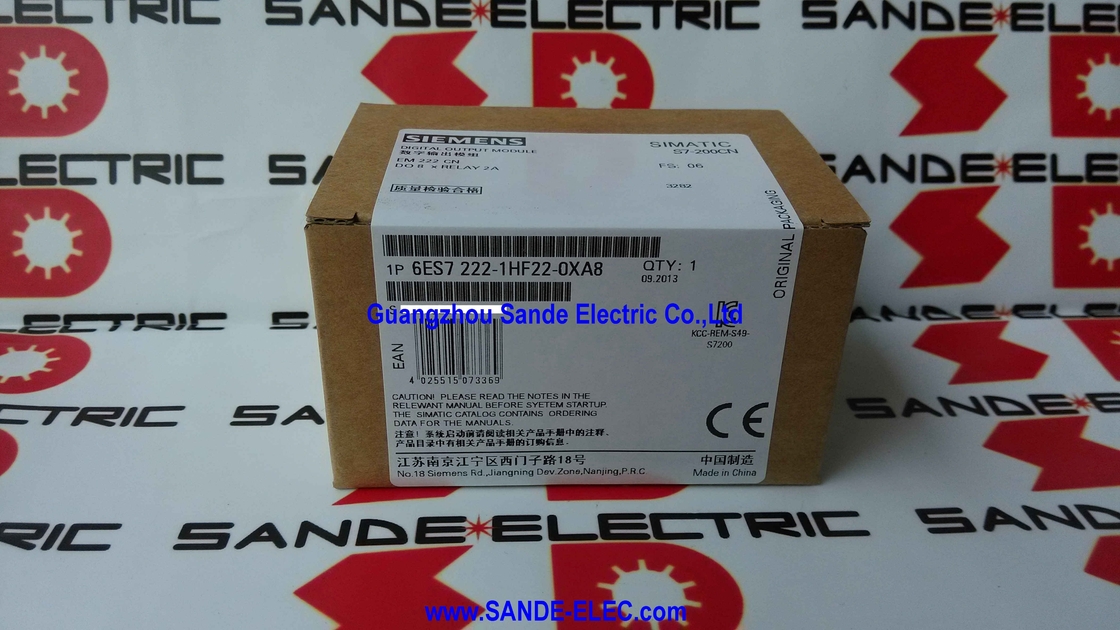
Siemens 6ES7222-1HF22-0XA8 | SIMATIC S7-200 CN EM 222 — 8 Relay Outputs / 2A / AC + DC Switching / S7-22X / CE / 62×45×80mm / Discontinued Spare
Why Relay Over Transistor — The Voltage Flexibility That Defines the Choice
The relay and transistor EM 222 modules share the same channel count, the same housing, and the same address in the expansion chain. What separates them is fundamental: a transistor output switches 24VDC only, while a relay contact switches whatever voltage is wired to it — up to the rated maximum, AC or DC, with complete galvanic isolation between the PLC circuit and the field load.
That isolation is the relay's defining advantage in mixed-voltage installations. Channel 1 can switch a 230VAC motor contactor coil. Channel 2, a 24VDC solenoid valve. Channel 3, a 48VDC safety relay. All from the same module, simultaneously, without any electrical interaction between circuits. A transistor module in this situation requires external interposing relays for every non-24VDC load — adding cost, panel space, and additional failure points.
Where the transistor wins is speed and cycle life. Relay contacts switch in milliseconds; transistors switch in 100–300 microseconds. For outputs that cycle frequently — pneumatic valves on packaging lines, high-speed dosing valves — relay contact wear becomes a maintenance concern. The relay EM 222 is the right choice when loads are infrequent-cycle or include AC voltages. The transistor EM 222 (6ES7222-1BF22-0XA8) is the right choice when all loads are 24VDC and fast or frequent switching matters.
Key Specifications
| Parameter |
Value |
| Output Type |
Relay contacts |
| Channels |
8 |
| Output Current |
2A per contact |
| Voltage |
AC or DC (up to contact rating) |
| Short-Circuit Protection |
None — external fuse required |
| Power Loss |
2W |
| Dimensions |
62 × 45 × 80mm |
| Compatible CPUs |
S7-22X only |
| Status |
Discontinued spare |
External Fuse Requirement — Not Optional
Relay contacts have no current-sensing or limiting capability. A short circuit on a relay output drives unlimited current until an external protection device clears it — and the relay contact itself may be damaged before the fuse clears.
Every relay output channel must have an external fuse or MCB in series, sized to protect the contact (2A rating), the field wiring, and the load. For 24VDC circuits: 1–2A miniature fuses on a fused terminal strip adjacent to the module. For 230VAC circuits: B or C curve MCBs of 1–2A. Freewheeling diodes across DC inductive loads (relay coils, solenoids) suppress reverse voltage spikes at switch-off and significantly extend contact life.
Contact Life — Planning for Inductive Loads
Mechanical contact life is typically around 10 million operations. Electrical life at rated conditions (2A) is typically 100,000–300,000 operations. For standard machine sequencing — start/stop on operator command, batch-triggered valve operations, shift-start motor commands — this service life is years.
For outputs cycling hundreds of times per shift on pneumatic or hydraulic valves, contact electrical life may expire within weeks. High-cycle applications belong on the transistor EM 222.
FAQ
Q1: Can different channels switch different voltages simultaneously?
Yes. Each relay contact is fully isolated — no common electrical path between channels. Channel 1 can switch 230VAC, channel 2 24VDC, channel 3 48VDC, all at once. In practice, good installation practice groups outputs by voltage class on separate terminal sections and labels them clearly, but electrically the isolation between contacts supports any mixed-voltage combination.
Q2: How many relay EM 222 modules can connect to one S7-22X CPU?
Up to 7 for CPU 224, 224XP, and 226; up to 2 for CPU 221 and 222. Multiple EM 222 relay modules can fill the available slots — a CPU 226 with seven relay EM 222 modules provides 56 relay contacts in addition to the CPU's own onboard outputs. The CPU's internal 5V expansion supply must also be verified against the total current draw of all expansion modules.
Q3: How does the -0XA8 CN variant differ from the -0XA0 European variant?
Electrically and functionally identical — same relay ratings, same I/O count, same S7-22X bus compatibility. The difference is certification: -0XA8 carries CE only; -0XA0 additionally carries UL and cUL. For CE-only installations, the -0XA8 is a direct drop-in substitute. Both coexist in the same expansion chain without any hardware or programme changes.
Q4: What causes relay contacts to fail early and how is it prevented?
Inductive loads (relay coils, solenoid valves) generate a reverse voltage spike when switched off that arcs across the contact surfaces, eroding them over time. A freewheeling diode across each DC inductive load absorbs this spike, eliminating the arcing and extending contact life substantially. For AC inductive loads (motor contactor coils, transformer primaries), RC snubbers across the contacts reduce arcing at both make and break.
Q5: Where is the 6ES7222-1HF22-0XA8 sourced?
Through the S7-200 CN spare parts aftermarket — legacy automation dealers, industrial surplus suppliers, and specialist S7-200 distributors. The EM 222 relay module is one of the most widely stocked S7-200 CN spare parts globally. Confirm the -0XA8 variant and S7-22X CPU compatibility before ordering.



 Your message must be between 20-3,000 characters!