logo
Guangzhou Sande Electric Co.,Ltd.
Email Sales01@sande-elec.com TEL: 86--18620505228
Home > Products > PLC Programmable Logic Controller >
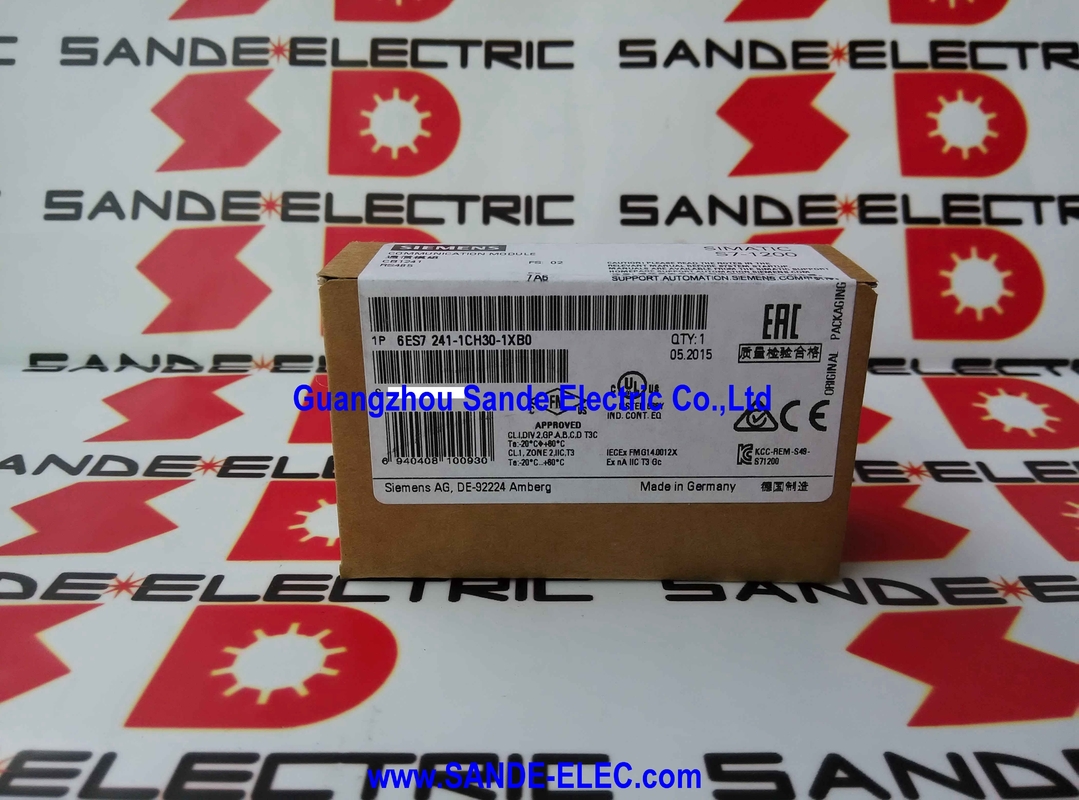
COMMUNICATION BOARD 6ES7241-1CH30-1XB0 6ES7 241-1CH30-1XB0 6ES7241-1CH3O-1XBO
  • COMMUNICATION BOARD 6ES7241-1CH30-1XB0  6ES7 241-1CH30-1XB0  6ES7241-1CH3O-1XBO

COMMUNICATION BOARD 6ES7241-1CH30-1XB0 6ES7 241-1CH30-1XB0 6ES7241-1CH3O-1XBO

Place of Origin GERMANY
Brand Name SIMENS
Certification CE RoHS
Model Number 6ES7241-1CH30-1XB0
Product Details
Condition:
New Factory Seal(NFS)
Item No.:
6ES7241-1CH30-1XB0
MFG:
Simens
Origin:
GERMANY
NET WEIGHT:
0.029KG
Highlight: 

PLC communication board 6ES7241-1CH30

,

Programmable logic controller interface module

,

Siemens PLC board with warranty

Payment & Shipping Terms
Minimum Order Quantity
1 pcs
Packaging Details
original packing
Delivery Time
0-3 days
Payment Terms
T/T,PayPal,Western Union
Supply Ability
100 pcs/day
Product Description

Siemens 6ES7241-1CH30-1XB0 | SIMATIC S7-1200 Communication Board CB 1241 — RS485, Freeport / Modbus RTU Master & Slave / USS, 300bps to 115.2kbps, 1000m, Screw Terminal


Overview

The Siemens 6ES7241-1CH30-1XB0 is the CB 1241 RS485 Communication Board — a compact plug-in board that clips directly onto the front face of any SIMATIC S7-1200 CPU to add a fully functional RS485 serial communication port without occupying a signal module slot on the DIN rail. At 38mm wide and 40 grams, it is one of the smallest expansions available for the S7-1200, and for applications that need serial communication alongside the CPU's native PROFINET Ethernet interface, it provides exactly the right capability in the smallest possible physical footprint.

What makes the CB 1241 more than a simple UART chip is the depth of protocol support it brings to the S7-1200.

Freeport mode allows the CPU program to directly control every aspect of serial communication — start character detection, telegram framing, timeout conditions, and data parsing — making it possible to communicate with virtually any serial device that speaks ASCII or binary data at standard baud rates.

Above this low-level mode sit ready-to-use protocol drivers that the S7-1200 executes without the user having to implement the protocol from scratch: Modbus RTU (both master and slave roles), USS for Siemens drive communication, and the 3964(R) block-oriented protocol used in some older Siemens industrial communication devices.

Together, these protocols cover the majority of serial communication needs encountered in machine and process automation.

The board connects to the CPU through the front connector interface built into every S7-1200 CPU. It draws its operating power entirely from the CPU's backplane bus (5V, 50mA) — no separate 24V connection is required.

The RS485 port itself connects via the screw terminal block that comes with the board, which wires to the twisted-pair cable running to the RS485 network.

An RS485 termination is provided by shorting specific terminal pins (TB to T/RB and TA to T/RA) — the effective termination resistance becomes 127Ω, appropriate for RS485 network endpoint termination.


Key Specifications

Parameter Value
Interface RS485, 2-wire half-duplex
Connection Screw terminal block
Supply 5V DC / 50mA (from CPU bus)
Protocols Freeport, ASCII, 3964(R), Modbus RTU M/S, USS
Data Rates 300 bps to 115.2 kbps
Max. Telegram 1 kByte
Cable Length 1000m max.
Modbus Addresses 1–49,999
Isolation 500VAC / 1 min.
Temp. Range −20 to +60°C
Protection IP20
Dimensions (W×H×D) 38×62×21mm
Weight 40g

Freeport Mode — Custom Serial Protocol Implementation

Freeport is the CB 1241's most flexible operating mode and the one that makes the board adaptable to virtually any serial device.

In Freeport mode, the S7-1200 CPU program takes complete control of the serial port — it determines the baud rate, parity, and stop bit settings, and then directly sends and receives raw data using the SEND_PTP and RCV_PTP (or MSG_SEND / MSG_RCV in TIA Portal) instruction set.

The practical application is integration with devices that don't implement a standardised industrial protocol: barcode scanners that output ASCII code strings when a label is read, weighing terminals that report weight values in a proprietary format, RFID readers that acknowledge commands with specific byte sequences, label printers that receive ZPL or EPL format strings, and data acquisition instruments that use custom command/response protocols.

For each of these, the programmer defines the exact communication sequence in the S7-1200 program using Freeport instructions, treating the serial port as a byte stream rather than a protocol stack.

The maximum Freeport telegram length of 1 kByte handles the common case of printing variable-length label data (up to approximately 1000 characters per label) or receiving measurement data strings without framing issues.

For applications requiring longer individual messages, the program can split transmission across multiple instruction calls.


Modbus RTU — Master and Slave in One Board

Modbus RTU is the most widely deployed serial communication protocol in industrial automation globally. Its simplicity, openness, and device support make it the default choice for interfacing automation systems with instruments, meters, drives, and sensors from virtually every manufacturer.

The CB 1241 supports both Modbus RTU Master (the S7-1200 polls other devices) and Modbus RTU Slave (the S7-1200 responds to another master's queries) roles:

Modbus RTU Master: The S7-1200 CPU initiates all communication, sending function code requests (read holding registers, read input registers, write single/multiple registers, read coils, write coils) to up to 247 slave devices on the RS485 bus.

In practice, the 1000m cable length limit and noise considerations are more constraining than the address space.

Common master applications include reading energy meters (power, current, voltage registers), commanding variable-speed drives (setpoint and enable/disable control via Modbus register writes), and collecting data from distributed sensors and transmitters.

Modbus RTU Slave: The S7-1200 responds to a Modbus master's read/write requests against a defined register map in the CPU's data memory.

This enables data exchange with SCADA systems, HMI servers, energy management systems, and other automation controllers that implement Modbus master capability — the S7-1200 appears as a standard Modbus device to any of them.

The Modbus address range of 1–49,999 covers both the standard Modbus addressing used by most devices and the extended range used by some SCADA systems.

The TIA Portal programming environment provides MODBUS_MASTER and MODBUS_SLAVE instruction blocks with clearly defined parameters for register address mapping, connection handles, and error reporting.


USS Protocol for Siemens Drive Control

The USS (Universal Serial Interface) protocol support is a direct benefit for installations where S7-1200 CPUs control Siemens variable-speed drives — MICROMASTER 420/440, SINAMICS G110, G120C, V20, and V90 — that have RS485 USS interfaces.

USS allows the S7-1200 to read and write drive parameters, command the drive's control word (enable/disable, direction, speed setpoint), and read the status word and actual speed value — all over the same RS485 cable that carries the CB 1241's serial communication.

A single RS485 network with one CB 1241 can address up to 31 USS-protocol drives simultaneously (the USS protocol supports addresses 0–30), with the S7-1200 program polling each drive sequentially.

TIA Portal provides dedicated USS instruction blocks (USS_DRIVE, USS_RPM, USS_WPM) that handle the protocol timing and data framing, leaving the programmer to work at the level of drive parameter numbers and physical values rather than raw byte sequences.


FAQ

Q1: Can the CB 1241 RS485 and the CM 1241 RS422/485 communicate module be used simultaneously on the same S7-1200 CPU?

Yes. The CB 1241 (this board) plugs into the CPU front face and does not consume a signal module slot.

The CM 1241 (a DIN-rail-mounted communication module) occupies a module slot on the S7-1200 rack extension.

Both can be installed and operate independently on the same CPU, providing two separate RS485 ports for applications that need two simultaneous serial connections — for example, one port for Modbus RTU to process instruments and a second for USS drive communication.


Q2: Modbus addresses 1–49,999 are listed. Does this mean Modbus register addresses are also supported beyond the 0–65,535 standard?

The 1–49,999 range refers to the Modbus slave station addresses (node addresses) that the CB 1241 can target in Modbus RTU Master mode.

This is an unusually large node address range — standard Modbus RTU supports up to 247 nodes (addresses 1–247), while the 49,999 upper limit extends into the range used by some SCADA implementations with extended addressing. 

The Modbus register address range (the data addresses within each slave, such as holding registers 40001–49999 in the traditional Modbus address notation) is independent and conforms to the standard Modbus specification.

Standard Modbus register reading and writing functions operate on the normal 0-indexed register addresses as defined by the Modbus specification.


Q3: The RS485 common mode voltage range is −7V to +12V for 1 second. Does this mean the port is not isolated from the CPU?

The specification of 500VAC (1 minute) between the RS485 port and the CPU backplane bus confirms that electrical isolation is provided — the RS485 ground is isolated from the CPU's internal ground by a galvanic barrier.

The common mode voltage range (−7V to +12V) describes the operating range of the RS485 interface itself relative to its own ground reference, which is the standard RS485 common mode specification (RS-485 standard: −7V to +12V). This is separate from the isolation between the RS485 ground and the CPU backplane.


Q4: What is the maximum number of Modbus slave devices that can be connected to a single CB 1241?

The RS485 standard supports up to 32 unit loads (equivalent to 32 standard receiver inputs) per segment without repeaters.

In practice, most modern Modbus slave devices use 1/8 unit load receivers, allowing up to 256 devices per segment electrically. 

However, Modbus RTU protocol limits the network to 247 slave addresses (1–247), and practical factors — cable length (1000m max.), communication cycle time, and application response time requirements — typically limit effective networks to 20–50 devices per port. Each Modbus polling cycle the CB 1241 performs is sequential (one device at a time), so adding more slaves increases the total cycle time for all devices.


Q5: How is the CB 1241 RS485 configured in TIA Portal, and is any additional license or software required?

The CB 1241 is configured directly within TIA Portal Basic or Professional (V11 or later) without any additional license.

In TIA Portal, the CB 1241 appears in the hardware catalog and is added to the S7-1200 device configuration by dropping it onto the CPU's front face position.

Port parameters (baud rate, parity, stop bits) are configured in the module properties. 

Protocol-level configuration (Modbus, USS) is handled through the corresponding instruction blocks and their parameters in the user program.

No separate communication software license is needed — the Modbus RTU and USS instruction blocks are included in the standard TIA Portal installation.


COMMUNICATION BOARD 6ES7241-1CH30-1XB0  6ES7 241-1CH30-1XB0  6ES7241-1CH3O-1XBO 0

Contact Us at Any Time

+86 18620505228
10/F,Jia Yue Building, Chebei Road,Tianhe district,Guangzhou,China
Send your inquiry directly to us