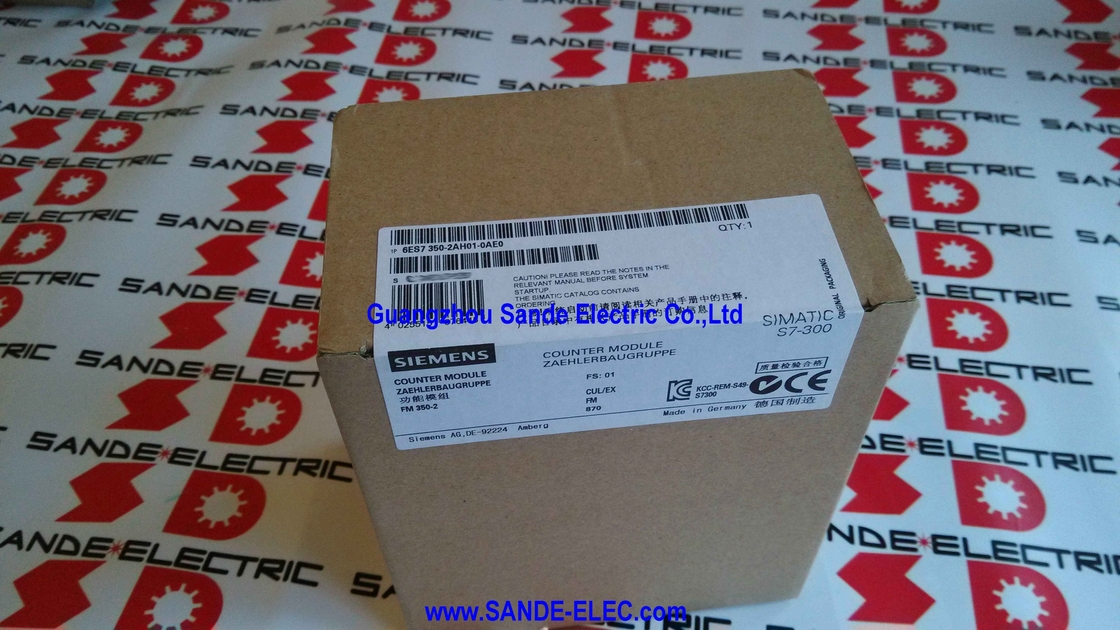
Siemens 6ES7350-2AH01-0AE0 | SIMATIC S7-300 FM 350-2 Counter Module — 8 Channels / 20kHz / NAMUR + 24V / 5 Modes / 8 DO / 32-Bit / CPU-Independent / 40-Pin
Eight Channels, Five Modes, CPU-Independent Operation
The FM 350-2 brings eight hardware counter and measurement channels to the S7-300 rack — each running in its own processor, independent of the S7-300 CPU's scan cycle, at up to 20kHz. Where the compact S7-300 CPUs typically offer two high-speed counter inputs at 10kHz, the FM 350-2 multiplies both channel count and frequency in a single rack slot.
The independence from the CPU scan cycle is not a minor technicality — it is the module's core value. An encoder signal at 20kHz completes a full pulse in 50 microseconds. No 10ms PLC scan cycle can reliably capture every pulse at this rate through standard digital input processing. The FM 350-2's hardware counters latch every pulse regardless of the CPU's workload. The accumulated count, measured frequency, or computed speed sits in the module's buffer memory, accurate to the last pulse, ready for the CPU to read on its next scan.
Each of the eight channels is independently configured — one FM 350-2 can simultaneously run a length counter on a conveyor, a frequency meter on a flow sensor, a speed monitor on a motor shaft, and a dosing controller on a fill valve, all from one module.
Key Specifications
| Parameter |
Value |
| Channels |
8, independent |
| Max. Frequency |
20kHz |
| Encoder Input |
NAMUR + 24VDC PNP |
| Digital Outputs |
8 × 24VDC, 500mA |
| Counter Width |
32-bit |
| Operating Modes |
Count, frequency, speed, period, dosing |
| Module Width |
80mm |
| Weight |
0.5 kg |
| Connector |
40-pin (separate order) |
Five Operating Modes — One Module, Multiple Measurement Tasks
Counting: Accumulates pulses in a 32-bit register, with configurable gate inputs controlling the active counting interval. When the count reaches a preset comparison value, a hardware output activates directly — without waiting for the CPU scan. Continuous, single-cycle, and periodic counting variants cover different production monitoring needs.
Frequency Measurement: Counts pulses over a configurable gate time and reports frequency in Hz. Longer gate times give better accuracy at low frequencies; shorter gate times give faster response at high frequencies. Directly applicable to flow meters, production rate counters, and vibration monitors.
Speed Measurement: Extends frequency measurement by converting pulse rate to RPM using the configured encoder resolution (pulses per revolution). The CPU reads a direct speed value from the FM 350-2's data buffer — no additional calculation in the programme.
Period Duration Measurement: Measures the time between successive encoder pulses — inverse-frequency measurement with much higher accuracy at low speeds. When a counting gate captures only a few pulses per second, direct frequency counting gives poor resolution; measuring the inter-pulse period at the microsecond level gives precise results.
Dosing Mode: The FM 350-2 counts pulses from a flow meter and activates an output when a programmed total (the dose) is reached — hardware-direct, without routing through the PLC scan cycle. The latency savings are real and significant: at high dosing speeds, one PLC scan cycle of delay represents measurable volume error.
NAMUR Interface — Hazardous Area Sensor Connection
NAMUR sensors (IEC 60947-5-6) are two-wire current-varying proximity sensors widely used in hazardous area installations. The FM 350-2's NAMUR-compatible inputs accept these sensors directly when used with appropriate intrinsic safety barriers (Zener or galvanic isolators) between the sensor and the module.
This makes the FM 350-2 suitable for speed monitoring and counting on rotating equipment in Zone 1 and Zone 2 hazardous areas — chemical plants, refineries, and similar process environments where standard 24VDC sensors cannot be used without appropriate protection. Standard 24VDC PNP proximity switches and encoders connect in the alternative 24V mode.
FAQ
Q1: Can channels run in different modes simultaneously on the same FM 350-2?
Yes. Each of the eight channels is independently configured and operates in its own selected mode. One FM 350-2 can simultaneously run channels 1–4 in counting mode, channels 5–6 in speed measurement, and channels 7–8 in dosing — all from the same module, all updating their respective data registers independently for the CPU to read.
Q2: Can the FM 350-2 be installed in an S7-300 expansion rack?
Yes, but only in expansion racks connected via IM 360/361 interface modules (which route the K-Bus to the expansion rack). The FM 350-2 communicates with the CPU via the K-Bus — it cannot operate in expansion racks connected with IM 365 modules, which do not route the K-Bus. This affects the rack interface module selection in multi-rack S7-300 configurations.
Q3: What happens to the FM 350-2 counters when the CPU goes to STOP?
The FM 350-2 and its hardware counters continue running in STOP — the counters keep accumulating pulses from connected encoders. K-Bus communication with the CPU stops in STOP mode, so the CPU cannot read updated values during that period. When the CPU returns to RUN, communication resumes and the CPU reads the current count values, which include everything accumulated during the STOP interval. Count data is not lost during CPU STOP.
Q4: What front connector does the FM 350-2 require?
The standard 40-pole S7-300 front connector — 6ES7392-1AM00-0AA0 for screw contacts or 6ES7392-1BM01-0AA0 for spring contacts. These are the same connectors used by other 40-pole S7-300 signal modules. The connector is not included with the FM 350-2 and must be ordered separately. Standard shielded twisted-pair cable is used for encoder wiring.
Q5: Is TIA Portal or STEP 7 Classic required for configuration?
The module ships with a configuration tool CD for STEP 7 Classic V5.x. For TIA Portal engineering environments, the FM 350-2's TIA Portal-compatible configuration package is available from Siemens Industry Online Support. Verify which engineering environment is in use before commissioning — the STEP 7 Classic package from the included CD is not directly usable in a TIA Portal project.



 Your message must be between 20-3,000 characters!