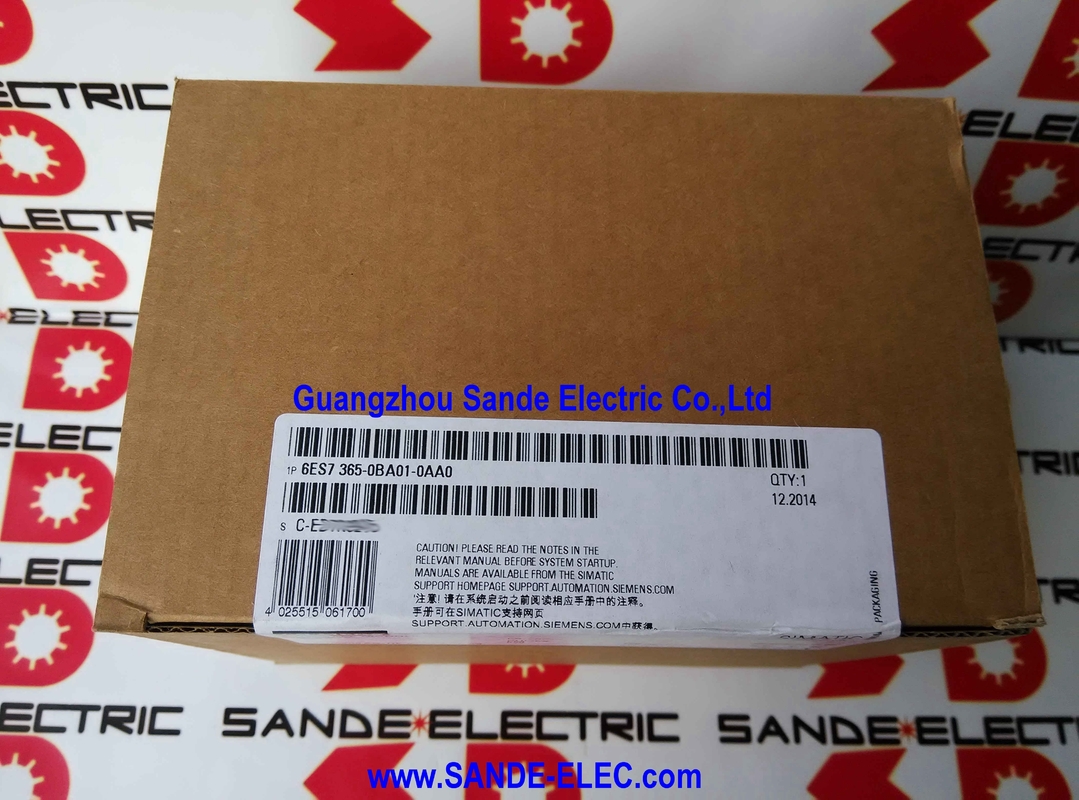
Siemens 6ES7365-0BA01-0AA0 | SIMATIC S7-300 IM 365 — Expansion Rack Interface Module Pair, 1m Connecting Cable, No K-Bus, 1.2A Power Supply, 40×125×120mm
Overview
The Siemens 6ES7365-0BA01-0AA0 is the IM 365 — the interface module pair that lets a SIMATIC S7-300 system grow beyond its single-rack limits. The S7-300's standard backplane accommodates up to 8 signal, function, and communication modules alongside the CPU and power supply.
When a machine or process demands more I/O points or additional function modules than one rack provides, the IM 365 bridges the gap: two module slots — one in the central rack, one in the expansion rack — become the data path between the two racks, effectively extending the PLC's available module positions.
The paired delivery is one of the IM 365's practical engineering refinements.
Rather than ordering two separate interface modules and sourcing a connecting cable, the 6ES7365-0BA01-0AA0 ships as a factory-matched set: the IM 365 send module (for rack 0), the IM 365 receive module (for rack 1), and a 1m cable already permanently connected between them. The modules are factory-tested as a pair, the cable is integrated rather than a separate connector, and commissioning is simply a matter of installing one module in each rack.
The cable length is 1m — which means the two racks must be installed within 1m of each other, typically in the same cabinet or on adjacent DIN rail sections.
Key Specifications
| Parameter |
Value |
| Modules in Package |
2 (send + receive) |
| Connecting Cable |
1m (permanently attached) |
| Total Power Supply |
1.2A |
| Max. Power per Rack |
0.8A |
| K-Bus Routing |
None (no communication bus to rack 1) |
| 5V Current Draw |
100mA max |
| Power Loss |
0.5W typical |
| Dimensions (W×H×D) |
40×125×120mm |
| Max. Pairs per CPU |
1 |
| Status |
Active |
No K-Bus Routing — The Critical Design Constraint
The IM 365's most important technical characteristic is the one it lacks: it does not route the S7-300's communication bus (K-Bus or C-Bus) to the expansion rack.
This is not an oversight — it is a deliberate architectural choice that defines where the IM 365 fits in the S7-300 expansion hierarchy.
The communication bus (K-Bus) is the channel over which certain S7-300 modules — function modules (FMs) and communication processors (CPs) — communicate directly with the CPU.
A SIMATIC FM 355 PID control module, for example, exchanges data with the CPU over the K-Bus; an FM 351 positioning module does the same.
These modules require the K-Bus to function. When they are installed in a rack connected by an IM 365, the K-Bus does not reach them, and they cannot communicate with the CPU — making their installation in the expansion rack impossible.
The alternative interface module — the IM 360/361 pair (send: 6ES7360-3AA01-0AB0, receive: 6ES7361-3CA01-0AB0) — does route the K-Bus to expansion racks and allows FMs and CPs to be installed in expansion racks.
The trade-off is that the 360/361 pair is more expensive and physically larger, and the cable is not permanently attached.
For the majority of S7-300 expansion requirements — adding more digital input and output modules, more analog modules, more capacity for standard signal modules — the IM 365's simpler, lower-cost architecture is entirely adequate.
Power Budget — 1.2A Total, 0.8A per Rack
The IM 365 provides the power supply for the expansion rack's module bus, drawn from the central rack's power supply through the interface.
The total available current through the IM 365 is 1.2A at the backplane voltage — of which no more than 0.8A can be consumed by modules in either individual rack. This power budget constrains the number and type of modules that can be installed in the expansion rack.
Most standard S7-300 digital signal modules consume 80–110mA from the backplane 5V supply. An expansion rack with eight standard 16-channel digital input or output modules would draw approximately 640–880mA — at the upper limit of what the IM 365 can supply.
For higher-current modules (certain analog modules or special function modules that draw more current), the expansion rack's backplane current must be totalled and verified against the 0.8A limit before the configuration is finalised.
When the expansion rack's power budget approaches the IM 365's limit, the engineer should consider either limiting the module count, splitting the station into two smaller racks (not possible with the IM 365 which supports only one expansion rack), or upgrading to a separate power supply module in the expansion rack.
The IM 360/361 Alternative — When IM 365 Is Not Enough
The IM 365's limitation to one expansion rack and its exclusion of K-Bus routing are the factors that determine whether IM 365 or IM 360/361 is the right choice for a given application.
A simple decision framework:
Use IM 365 when: Only one expansion rack is needed, all modules in the expansion rack are standard signal modules (no FMs or CPs), and the combined backplane current load is within the 0.8A per rack limit.
Use IM 360/361 when: More than one expansion rack is needed (IM 360/361 supports up to three expansion racks), function modules or communication processors must be installed in expansion racks, or the backplane current requirements exceed the IM 365's supply capability.
The IM 365's single-pair, single-rack, no-K-Bus design is exactly matched to straightforward I/O expansion applications — which represent the majority of S7-300 expansion needs.
For those applications, it provides everything required at lower cost and simpler installation than the full IM 360/361 solution.
FAQ
Q1: Can a single S7-300 CPU use both an IM 365 and an IM 360/361 pair at the same time?
No. The S7-300 CPU supports one expansion interface configuration — either one IM 365 pair (one expansion rack) or one IM 360/361 send module with up to three IM 361 receive modules. These interface types cannot be mixed in the same S7-300 station.
The choice between the two must be made during system design, and the hardware configuration in STEP 7's HW Config must reflect the actual installed interface type.
Q2: What is the maximum number of signal modules that can be installed in the IM 365 expansion rack?
The expansion rack can accommodate up to 8 signal modules (the same maximum as the central rack), subject to the backplane current budget of 0.8A for the expansion rack.
The actual module count depends on the current consumption of each installed module — a rack of eight standard 16-channel digital I/O modules is typically within the budget; a rack of modules with higher current consumption may be limited to fewer positions.
The STEP 7 hardware configuration tool will flag configuration errors if the total current exceeds the available supply.
Q3: The connecting cable is permanently attached. What happens if the cable is damaged?
The 1m connecting cable is not field-replaceable — it is an integral part of the IM 365 module pair. If the cable is damaged (cut, crushed, or the connector damaged), the entire IM 365 pair must be replaced.
This is a maintenance consideration when planning the cable routing between racks: the cable should be routed through cable ducting that protects it from mechanical damage, with sufficient service loop to allow the racks to be pulled forward for maintenance without straining the cable.
Q4: Can the IM 365 expansion rack be a different type of S7-300 rack (e.g. a different length rail)?
The expansion rack can be any standard S7-300 mounting rail, including rails of different lengths from the central rack rail. The IM 365 receive module installs in the leftmost slot of the expansion rack's mounting rail, and the remaining slots are available for signal modules.
The expansion rack requires its own S7-300 power supply module (PS 307 series) if the modules in the expansion rack draw power from mains — however, the 1.2A power provided through the IM 365 connection may be sufficient for the backplane power needs without a separate PS in the expansion rack, depending on the module mix.
Q5: Does the IM 365 expansion affect the S7-300 scan time, and are there any functional restrictions for modules in the expansion rack?
The addition of an expansion rack via IM 365 adds a small amount to the CPU scan cycle — the CPU must include the expanded I/O in each scan. This additional cycle time is typically negligible for standard applications.
The functional restriction is the K-Bus limitation: FMs (function modules) and CPs (communication processors) that require K-Bus communication with the CPU cannot be installed in the IM 365 expansion rack and will not operate correctly there.
Standard digital and analog signal modules (SM 321/322/323/331/332/334 series) have no such restriction and work normally in the expansion rack.



 Your message must be between 20-3,000 characters!