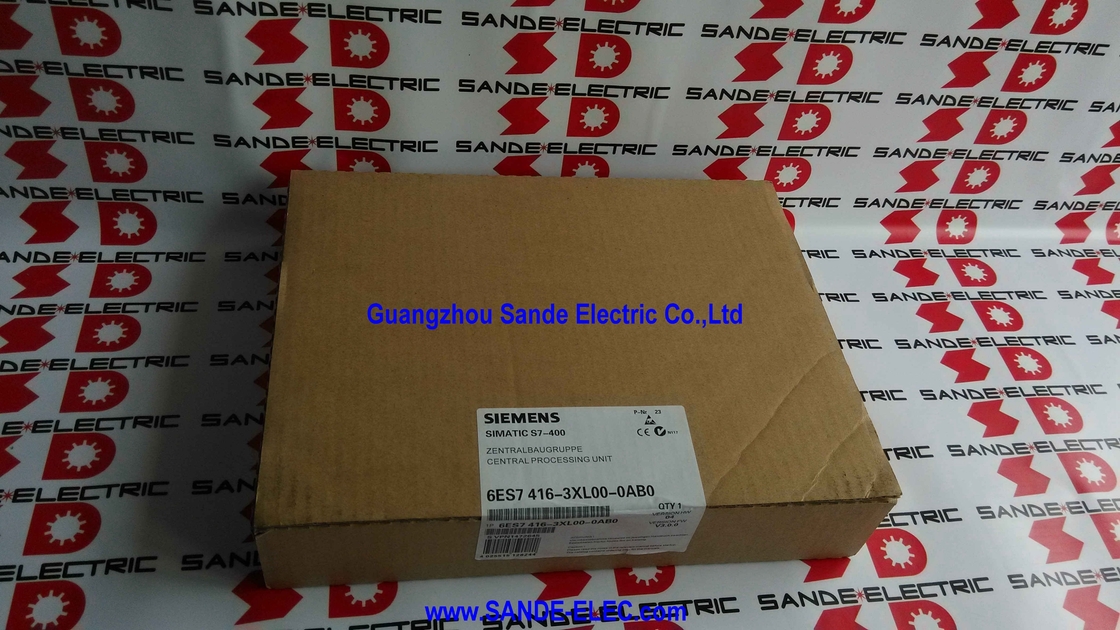
6ES7416-3XL00-0AB0 | SIMATIC S7-400 CPU 416-3 — 3.2MB / MPI/DP + PROFIBUS DP + IFM Interface / Three-Interface Central Processing Unit
Three Interfaces — What the CPU 416-3 Adds Over the 416-2
The CPU 416-3 and CPU 416-2 are both S7-400 high-performance CPUs, but they serve different architectural requirements. The CPU 416-2 maximises working memory at 5.6MB with two communication interfaces. The CPU 416-3 trades some memory (3.2MB) for a third interface: the IFM connector.
The third interface — designated for IFM (Interface Module) — provides the physical connection for direct inter-rack communication in S7-400 multi-rack configurations. Where the standard IM 460/461 interface module pair handles backplane bus extension, the CPU 416-3's dedicated IFM interface enables direct synchronised communication between the central rack and specific expansion rack architectures without consuming a standard I/O slot.
The first interface (MPI/DP, 12 Mbit/s) covers programming access, HMI connections, and PROFIBUS DP master/slave operation. The second interface adds an independent PROFIBUS DP network. The third IFM interface rounds out the connection architecture for installations that need all three.
Key Specifications
| Parameter | Value |
|---|
| Working Memory | 3.2 MB (1.6 MB code + 1.6 MB data) |
| 1st Interface | MPI/DP, 12 Mbit/s |
| 2nd Interface | PROFIBUS DP |
| 3rd Interface | IFM |
| Platform | SIMATIC S7-400 |
CPU 416-2 vs CPU 416-3 — Choosing Between Them
| Feature | CPU 416-2 (XN05) | CPU 416-3 (XL00) |
|---|
| Working Memory | 5.6 MB | 3.2 MB |
| Interfaces | MPI/DP + DP | MPI/DP + DP + IFM |
| IFM Connector | No | Yes |
The CPU 416-3 is the correct specification when the third IFM interface is a required part of the installed system design — typically in multi-rack architectures that use the IFM connection for direct CPU-to-expansion-rack communication. The CPU 416-2 is the better choice when programme and data memory capacity is the primary design driver.
Application Scenarios
Multi-rack S7-400 systems with IFM synchronisation: Large process controllers where the CPU-to-rack communication architecture requires the IFM interface alongside dual PROFIBUS DP networks.
High-channel-count process automation: 3.2MB provides sufficient memory for substantial control programmes managing hundreds of I/O points across multiple PROFIBUS DP segments.
Replacement in installed CPU 416-3 systems: The exact 6ES7416-3XL00-0AB0 part number preserves the three-interface architecture and hardware configuration of the installed system.
FAQ
Q1: What is the IFM interface used for on the CPU 416-3?
The IFM (Interface Module) interface connects the CPU to specific inter-rack communication modules in S7-400 multi-rack configurations. It provides a direct data path between the CPU and expansion rack hardware without using the standard PROFIBUS DP or MPI interfaces. The specific IFM modules and rack architecture determine the functional use of this interface.
Q2: Can the CPU 416-3 be replaced by a CPU 416-2 in an existing system?
Not directly if the system uses the IFM interface. The CPU 416-2 has no third IFM interface — substituting it removes the IFM connection from the system and requires hardware configuration changes. If the IFM interface is not active in the installed system, the CPU 416-2 may be usable, but the memory difference (5.6MB vs 3.2MB) means larger programmes on the 416-2 run without issue, while very large programmes would not fit on the 416-3.
Q3: What is the maximum expansion rack count for the CPU 416-3?
The S7-400 CPU 416 family supports up to 21 expansion racks. The specific count depends on the rack and interface module configuration. The S7-400 system documentation specifies the exact limits based on the IM 460/461 interface module types and the IFM connection arrangement.
Q4: What programming tool is required for the CPU 416-3?
STEP 7 Classic (V5.x) is the primary programming and configuration tool for S7-400 CPUs including the CPU 416-3. Hardware configuration, PROFIBUS DP network assignment, and programme download are all performed in STEP 7. TIA Portal support for specific S7-400 CPUs should be verified against the installed firmware version.
Q5: What memory backup option is available for the CPU 416-3?
S7-400 CPUs use a RAM/Flash-based memory card (Memory Card S7-400) that stores the programme non-volatilely. On power-up, the CPU loads the programme from the memory card into working RAM. The memory card retains the programme without battery backup, though retentive data (counters, flags, timers) requires battery backup. Replace the battery on a scheduled maintenance cycle.



 Your message must be between 20-3,000 characters!