Home
>
Products
>
PLC Programmable Logic Controller
>
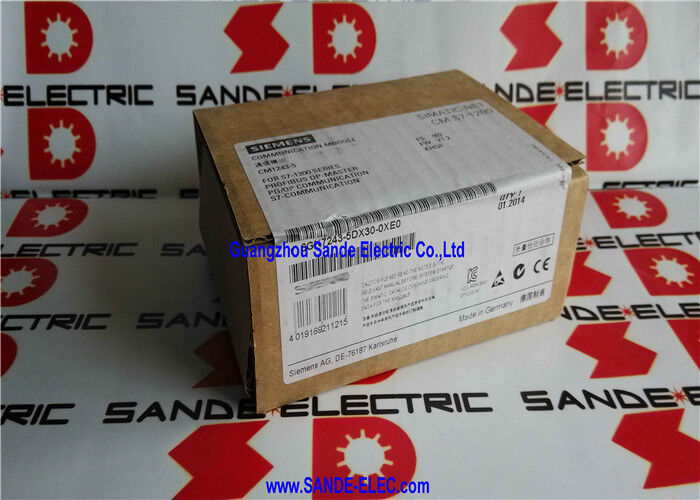
The Siemens 6GK7243-5DX30-0XE0 is the CM 1243-5 — the PROFIBUS DP master communication module that gives the SIMATIC S7-1200 a full PROFIBUS presence. The S7-1200, Siemens's current mid-range PLC platform, was designed from the ground up around PROFINET — its CPUs include integrated PROFINET interfaces as standard. PROFIBUS, by contrast, is not available natively on the S7-1200 CPU. The CM 1243-5 fills that gap by adding a dedicated PROFIBUS DP master interface that plugs directly into the S7-1200's left-side expansion slot, operating independently of the CPU's PROFINET interface.
Why would a new S7-1200 installation need PROFIBUS? The answer is almost always the installed base. Thousands of plants worldwide run PROFIBUS DP networks built during the 2000s and 2010s, connecting drives, remote I/O, instruments, and safety systems.
When those plants upgrade to S7-1200 CPUs — migrating from older S7-200, S7-300, or S7-400 platforms — the existing PROFIBUS field devices and cabling do not get replaced as part of the controller upgrade. The CM 1243-5 lets the new S7-1200 controller step into the DP master role previously held by the legacy CPU, preserving the entire field device infrastructure while bringing the controller up to a current, supported platform.
The module is equally relevant for new S7-1200 installations where specific field devices — particularly established Siemens drives like the MICROMASTER 440 or older G120 variants — are available only with PROFIBUS interfaces.
The CM 1243-5 makes these devices accessible to the S7-1200 without requiring field device replacement.
| Parameter | Value |
|---|---|
| PROFIBUS Role | DP Master (Class 1) |
| Max. DP Slaves | 16 |
| Speed Range | 9.6kbps – 12Mbps |
| Physical Interface | 9-pin Sub-D (RS-485) |
| Supply Voltage | 24VDC |
| Power Dissipation | 2.4W |
| Dimensions (W×H×D) | 30×100×75mm |
| Weight | 0.19kg |
| Protection | IP20 |
| Origin | Germany |
| Status | Active |
The CM 1243-5 operates as a DP master Class 1, which means it manages the cyclic data exchange with all connected PROFIBUS DP slave devices. In each PROFIBUS scan cycle, the CM 1243-5 sends output data (process values, setpoints, control words) to each slave and receives input data (measurements, status words, feedback values) from each slave, updating the S7-1200 CPU's process image with the incoming slave data and writing the CPU's output data to the slave devices.
The 16-slave limit defines the maximum number of PROFIBUS DP slave devices the CM 1243-5 can manage simultaneously. Each slave occupies one DP slave address on the network (addressing from 1 to 125), and the total input/output data volume from all 16 slaves must fit within the CM 1243-5's data exchange capacity.
For the majority of S7-1200 PROFIBUS applications — four to eight drives plus a few remote I/O stations — the 16-slave limit is entirely adequate.
For larger PROFIBUS networks with dozens of slaves, the S7-300 or S7-400 with their dedicated PROFIBUS CP modules or integrated PROFIBUS ports are the appropriate platform, as these support up to 125 DP slaves per master interface.
The bus speed is automatically configured from the GSD (Generic Station Description) files of the slowest slave on the network — the network operates at the highest common speed that all installed slaves support.
The CM 1243-5 provides three distinct communication services over its single PROFIBUS connector, and understanding which service is being used matters for troubleshooting and network design:
PROFIBUS DP cyclic master: The primary service — continuous, time-deterministic exchange of I/O data between the CM 1243-5 (as master) and its configured slave devices.
This is the data path for drives, I/O modules, and process instruments. The cycle time depends on bus speed and total data volume, but is typically a few milliseconds at normal PROFIBUS speeds.
PG/OP communication: Allows a STEP 7 or TIA Portal programming terminal connected to the PROFIBUS bus to access the S7-1200 CPU for online monitoring, program download, and diagnostics — without needing a separate Ethernet connection to the CPU.
This is particularly useful when the plant network does not provide Ethernet access to the controller cabinet.
S7 communication (PUT/GET): Enables the S7-1200 to exchange data with other S7 PLCs on the same PROFIBUS network using the native S7 protocol.
A larger S7-400 system acting as a plant supervisory controller can communicate with S7-1200 stations on the PROFIBUS network using PUT/GET function blocks, reading process data from and writing setpoints to the S7-1200 without requiring a separate Ethernet connection.
The CM 1243-5 attaches to the left side of the S7-1200 CPU through the system connector — the same mechanical and electrical interface used by other S7-1200 communication modules. It receives its 24V DC power through this connector from the S7-1200 system supply, requiring no external power connection.
Configuration is done entirely in TIA Portal's network and device view.
After adding the CM 1243-5 to the S7-1200 rack in the hardware configuration, the PROFIBUS network is defined (bus address, speed), and each slave device is added from the TIA Portal hardware catalogue using the slave's GSD file.
The slave's I/O data is mapped to PLC data blocks or I/O addresses, and the cyclic data exchange begins automatically once the configuration is downloaded and the network is energised.
The CM 1243-5 operates independently of the S7-1200 CPU's PROFINET activity — the two networks run in parallel on the same PLC, with the CPU exchanging data with PROFIBUS slaves through the CM 1243-5 and with PROFINET devices through its integrated PROFINET port simultaneously.
Q1: Can the CM 1243-5 act as a PROFIBUS DP slave, or only as a master?
The CM 1243-5 is a DP Master only — it cannot be configured as a DP slave. This means it cannot receive cyclic data from a higher-level DP master and forward it to the S7-1200 CPU in slave mode.
For applications where the S7-1200 must act as a PROFIBUS DP slave (connecting to a supervisory S7-400 or DCS as its master), a different communication module — the CM 1242-5 (6GK7242-5DX30-0XE0) — is required. The CM 1242-5 provides DP slave functionality.
The CM 1243-5 and CM 1242-5 are distinct modules for distinct roles.
Q2: What is the GSD file, and how is it used when connecting a PROFIBUS slave to the CM 1243-5?
A GSD (Generic Station Description) file is a device description file provided by the slave device manufacturer. It describes the slave's PROFIBUS capabilities — its supported data formats, I/O data sizes, configuration options, and supported bus speeds.
In TIA Portal, the slave's GSD file is imported into the hardware catalogue, and the slave device is then added to the PROFIBUS network configuration using its GSD-defined properties.
The TIA Portal configuration tool reads the GSD file to determine the correct telegram structure for the data exchange between the CM 1243-5 master and the slave.
GSD files for Siemens products are available from the Siemens Industry Online Support (SIOS) portal, and third-party slave GSD files are available from the respective device manufacturers.
Q3: Is one CM 1243-5 module sufficient for an S7-1200 that needs both PROFIBUS and a second Ethernet interface?
The CM 1243-5 provides only PROFIBUS — no Ethernet functionality. If the S7-1200 needs a second Ethernet interface (in addition to the CPU's integrated PROFINET port), a separate communications module for Ethernet (such as the CP 1243-1) must be installed.
The S7-1200 can accommodate multiple communication modules in its left-side expansion slots, so combining the CM 1243-5 for PROFIBUS with a CP 1243-1 for additional Ethernet is a valid configuration, subject to the slot count and power budget constraints of the specific S7-1200 CPU model.
Q4: Does the CM 1243-5 support isochronous PROFIBUS operation for motion control applications?
The CM 1243-5 supports standard PROFIBUS DP cyclic communication (DP-V1 master Class 1) but is not designed for the isochronous PROFIBUS DP-V2 operating mode (also known as isochrone mode or clock synchronous communication) used in high-precision motion control.
For applications requiring microsecond-accurate time synchronisation between drives on PROFIBUS — such as multi-axis coordinated motion — a dedicated motion control platform (Siemens SIMOTION or S7-300/400 with PROFIBUS DP-V2 capable CP) is the appropriate solution.
The CM 1243-5 is suited for process and machine automation where standard cyclic communication at millisecond cycle times is sufficient.
Q5: Can TIA Portal diagnose PROFIBUS slave faults through the CM 1243-5?
Yes. TIA Portal's online diagnostics provide access to the CM 1243-5's diagnostic information, including the status of each configured DP slave — whether each slave is communicating correctly, in error, or absent from the network.
Individual slave diagnostics (alarm bytes, extended diagnostic data from DP-V1 capable devices) are accessible through the TIA Portal's device and network online view when connected to the S7-1200 via PROFINET or USB.
The CM 1243-5 itself generates diagnostics in the S7-1200's system diagnostic buffer if the PROFIBUS network develops a fault, providing timestamps and fault codes that assist in root cause analysis.
![]()
Contact Us at Any Time