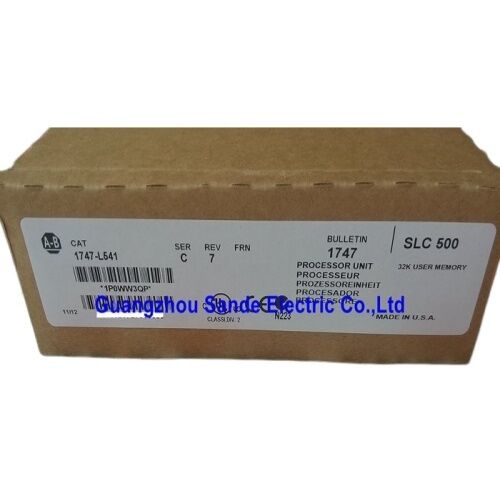
Allen-Bradley 1747-L541 SLC 5/04 16K Processor — DH+, RS-232, Battery-Backed RAM
Product Overview
Part Number: 1747-L541
Also Searched As: 1747L541, Allen-Bradley 1747-L541, AB SLC 5/04 16K
Product Line: SLC 500
Classification: Allen-Bradley SLC 5/04 CPU Module — 16K User Memory, 4096 I/O, DH+ and RS-232 Communication, Battery-Backed RAM, 0.9 ms/K Scan Time
Technical Specifications
| Parameter |
Value |
| Part Number |
1747-L541 |
| Processor Type |
SLC 5/04 |
| User Memory |
16,000 Words (16K) |
| Memory Type |
Battery-Backed RAM |
| Backup Memory Module |
1747-M13 |
| Battery |
1747-BA |
| Program Scan Time |
0.9 ms/K |
| I/O Scan Time |
0.225 ms |
| Maximum Inputs |
4,096 |
| Maximum Outputs |
4,096 |
| Analog I/O |
480 |
| Maximum I/O Chassis |
3 |
| Maximum Chassis Module Slots |
30 |
| Communication Ports |
Data Highway Plus (DH+), RS-232 |
| Ambient Temperature |
0°C to 60°C |
| Weight |
1.25 lbs (0.57 kg) |
| GTIN |
10662468653029 |
| UNSPSC |
32151705 |
| Manufacturer |
Allen-Bradley (Rockwell Automation) |
The SLC 5/04 in Practice — What 16K of Memory Actually Means
The 1747-L541 is the 16K variant of Allen-Bradley's SLC 5/04 processor, and for the majority of mid-complexity SLC 500 applications, the memory headroom it provides is the right balance between capability and cost.
Sixteen thousand words of user memory accommodates programmes of meaningful complexity — multiple rungs of ladder logic covering coordinated machine sequences, PID loops, data manipulation, and communication handling — without the overhead of the 32K or 64K versions where the extra memory would simply go unused.
What separates the SLC 5/04 from the SLC 5/03 below it in the family is not just memory capacity.
The 0.9 ms per K scan time puts this processor in the performance tier where real-time response to process changes is genuinely achievable.
For a 16K programme fully utilised, the worst-case full-programme scan sits under 15 milliseconds — fast enough for the vast majority of discrete manufacturing and process control applications where machine cycle times run in the hundreds of milliseconds to seconds, and where fast I/O response to faults and interlocks is a machine safety and productivity requirement.
The 0.225 ms I/O scan time is a separate figure worth understanding. In the SLC 500 architecture, the I/O scan and the programme scan are not the same thing.
The I/O scan updates the input and output image tables independently of the programme scan interval. At 0.225 ms, the input image is refreshed quickly enough that brief input pulses — push-to-test buttons, proximity switch triggers on fast-moving parts, high-speed counter inputs — are reliably captured within a scan cycle.
Communication Ports: DH+ and RS-232 — Two Different Jobs
The 1747-L541 carries two communication interfaces, and they serve genuinely different functions in a plant network.
Understanding the distinction helps when planning system integration and troubleshooting connectivity problems.
Data Highway Plus (DH+) is Allen-Bradley's peer-to-peer industrial network for SLC and PLC-5 systems.
It runs at 57.6 Kbps, 115.2 Kbps, or 230.4 Kbps (selectable) and supports network configurations where multiple SLC processors, PLC-5 systems, and programming terminals share the same communication bus.
On a DH+ network, the 1747-L541 can exchange data with other controllers via MSG instructions — sending and receiving files of data between PLCs as part of a coordinated multi-controller system.
This is the backbone for line-level production control networks that were designed around the Allen-Bradley DH+ architecture in the 1990s and 2000s, many of which are still in production operation today.
RS-232 on the same processor serves a completely different role.
This port is typically used for programming access from a computer running RSLogix 500, for connection to operator terminals and barcode readers, or for communication with third-party devices using the DF1 protocol.
It is a point-to-point connection, not a network — one device to one device — and operates at baud rates configured to match the connected device.
The RS-232 port being physically separate from the DH+ port means the programmer can be connected and monitoring the programme while the controller is simultaneously communicating on the DH+ network, which is a practical necessity during commissioning and maintenance on a running system.
I/O Capacity: 4,096 Points and 30 Module Slots Across 3 Chassis
The 1747-L541 supports up to 4,096 discrete inputs and 4,096 discrete outputs — figures that describe the processor's logical addressing capacity across its physical I/O infrastructure.
In the SLC 500 architecture, this capacity is distributed across the modules installed in up to 3 I/O chassis containing a maximum of 30 module slots in total.
A practical note on how these limits interact: the module slot limit (30) and the I/O point limit (4,096 in and 4,096 out) set independent ceilings. A 32-point I/O module in each of 30 slots yields 960 inputs and 960 outputs from discrete I/O alone — well under the 4,096 point ceiling.
The 4,096 limit only becomes a constraint in high-density module configurations.
For most applications running standard 16 or 32-point I/O modules, the physical slot count is the binding constraint.
The 480 analog I/O figure deserves specific attention for process applications.
Analog modules in the SLC 500 system occupy module slots and consume analogue I/O addresses — a 4-channel analogue input module occupies one slot but uses 4 analogue input words.
The 480 analogue I/O limit is a separate address space from the discrete I/O limit; both limits apply simultaneously, and the programme file structure must account for both when planning a high-I/O-density system.
Battery-Backed RAM and the 1747-M13 Backup Module
The 1747-L541's user memory is battery-backed RAM — the programme and data stored in this processor are retained when control power is removed, but only as long as the backup battery (1747-BA) remains charged.
This is a critical maintenance point that distinguishes the SLC 5/04 generation from modern processors with non-volatile flash programme storage.
The 1747-BA battery must be replaced on a regular schedule — typically every one to three years depending on operating conditions and backup duty cycle.
When the battery depletes fully, the processor loses its programme on the next power cycle, and a programme reload from RSLogix 500 or the backup memory module is required before the controller can resume operation.
Battery low indicators on the SLC 5/04 module signal when replacement is due; waiting for the indicator alarm is acceptable practice, but running the battery to full depletion before replacement creates an unnecessary recovery event.
The 1747-M13 backup memory module provides a second line of defence for programme retention.
This plug-in EEPROM cartridge stores a copy of the programme that can be loaded into the processor on power-up, optionally automatically.
A machine where the 1747-M13 is programmed to auto-load on memory loss can recover from a full battery depletion without a programmer present — the processor loads from the EEPROM, and the machine restarts from a known-good programme state.
For production facilities where the 1747-L541 controls a critical process and unplanned downtime has significant cost, this configuration is strongly recommended over relying on battery backup alone.
Typical Applications
Discrete manufacturing lines with multi-PLC coordination. Assembly lines, transfer lines, and automated production cells where the DH+ network connects multiple SLC 5/04 processors coordinating material flow, safety interlocks, and production data exchange across the line.
Process control with analogue loop management. Mixing, conveying, and fluid handling systems where the 480 analogue I/O points accommodate temperature, pressure, flow, and level loops alongside discrete control, and the PID instructions in the SLC 5/04 instruction set manage the closed-loop control.
Machine tool and press control. Production machinery requiring fast I/O response — stamping presses, injection moulding machines, CNC peripherals — where the 0.225 ms I/O scan time and 0.9 ms/K programme scan keep response latency within the machine's safety and cycle time requirements.
Building automation and utilities. HVAC, chiller, and compressed air systems in manufacturing facilities where the SLC 500 platform was specified for control and the 1747-L541's 16K memory handles the sequence and setpoint management logic for a medium-complexity utilities system.
Retrofit and legacy system maintenance. Any facility currently running SLC 5/04 controlled equipment where a failed 1747-L541 processor requires a like-for-like replacement to restore production without a control system upgrade.
FAQ
Q1: What is the difference between the 1747-L541 (16K) and the other SLC 5/04 memory variants?
The SLC 5/04 processor family spans three user memory sizes: 8K (1747-L531), 16K (1747-L541), and 64K (1747-L552). All three run identical instruction sets, support the same I/O capacity (4,096 in/out), and use the same DH+ and RS-232 communication ports.
The difference is purely programme memory available for ladder logic, data tables, and subroutine files.
The 1747-L541's 16K is adequate for the majority of mid-complexity machines and production line segments.
Choose 8K when the application is simple and memory will not be a future constraint; choose 64K when a large number of subroutines, extensive data file usage, or future programme growth makes 16K likely to become a limitation.
Q2: Can the 1747-L541 communicate directly with a modern Logix platform PLC?
Not natively. The 1747-L541 uses DH+ as its primary peer-to-peer network, which is not supported on ControlLogix or CompactLogix processors without a gateway or bridge device.
A 1761-NET-AIC or a 1784-PKTX card, or a ControlLogix 1756-DHRIO module, is required to bridge DH+ to the EtherNet/IP or ControlNet networks that modern Logix systems use.
For read/write data exchange between a 1747-L541 and a ControlLogix processor in the same facility, the MSG instruction through a DH+ bridge is the established method. Plan for this interface hardware when integrating legacy SLC 5/04 systems into modern network architectures.
Q3: How is the programme backed up and what happens if the battery fails completely?
The 1747-L541 uses a 1747-BA lithium battery to maintain RAM contents during power-off periods. If this battery depletes fully before replacement, the programme and all data tables are lost on the next power cycle.
Recovery requires reloading the programme from a computer running RSLogix 500 or from the 1747-M13 EEPROM backup module.
The 1747-M13 can be configured to auto-load on power-up when memory loss is detected, which enables automatic recovery without a technician present. Always maintain both a current RSLogix 500 programme backup on a networked computer and a loaded 1747-M13 in the processor slot for critical applications.
Q4: What programming software is used for the 1747-L541, and is it still supported?
The 1747-L541 is programmed with Rockwell Automation RSLogix 500 — the standard ladder logic development environment for the entire SLC 500 and MicroLogix family.
RSLogix 500 runs on Windows operating systems and connects to the processor via a USB-to-RS-232 adapter (for the RS-232 port) or through a DH+ network using a 1784-PKTX or USB-to-DH+ bridge.
Rockwell continues to sell and support RSLogix 500 as of the current date, though the SLC 500 hardware platform itself is in a mature product lifecycle status. Programme files (.RSS) created in RSLogix 500 can be archived and restored indefinitely, making it straightforward to maintain programme versions across the life of the machine.
Q5: Is the 1747-L541 compatible with all SLC 500 I/O modules?
Yes — the SLC 5/04 processor is compatible with the full SLC 500 I/O module library, including all 1746-series discrete, analogue, specialty, and communication modules.
Module compatibility is determined by the SLC 500 backplane architecture, not by the specific processor variant.
The only constraint is addressing: the processor must have sufficient user memory and data file space to address all installed modules, and the total I/O point count must stay within the 4,096 discrete input / 4,096 discrete output / 480 analogue limits.
All SLC 500 I/O modules in both the fixed and modular chassis formats are electrically and logically compatible with the 1747-L541.



 Your message must be between 20-3,000 characters!